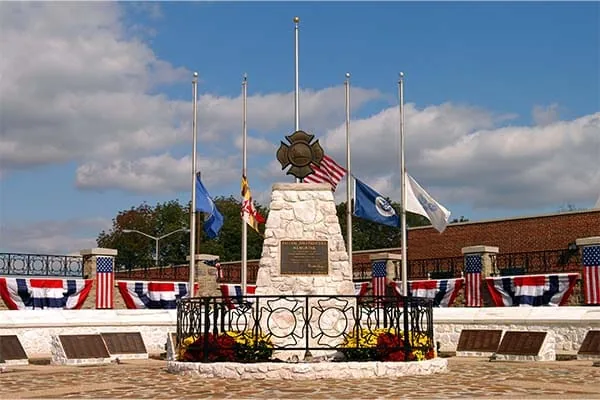
American flags on all Federal office buildings are lowered to half-staff each year on the day of the National Fallen Firefighters Memorial Service. The continuing basis is Public Law 107-51, approved in 2001. The law ties the tribute to the annual service in Emmitsburg, Maryland, rather than to one permanent calendar date.
For 2026, the White House proclaimed May 2–3 as National Fallen Firefighters Memorial Weekend and identified Sunday, May 3 as the day for the federal-office-building display. That date is a year-specific example, not a rule that May 3 will always be the answer. Before acting in another year, confirm the current service date and the notice that applies to your property. Start with today’s national and state flag status, and use the half-staff calendar to plan ahead without treating an old calendar entry as a new order.
The property distinction matters. The federal law expressly addresses Federal office buildings. A governor can separately cover state facilities, a city can issue instructions for municipal property, and the National Fallen Firefighters Foundation may invite fire departments, businesses, and households to join the tribute voluntarily. Those actions can align on the same day without sharing the same legal source or scope.
This guide separates the enduring statute from the annual presidential proclamation, explains who is covered, and gives a source-first procedure for lowering and returning the flag. If you only need a dependable notification workflow, see our guide to official half-staff alerts. If you manage a flagpole, continue below for the date check, authority check, and correct peak-first handling sequence.
When Is the Fallen Firefighters Half-Staff Day?
The half-staff day is the day of that year’s National Fallen Firefighters Memorial Service. It is normally the Sunday service within Memorial Weekend, but the controlling idea is the service date—not a permanently numbered date in May. In 2025, the service and federal display were Sunday, May 4. In 2026, they were Sunday, May 3. That one-day shift is enough to show why copying last year’s date is unsafe.
| Planning question | Source-first answer | What to do |
|---|---|---|
| What was the 2026 half-staff day? | Sunday, May 3, 2026, the Memorial Service day identified in the presidential proclamation. | Treat it as a historical 2026 record, not a standing May 3 rule. |
| What is the next weekend? | NFFF currently lists May 1–2, 2027 as its save-the-date weekend. | Wait for the current service schedule and official flag notice before assigning the half-staff day. |
| Does the entire weekend mean half-staff? | Not under the short federal law. It links the action to the Memorial Service. | Use the exact date and duration in the current instruction. |
| Can an old October calendar be used? | No. NFFF first moved Memorial Weekend from October to May in 2023. | Check current NFFF and government sources. |
Searchers sometimes call the observance “National Fallen Firefighters Memorial Day.” Official sources more consistently use National Fallen Firefighters Memorial Service for the Sunday ceremony and National Fallen Firefighters Memorial Weekend for the surrounding program. It is also distinct from the federal Memorial Day holiday on the last Monday in May. That military remembrance has a special half-staff-until-noon rule; the fallen-firefighters service does not borrow that noon transition.
For planning, add the announced weekend to your calendar and schedule a verification check when the annual proclamation and agency notices appear. For action today, use the current flag-status page. Our observance calendar is useful as a reminder, but the dated official document should decide the final day, property scope, and end time.
What Public Law 107-51 Actually Requires
Public Law 107-51 is unusually short, so its scope can be read without guessing. Congress approved the joint resolution on October 16, 2001. Its operative sentence provides that, each year, American flags on all Federal office buildings will be lowered to half-staff in honor of the National Fallen Firefighters Memorial Service in Emmitsburg, Maryland.
Four parts of that sentence do most of the work:
- “Each year” creates a recurring obligation. This is more than a custom that exists only when an administration chooses to revive it.
- The event controls the timing. Congress linked the action to the service; it did not write “May 3,” “the first Sunday in May,” or another fixed date into the law.
- The object is the American flag. The resolution does not separately list every agency, state, municipal, or organizational flag.
- The express property scope is all Federal office buildings. It does not say every building, every fire station, or every privately owned pole in the United States.
That produces a precise description: this is an enduring annual federal-office-building rule tied to a moving event date. Calling it a permanent May observance would be misleading because the numbered date can change. Calling it only a discretionary annual presidential gesture would also be misleading because Congress already supplied the recurring federal basis.
Agency policy turns the law into facilities practice. For example, a 2023 General Services Administration memorandum recognized the service as a half-staff occasion and described coverage for buildings under GSA control, delegated operation, and certain federal leases whose terms address flag display. A facility manager should therefore follow the responsible agency’s current operational message rather than invent a broader definition of “Federal office building.”
The law’s silence also matters. Its one-page text does not set sunrise and sunset, prescribe a weekend-long display, command private participation, or tell a governor how to handle a state flag. Those questions require the current proclamation, agency guidance, state order, or ordinary Flag Code procedure. For a broader explanation of jurisdiction, see who can order flags to half-staff.
What the Annual Presidential Proclamation Adds
The annual presidential proclamation is the clearest year-specific bridge between the recurring law and the operating calendar. It normally does three useful things: names the Memorial Weekend dates, identifies the service day on which the federal flag action occurs, and explains whom the Nation is honoring. Facility managers, newsrooms, and state officials can cite one dated presidential document instead of trying to calculate the service day from a general calendar.
Compare the operative details. The 2025 proclamation named May 3–4 as Memorial Weekend and Sunday, May 4 as the federal-office-building half-staff day. The 2026 proclamation named May 2–3 and Sunday, May 3. Both said the action was “in accordance with Public Law 107-51.” That phrasing matters: the proclamation confirms and communicates the current implementation of an existing annual law; it does not create the enduring rule from scratch.
The format has changed with the observance. In 2015, when the service still occurred in October, the White House included the October 4 half-staff statement in its Fire Prevention Week proclamation. Current proclamations use the National Fallen Firefighters Memorial Weekend title. The change in document framing and month did not convert the statute into a fixed Sunday formula. The service date remained the connecting fact.
Use the proclamation as an annual snapshot, not a perpetual command. A 2015, 2025, or 2026 page proves what federal office buildings were told to do in that named year. It cannot supply the date for 2027 or later. Likewise, a search snippet that says “Sunday” without showing the year is not enough to schedule staff or issue a public notice.
For durable verification, save both the current White House URL and its Federal Register or GovInfo record. Confirm the document title, signature date, named service day, property language, and any explicit end time. Then compare the responsible agency’s instructions and any state notice. Our official alerts guide provides that source chain. Calling the document a “proclamation” is also more precise than casually labeling every presidential flag notice an executive order.
Which Flags and Properties Should Participate?
Begin with ownership and jurisdiction, not with what a neighboring flagpole is doing. Public Law 107-51 directly names American flags on Federal office buildings. Broader participation may result from a governor’s order, a local policy, or a voluntary invitation, and the exact wording determines which category applies.
| Flag location | Authority to check | Typical status for the annual service |
|---|---|---|
| Federal office building | Public Law 107-51, current proclamation, and agency/facility instruction | Recurring federal half-staff action on the service day. |
| State-controlled building or grounds | Current governor or state flag-office notice | Often aligned with the federal day, but flags, properties, and hours depend on state wording. |
| County, city, school, or fire department | State order plus the entity’s ownership and local policy | May be ordered, may be included by definition, or may be invited to participate. |
| Business, nonprofit, or home | Owner’s decision and any official public invitation | Normally voluntary; follow correct etiquette and the verified current duration. |
Current state examples show why a national shortcut fails. Virginia’s 2026 order expressly covered U.S. and Commonwealth flags on state and local buildings and grounds. Pennsylvania covered Commonwealth facilities, public buildings, and grounds, then invited all Pennsylvanians to participate. Connecticut specified state-operated property while encouraging individuals, businesses, schools, municipalities, and other entities. Iowa ordered the display at public buildings and facilities and separately encouraged local and private participants.
The verbs matter. “Ordered” or “directed” identifies an instruction within the issuer’s authority; “invited” or “encouraged” identifies voluntary participation. A firehouse is not automatically federal property because the tribute concerns firefighters. It may be operated by a city, county, fire district, volunteer nonprofit, or another organization. The person responsible for that pole should identify the property owner and applicable policy.
If the U.S. flag is lowered, arrange other flags so none appears above it. On adjacent poles, that commonly means lowering state, municipal, department, and organizational flags for the same display period; on one pole, preserve the U.S. flag’s superior position. Follow the current notice when it expressly names additional flags. That protocol principle does not turn a private invitation into a statutory command.
For authority questions, consult our issuer and jurisdiction guide. Also separate this recurring national service from an ad hoc state or local order honoring a particular line-of-duty death; our guide to flags lowered for fallen service members and first responders explains that distinction.
How to Lower and Raise the Flag Correctly
Once an applicable notice is confirmed, use the peak-first sequence in 4 U.S.C. §7(m). Do not raise the flag directly from the bottom to the halfway point or pull it straight down from half-staff at closing.
- At opening, hoist the U.S. flag briskly to the peak. Let it reach the top for an instant.
- Lower it ceremoniously to half-staff. The Flag Code defines that position as halfway between the top and bottom of the staff.
- Keep it there for the period in the applicable instruction. If the notice says sunrise to sunset, those are the controlling operational endpoints for that display.
- At closing, raise it to the peak again. Only then lower it ceremoniously all the way and secure it.
For an outdoor stationary pole, the general custom in 4 U.S.C. §6 is display from sunrise to sunset. A flag may remain displayed around the clock when it is properly illuminated during darkness. A 24-hour facility therefore does not need to take its flag down every night, but it must still move the flag to half-staff for the applicable observance and return it to full staff when the instruction ends.
Do not use the Memorial Day noon rule here. Section 7(m) specifically directs half-staff until noon on the federal Memorial Day holiday and full staff afterward. Public Law 107-51 does not copy that transition for the fallen-firefighters service. When a state order says sunrise to sunset—as Virginia and Connecticut did in 2026—keep the flag at half-staff for that full stated period. Our Memorial Day flag guide covers the separate noon procedure.
Inspect the halyard, clips, pole, and weather before the ceremony. The flag should not touch the ground, water, or objects beneath it. Use an all-weather flag in inclement conditions, and never create a safety risk merely to match a symbolic time. At a staffed public facility, follow the responsible facilities office’s operating and safety plan.
A fixed wall-mounted flag or indoor flag without a working halyard cannot be moved to a literal half-staff position. Do not claim that an improvised black ribbon is required by the federal law; it is not in Public Law 107-51. Follow the organization’s protocol, or use another respectful remembrance while keeping the flag displayed correctly.
How to Verify This Year’s Service and Flag Order
A reliable check moves from the event source to the authority responsible for your pole. Do not stop at a search result that happens to display a date. Open the documents and read their operative language.
- Confirm the event with the National Fallen Firefighters Foundation. Note the current Memorial Weekend and the actual Memorial Service day. Do not assume the second date in a weekend is always the service without checking.
- Open the current White House proclamation. Verify the year in the title, its issuance date, the named service day, and its federal property language.
- Cross-check Federal Register or GovInfo. These official records provide a durable version if a White House link changes or an archive is difficult to search.
- Check your governor or state flag-status page. Read the property scope, the flags named, and the exact start and end time. Subscribe to official notices when available.
- Resolve local implementation. A school district, city, fire district, landlord, or facilities office can explain who controls the pole and whether a state instruction includes it.
Never assume that the state and federal operating dates are identical. In 2026, the federal proclamation named Sunday, May 3 for Federal office buildings. North Carolina separately instructed state facilities to lower U.S. and North Carolina flags on Monday, May 4, explaining that it was observing on the Monday following the Sunday service. That state-specific choice did not rewrite the federal service date; it controlled the state property named in the North Carolina notice.
Before sending an alert or assigning staff, record six fields: issuer, reason, year and date, start/end time, flags, and property scope. Also check for a later correction and for an overlapping order. If another applicable mourning instruction continues beyond the service day, keep the flag at half-staff through the later valid end time. There is no need to raise briefly between two continuous instructions; retain both notices in the operational log.
Old October observance pages, screenshots, copied calendar lists, and snippets without a visible year are leads—not final authority. Use our official-alert workflow to build a dependable source chain. The calendar helps with advance planning, while the current status page helps answer what applies now.
How Communities Can Honor Fallen Firefighters Respectfully
Lowering the flag is one part of a larger act of remembrance. The National Fallen Firefighters Memorial has stood at the National Fire Academy campus in Emmitsburg since 1981, and Congress designated it in 1990 as the official national memorial to volunteer and career firefighters who die in the line of duty. The names and families—not the visual spectacle—should remain at the center of any local observance.
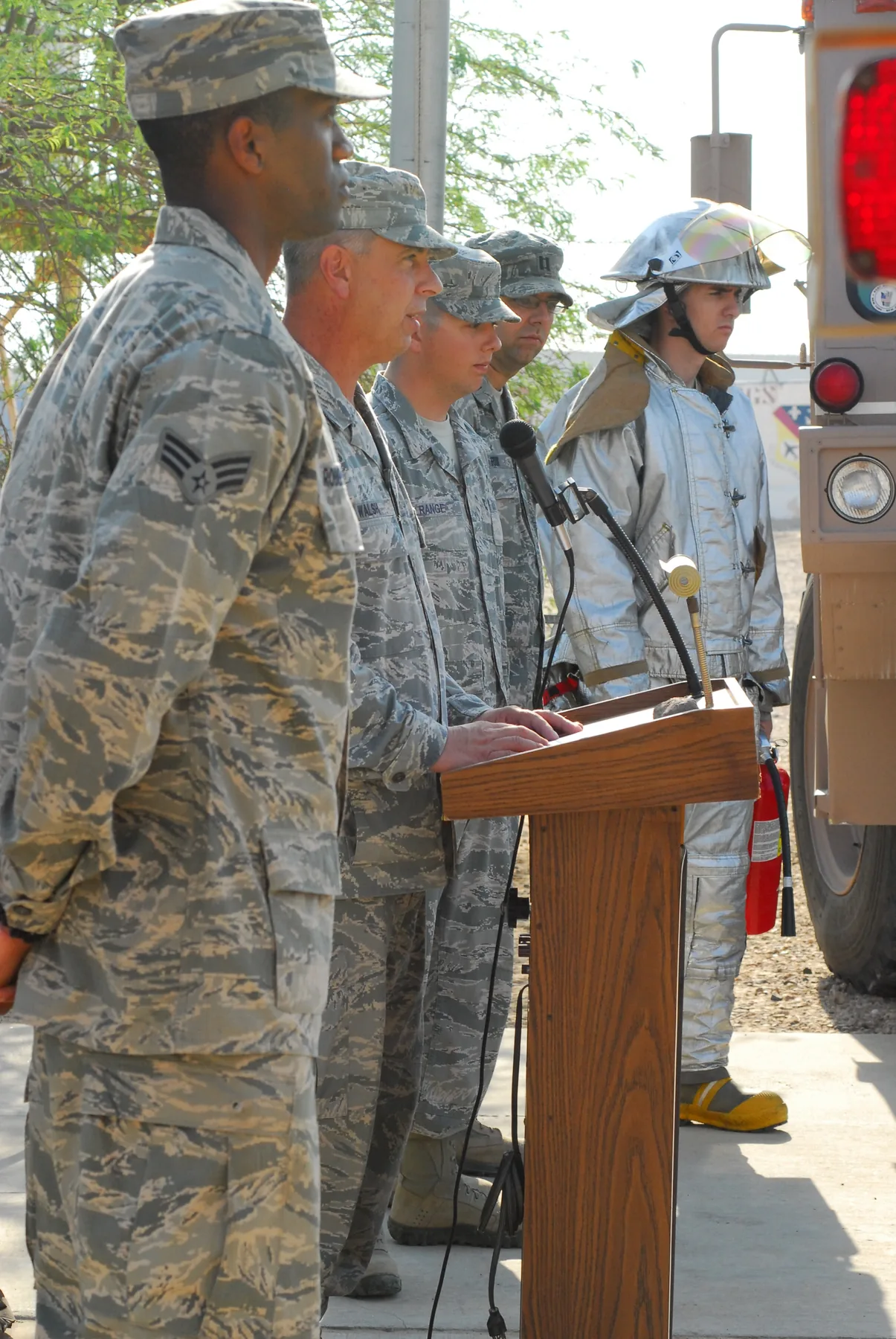
Communities can choose a form of participation that fits their setting:
- Join the verified flag tribute. A home, business, or independent fire department can voluntarily follow the current service-day period even when it is outside the direct federal property mandate.
- Ask local officials for a proclamation. Use current NFFF sample language, identify the correct year and service date, and make clear whether the document is ceremonial or also directs public-property flags.
- Use current NFFF remembrance programs. Bells Across America invites fire departments, places of worship, carillonneurs, and community organizations to ring in remembrance. NFFF also publishes current-year guidance for Light the Night and Sound the Sirens.
- Share verified stories. Link to the current Roll of Honor or an official department remembrance rather than copying incomplete names or circumstances from social media.
- Support families and colleagues. Coordinate with the department and family-facing organizers before using a name, photograph, or personal story in public materials.
Check the current year’s instructions for every program. Bell, light, and siren dates can change with Memorial Weekend, just as the flag date changes. If a siren tribute is planned, notify the community beforehand so residents do not mistake it for an emergency warning. Assign a named coordinator, confirm accessibility and safety, and keep announcements concise and factual.
Finally, label the reason accurately. The annual National Fallen Firefighters Memorial Service is a nationwide tribute connected to the official memorial and Roll of Honor. A funeral for a local firefighter or a governor’s order after a recent line-of-duty death is a different event with its own scope and duration. The two may both deserve solemn observance, but one notice should not be reused to justify the other. See our first-responder mourning guide for that event-specific process.
Frequently Asked Questions
Is the fallen-firefighters half-staff observance a permanent annual rule?
It is an enduring annual, event-linked rule for American flags on Federal office buildings. Public Law 107-51 says the action occurs each year in honor of the National Fallen Firefighters Memorial Service. It is not a permanent numbered calendar date. The annual service schedule and current proclamation identify the actual day.
Is the date always May 3 or always the first Sunday in May?
No fixed date or Sunday formula appears in Public Law 107-51. May 3 was the federal service-day display in 2026; May 4 was the date in 2025. NFFF currently schedules Memorial Weekend in May, but readers should confirm the service day every year instead of calculating it from an old example.
Must every flag in the United States be lowered?
No. The federal law expressly names American flags on all Federal office buildings. A governor can separately direct state property, and a state order may name state, municipal, or other flags. Cities, schools, fire departments, businesses, and homes must check their property status and the current notice. Private participants are commonly invited or encouraged rather than directly commanded by Public Law 107-51.
Does the flag return to full staff at noon?
Not because of this observance. The noon transition belongs to the federal Memorial Day holiday. For the National Fallen Firefighters Memorial Service, use the period in the current instruction. Many 2026 state notices specified sunrise to sunset. A continuously displayed flag may remain outside after dark when properly illuminated, but it should return to full staff when the applicable half-staff period ends.
Can a home or business participate without a governor’s order?
Yes, an owner may choose to join the national tribute voluntarily and follow proper flag etiquette. Kentucky’s 2026 notice, for example, directed state office buildings and encouraged individuals, businesses, and organizations to participate. Treat that as an invitation, identify the verified current reason and duration, and avoid implying that the property was legally ordered when it was not.
What if another half-staff order overlaps the service day?
Keep the flag at half-staff for the continuous period required by every applicable instruction, using the latest applicable end time. Log both documents and reasons. An overlap does not require a symbolic trip to full staff between orders. When the final applicable period ends, raise the flag to the peak before lowering it for the day, or return it to full staff if it will remain displayed.
What is the safest one-sentence instruction for staff?
“Follow the current official notice for this property: raise the U.S. flag to the peak, lower it to half-staff for the stated service-day period, then raise it to the peak again before final lowering or return to full staff.” Attach the source URL so the date, scope, and end time can be checked rather than copied from memory.
Comments
Comments are reviewed before publication.
Sign in with Google to join the discussion.
Loading comments…