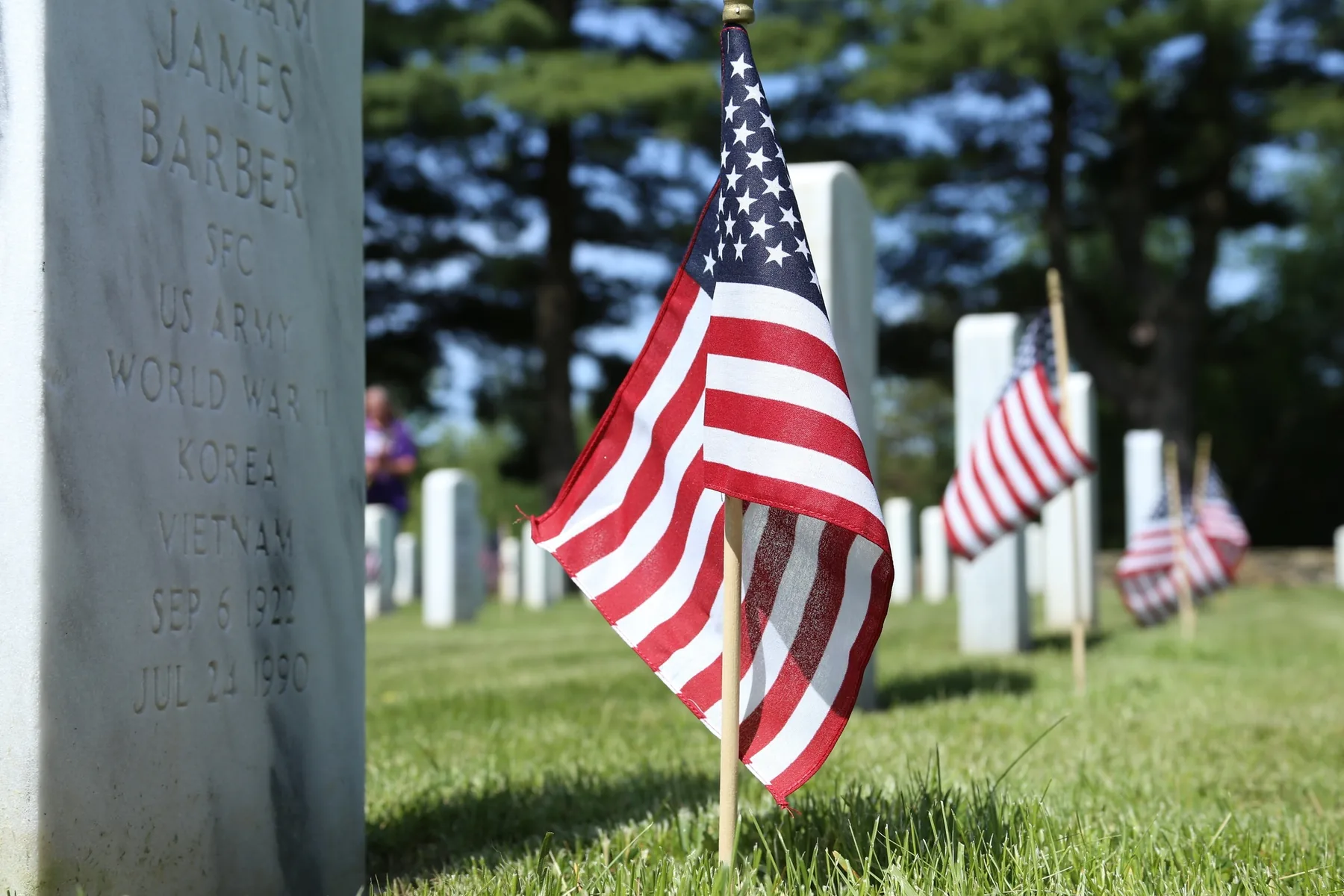
On Memorial Day, the U.S. flag is at half-staff only until noon. At the start of the customary display day, raise it all the way to the peak for an instant and then lower it to half-staff. At noon, raise it to full staff, where it remains until the day?s final lowering. That split schedule is written into 4 U.S.C. ? 7(m); it is not a mistake and does not require a new tragedy announcement.
The morning position marks national mourning for people who died in military service. The upward movement at noon is commonly explained as an expression of resolve: the nation remembers its losses yet continues the work and freedoms for which they sacrificed. That meaning has been expressed in official Memorial Day addresses, but it should not be confused with the legal text. The statute supplies the movement and timing; commemorative speakers explain what the movement can signify.
Memorial Day falls on the last Monday in May. The exact date changes each year, so use the half-staff calendar when planning a ceremony. The clock does not: half-staff through 12:00 noon local time, full staff afterward, subject to any separate active order that actually extends beyond noon.
This guide explains that exception step by step, including the peak-first ceremony, fixed residential poles, nighttime illumination, other flags, and overlapping orders. It also clears up a frequent timing mix-up: the noon flag raising and the 3:00 p.m. National Moment of Remembrance are two separate Memorial Day observances.
The Rule in One Timeline: Sunrise, Noon, Sunset
Memorial Day has two flag positions during one display day. The transition is tied to local clock time, not to the start or finish of a parade, cemetery service, or family gathering.
| Time | Flag position | Action |
|---|---|---|
| Sunrise or when the flag is first raised | Half-staff | Hoist briskly to the peak for an instant, then lower ceremoniously to halfway. |
| 12:00 noon local time | Full staff | Raise the flag briskly from half-staff to the peak. Do not lower it again merely because Memorial Day continues. |
| Sunset or facility closing | End of display | Lower ceremoniously from the peak. A flag displayed after dark may remain up when properly illuminated. |
Title 4?s general display guidance describes sunrise to sunset as the customary period for an outdoor stationary flag. It also permits a patriotic 24-hour display when the flag is properly illuminated during darkness. That is why ?until noon? does not mean ?take the flag down at noon.? It means end the mourning position by moving the flag to the top; normal display continues.
An office or home that puts its flag up after sunrise follows the same sequence at the actual raising time: peak first, then half-staff if it is still before noon. A flag first displayed after noon goes to full staff. USPS?s 2026 facility instructions use this practical phrasing??sunrise, or the hour when it?s raised??and direct the flag to the peak at noon until closing, sunset, or continued illuminated display.
The half-staff position is one-half the distance between the top and bottom of the staff. A clearly intentional midpoint is the goal; leaving the flag a few feet below the finial is not the Memorial Day position. At noon, bring it fully to the peak rather than merely raising it a little.
What 4 U.S.C. ? 7(m) Actually Requires
The controlling display sentence is unusually direct: on Memorial Day the flag should be displayed at half-staff until noon only, then raised to the top of the staff. The same subsection supplies the peak-first procedure for entering and leaving half-staff. Meanwhile, 5 U.S.C. ? 6103 defines the federal holiday as the last Monday in May, and 4 U.S.C. ? 6 lists Memorial Day with the parenthetical ?half-staff until noon.?
This is a standing calendar rule. It differs from an event-specific presidential proclamation issued after a death or tragedy. You do not need to wait for a breaking-news order to know the ordinary Memorial Day position. A separate active proclamation can matter if it overlaps the holiday, but the annual sunrise-to-noon pattern already exists in the Flag Code.
Presidents also issue annual Memorial Day proclamations under the broader commemorative framework in 36 U.S.C. ? 116. For example, the 2025 proclamation requested governors and government officials to direct half-staff display until noon and asked citizens to observe the customary forenoon period at home. Such a proclamation reinforces the nationwide observance, identifies that year?s date, and addresses prayer and remembrance. It should not be mistaken for the only reason the noon rule exists each year.
There is also a legal-character distinction between a private home and a government facility. The Congressional Research Service explains that most Flag Code display provisions for private citizens have no explicit enforcement mechanism and are generally declaratory or advisory. Public agencies, military commands, postal facilities, states, schools, and employers may have binding statutes, directives, or operating policies of their own. Respectful private observance follows the national standard even though the homeowner is not receiving a daily operational command.
The practical result remains simple: treat Memorial Day as a scheduled observance and then check whether another valid notice changes the afternoon instruction for your property. Other officeholder and tragedy-related periods follow different legal rules, summarized in the guide to when the U.S. flag is flown at half-staff.
Why the Flag Rises at Noon
The morning half-staff position is the clearest part of the meaning: Memorial Day commemorates the women and men who died while serving in the U.S. Armed Forces. Lowering the flag expresses mourning and respect for that sacrifice. Memorial Day is therefore not simply a general appreciation day for everyone who has served; Veterans Day has that broader living-veteran emphasis.
The noon rise changes the visual language. In a 2015 address at Arlington National Cemetery, then-Secretary of Defense Ash Carter described the morning lowering as tribute to those who gave the ultimate sacrifice and the noon rise as a sign of the nation?s will to recover after tragedy and of the strength and resilience of the country, those who defend it, and their families. GovInfo preserves and attributes that explanation in its Memorial Day feature.
That is a powerful official interpretation, but accuracy requires a boundary. Section 7(m) does not say, in words, ?the morning honors the dead and the afternoon honors the living.? It directs the flag?s positions. Speakers, agencies, veterans? organizations, and communities have explained the upward transition through themes of perseverance, resolve, freedom, and continued service. Those themes help people understand the ceremony; none needs to be presented as a separately enacted sentence.
This distinction also prevents a common mistake. Raising the flag at noon does not end remembrance or cancel mourning. Memorial ceremonies, grave visits, names read aloud, and private reflection continue throughout the day. The movement says that remembrance and national life coexist: loss is acknowledged visibly in the morning, and the symbol of the nation returns to its position of full prominence.
Nor does full staff after noon mean that living service members have replaced the fallen as the day?s honorees. The holiday remains dedicated to those who died in military service. Caring for veterans and military families is a fitting consequence of remembrance, while the legal and historical subject of Memorial Day remains the fallen.
How to Perform the Memorial Day Flag Ceremony
You do not need a band, bugler, or formal color guard to follow the protocol correctly. The essential ceremony is the respectful movement of the flag at the right times. If an organization has its own authorized commands or music, coordinate them without changing the three required positions.
- At sunrise or your opening time, attach the flag securely. Check the halyard, clips, and weather before beginning. Keep the fabric from touching the ground.
- Hoist briskly to the peak. The flag does not stop at halfway on its first upward movement. Pause at the top for an instant.
- Lower ceremoniously to half-staff. Position the midpoint of the flag?s hoist about halfway between the top and bottom of the staff. Secure the halyard.
- At 12:00 noon, raise to the peak. Hoist the flag briskly to full staff. It remains there for the afternoon unless a separate valid half-staff instruction covers the property.
- At sunset or closing, lower ceremoniously. Because the flag is already at the peak after noon, it can be lowered from there. Fold and store it dry and safely.
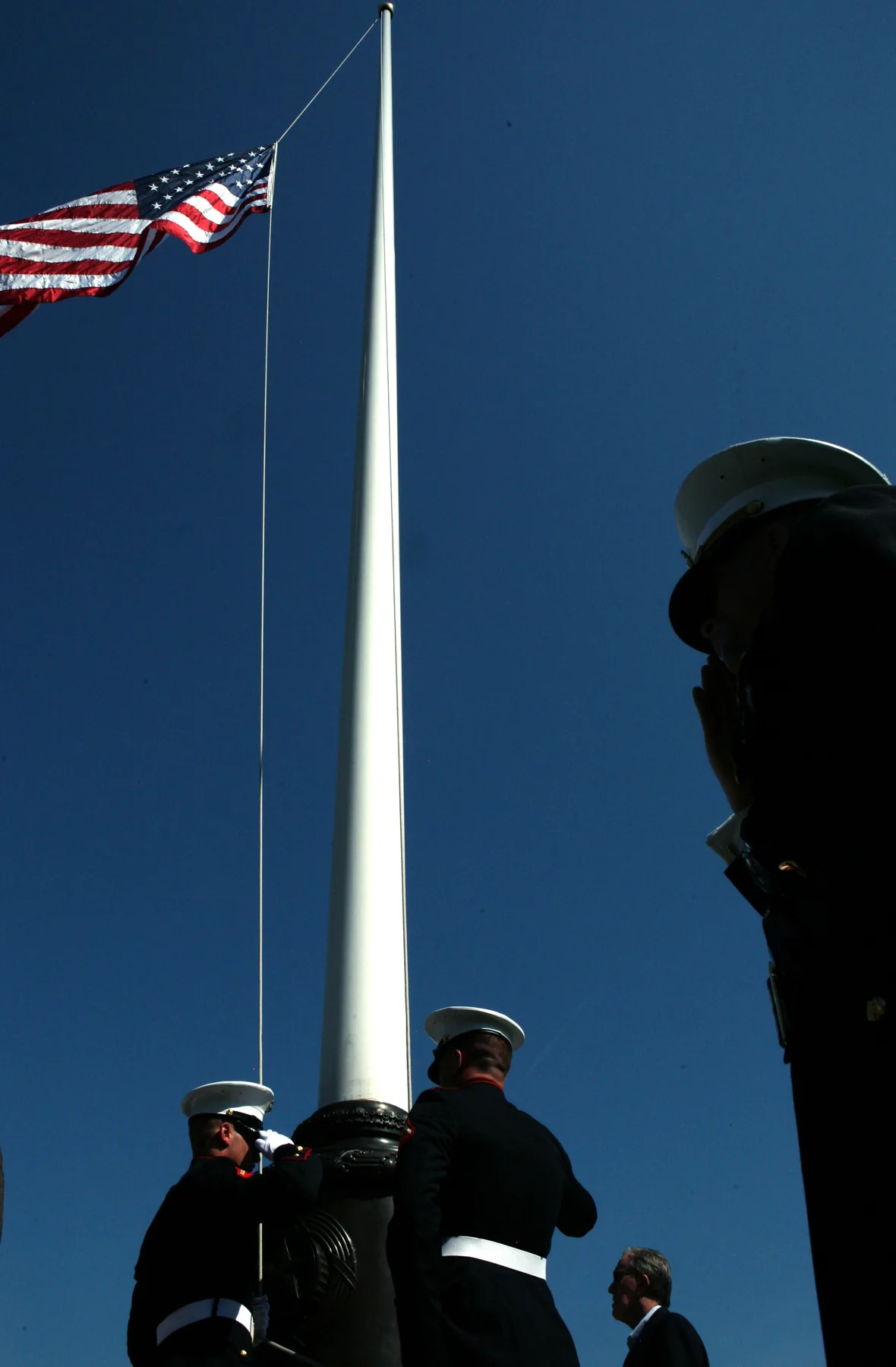
During a formal hoisting or lowering ceremony, 4 U.S.C. ? 9 says people in uniform should render the military salute. Members of the Armed Forces and veterans who are present but not in uniform may render it. Other people should face the flag, stand at attention, and place the right hand over the heart; the section also gives guidance for removing headdress and for citizens of other countries.
Some military installations mark noon with music and a national salute. Historical Army regulations described an appropriate air and 21 guns before the flag returned to the top. That is installation ceremony?not a requirement for a homeowner, school, or small business. Silence, a reading of names, or a brief reflection may accompany a local raising, but no made-up script is necessary.
If you miss noon by a few minutes, correct the position respectfully when you can; do not leave it half-staff all afternoon because the exact moment passed. For more detail on halyards, peak-first movement, and safe handling, see how to lower and raise a flag at half-staff.
Fixed Poles, Night Display, Weather, and Other Flags
What if a porch flag cannot move to half-staff?
A short wall-mounted staff without a halyard cannot reproduce a halfway position. The Flag Code does not prescribe a mechanical substitute. A widely used mourning custom is to attach a black crepe streamer or bow at the top of the staff, immediately below the finial, during the half-staff period. Treat that as a symbolic alternative, not as statutory text, and remove it at noon when the mourning period ends. Do not tie or pin anything directly onto the U.S. flag.
It is also respectful simply to display the fixed flag normally or to leave it indoors. Do not angle it awkwardly, roll it around the staff, or improvise a position that lets the fabric touch the building, vegetation, or ground. An HOA, employer, school, or public agency may have its own display policy, so operators should follow that policy as well.
Can the flag stay outside overnight?
Yes, when properly illuminated during darkness. A flag already displayed around the clock should be placed at half-staff for the Memorial Day morning and raised to the peak at noon. Proper illumination means the flag remains recognizably visible; a distant porch glow that leaves it effectively in darkness defeats the purpose of the exception. A facility?s written lighting standard controls where one exists.
What about rain and other flags?
Title 4 advises against displaying the flag in inclement weather unless it is an all-weather flag. Check the material and forecast rather than assuming every nylon-looking flag is rated for severe conditions. Safety comes first during lightning, high wind, or a damaged halyard.
State, city, POW/MIA, agency, and organization flags must not be left in a position superior to the U.S. flag. On a shared halyard, the U.S. flag remains above the others, so the group must move in a way that preserves that order. On separate staffs, many agency policies lower the full group together; USPS explicitly does so at its facilities. Foreign national flags require separate, equal staffs in peacetime and may be governed by diplomatic protocol, so do not lower another country?s flag merely by applying a domestic subordinate-flag rule.
What If Another Half-Staff Order Overlaps Memorial Day?
Start with the documents, not a slogan such as ?the later deadline always wins.? Memorial Day?s standing rule calls for full staff at noon. A separate presidential, governor, or agency action may address a different death or tragedy and may name a period that includes the holiday. Whether it modifies the noon movement depends on its authority, wording, scope, and any implementation notice sent to the facility.
For an ordinary year with no other applicable instruction, raise at noon. State Memorial Day orders usually confirm exactly that. Florida?s 2026 memorandum covered U.S. and state flags on local and state property from sunrise until noon. Michigan?s 2026 notice likewise instructed covered flags to return to full staff at noon. These state documents did not create an afternoon extension.
If another order is active, perform this short check:
- Identify the issuer and the separate reason for lowering.
- Confirm that the order covers your federal, state, local, agency, or private property.
- Copy its exact start and end, including whether the end is sunset, a date, or interment.
- Look for a Memorial Day-specific implementation notice or amendment.
- If two instructions genuinely conflict, ask the responsible facility office or issuing authority before changing the schedule.
Federal GSA policy illustrates why this is not guesswork. It lists Memorial Day as half-staff until noon and full staff until sunset, while also stating that a prescribed period cannot be adjusted unless authorized by a presidential order or proclamation or by statute. A state order cannot silently rewrite a nationwide federal instruction, and a national order does not automatically expand a local agency tribute beyond its named properties.
A homeowner who voluntarily follows official mourning notices can use the same source hierarchy. Check the original White House or governor document, then the state or agency implementation page. The current flag status is a useful cross-check, but the operative notice remains the best answer for a particular flagpole. Save the notice in a facility log so the noon decision is explainable later.
Memorial Day Half-Staff FAQ
Is the flag at half-staff all day on Memorial Day?
No. Under the standing U.S. rule, it is at half-staff from sunrise, or from the time it is first raised, until 12:00 noon. It then goes to the top of the staff for the afternoon. A separately applicable order is the reason to investigate a different schedule, not Memorial Day by itself.
Does ?noon? mean local time?
Yes. Use 12:00 p.m. local civil time where the flag is located. The national rule does not tell every time zone to raise simultaneously. A staffed facility that opens after sunrise may begin the display when it opens, but it still changes to full staff at its local noon.
Should the flag be raised at noon or at the 3 p.m. National Moment of Remembrance?
Raise it at noon. The National Moment of Remembrance begins at 3:00 p.m. local time and is a separate observance created by Public Law 106-579. People are encouraged to pause and remember the fallen then; the law did not move the flag transition from noon to 3 p.m. At 3 p.m., the flag ordinarily remains at full staff.
Is Memorial Day for all veterans?
It specifically remembers military personnel who died in service to the country. Veterans Day honors everyone who served honorably, living and dead, and is especially associated with thanking living veterans. It is appropriate to support veterans and military families on Memorial Day, but the holiday?s central honorees are the fallen.
Are flags automatically at half-staff on Veterans Day?
No. Veterans Day is a day on which the Flag Code especially encourages displaying the flag, but it has no recurring half-staff requirement comparable to Memorial Day morning. A presidential, governor, or other applicable directive issued for a separate reason could overlap November 11, so check current official notices rather than relying only on the calendar.
Can a homeowner follow the Memorial Day half-staff schedule?
Yes. Annual presidential Memorial Day proclamations commonly request that citizens display the flag at half-staff from their homes during the customary forenoon period. A private owner with a movable flag follows the same peak-first procedure and raises at noon. If the pole cannot move, use a clearly identified mourning custom cautiously or keep the flag displayed in its normal dignified position.
Comments
Comments are reviewed before publication.
Sign in with Google to join the discussion.
Loading comments…