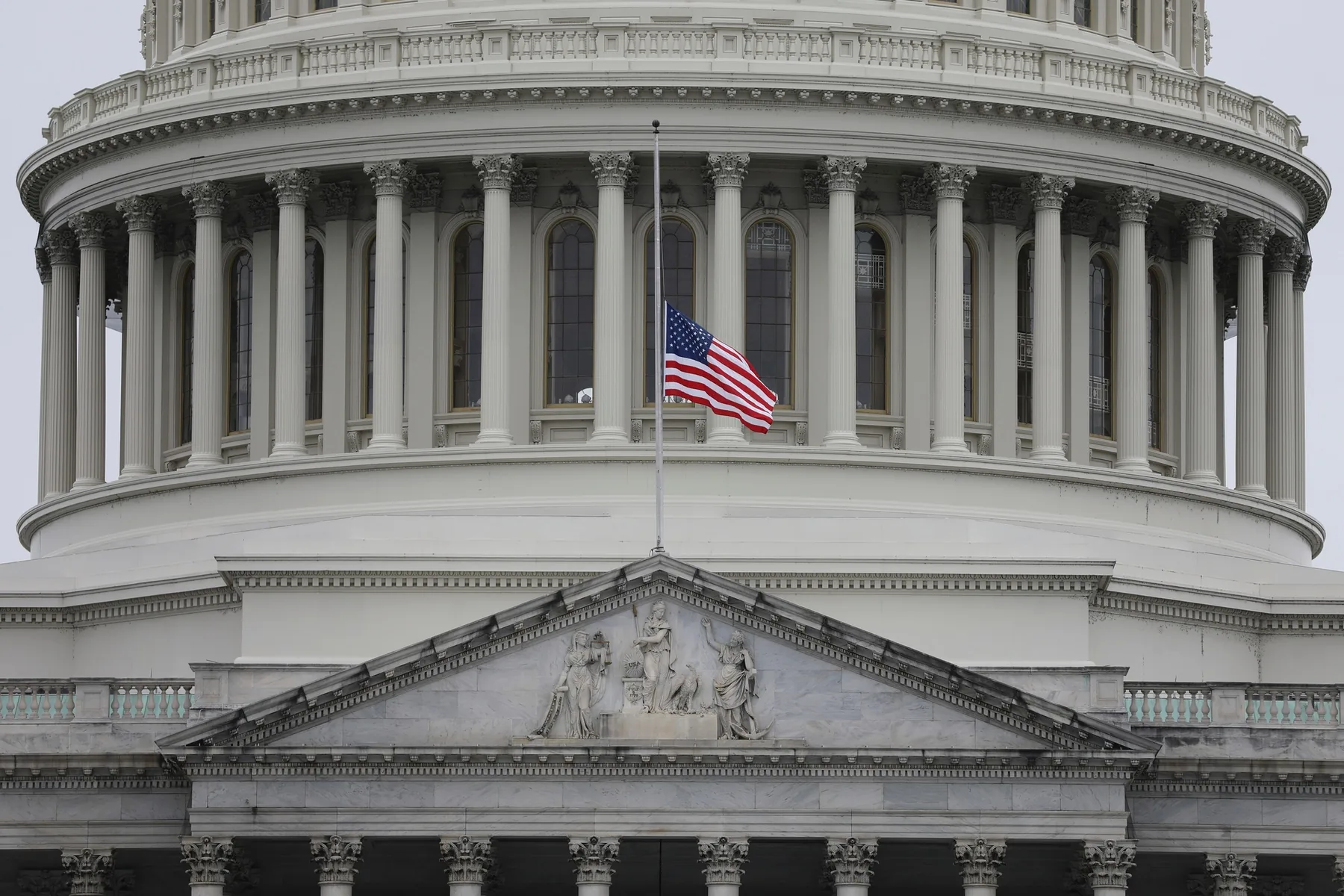
The President can direct U.S. flags to half-staff at federal facilities; governors can issue orders within their state or territorial jurisdiction; and the mayor of Washington, D.C., has a special role expressly recognized in federal law. Federal department and agency heads may also direct flags on property under their control when applicable policy allows it. Other mayors, county executives and local officials can generally act only for municipal or county property they govern. A notice from any one official does not automatically control every flagpole in America. To know whether an order applies, identify both the issuer and the property covered. For the active national picture, begin with today?s U.S. half-staff status.
The short answer: authority follows jurisdiction
?Who ordered the flags down?? is only half of the useful question. The other half is ?Which flags did that official have authority to direct?? A presidential proclamation may cover federal buildings nationwide and specified U.S. facilities abroad. A governor?s order may cover state property. A mayoral notice may cover city hall and municipal buildings. A private business may choose to participate without being within any government directive.
| Authority | Typical reach | What to verify |
|---|---|---|
| Federal statute | Recurring observances and standard periods for named officials | The current U.S. Code and any implementing notice |
| President | Federal executive buildings, grounds, military locations and any overseas facilities named | The proclamation?s exact property list and duration |
| Governor | State or territorial facilities under the order and applicable law | The state notice, subject, start and end |
| Mayor of Washington, D.C. | District facilities, with a role expressly recognized by 4 U.S.C. ? 7(m) | The mayoral order and District implementation notice |
| Federal department or agency head | Buildings, grounds or vessels under that agency?s jurisdiction | Delegated authority and property limits |
| Other mayor or local official | Municipal or county property when local law or policy permits | The local directive and facilities named |
| Private owner | The owner?s flagpole, subject to organizational rules | Whether participation is invited, voluntary or required by policy |
Congress also shapes half-staff practice by enacting statutes that establish recurring observances or standard mourning periods. That is different from a case-by-case executive order: a facility may be following a standing law even when no new proclamation was issued that morning. The implementation notice should identify the underlying statute or policy.
For U.S. flags on land, the preferred term is half-staff. ?Half-mast? is traditionally used for vessels, although people often use the phrases interchangeably.
What the President can order
The President is the principal source of event-specific federal half-staff proclamations. Under 4 U.S.C. ? 7(m) and longstanding presidential instructions, federal flags are lowered for the deaths of certain officials and may also be lowered for other officials, foreign dignitaries or national tragedies.
Federal buildings, military locations and overseas facilities
A typical presidential proclamation identifies the White House, public buildings and grounds of the Federal Government, military posts, naval stations and federal naval vessels. Some proclamations also expressly reach U.S. embassies, consular offices and military facilities abroad. The document?s wording matters: overseas coverage should not be assumed when it is not stated or supplied by the department?s own policy.
The 1954 Presidential Proclamation 3044 created uniform federal mourning rules for named offices. It remains an important baseline alongside the current U.S. Code. It prescribes, for example, 30 days for a current or former President, 10 days for a Vice President, Chief Justice or Speaker of the House, and other periods tied to death and interment for specified offices.
Event-specific proclamations versus standard periods
Not every half-staff event fits the office-based schedule. A President may issue a specific proclamation after a mass-casualty event or to honor someone not included in the standard list. That document can define its own start, end and facility scope. An annual observance may instead come from statute and a recurring presidential proclamation.
Do not rely only on a headline saying ?all flags.? Read the operative paragraph. It may mean all federal flags in a stated area, not every privately owned flag in the country.
What governors can order
Governors issue half-staff proclamations for their states, territories or possessions. The federal baseline in 4 U.S.C. ? 7(m) expressly recognizes a governor?s authority after the death of:
- a present or former official of that state, territory or possession;
- a member of the Armed Forces from that jurisdiction who dies while serving on active duty; or
- a first responder working in that jurisdiction who dies in the line of duty.
State law and executive policy may also govern how flags on state-owned property are handled for other events. That is why a governor?s actual notice remains essential. It may name state office buildings, all state facilities, state agencies, schools or other property, and it may direct both the U.S. flag and the state flag.
Federal law contains one especially important cross-jurisdiction rule. When a governor?s proclamation honors an Armed Forces member from the state who died on active duty, the U.S. flag at federal installations in the covered area must be flown consistently with that proclamation. That federal-facility consequence should not be generalized to every governor order.
A resident who sees a state building lowered while the national status is full staff may be looking at a valid state-only order. Use the relevant state source?such as the Texas half-staff status page?and then open the issuing governor?s original notice.
Why the mayor of Washington, D.C., is different
The mayor of Washington, D.C., is not merely an example of an ordinary city mayor. Federal law expressly gives the D.C. mayor authority corresponding to a governor?s for present or former District officials, Armed Forces members from the District and District first responders killed in the line of duty.
The District?s official flag protocol manual shows how that authority becomes an operational instruction. The Secretary of the District sends written notification to the Department of General Services, which notifies District agencies operating District facilities. The model order addresses ?all flags at District facilities? and supplies a defined time period.
This special statutory treatment does not give every mayor the same federal-law reach. A mayor elsewhere may control municipal flagpoles under a city charter, executive authority or local policy, but that direction remains local unless another law says otherwise.
Can a federal department or agency head order half-staff display?
Yes, within defined jurisdiction. Paragraph 5 of Proclamation 3044 permits heads of federal departments and agencies to direct the flag to half-staff on buildings, grounds or naval vessels under their jurisdiction for occasions they consider proper. Agency policies and delegations determine who may exercise that authority and how widely it reaches.
The General Services Administration?s flag policy illustrates the limits. In some delegated or leased buildings, an agency head may authorize half-staff display for a person who worked in that specific building. That authority does not automatically extend to other facilities under GSA?s jurisdiction. The agency can request broader action from the appropriate GSA official, but it cannot simply treat every federal property as its own.
The State Department provides another example. Its manual recognizes several paths: an automatic requirement established by law, a presidential direction, an instruction by the Secretary or a designee, or a qualifying decision by a chief of mission abroad. This is why an email from a facilities office may be an implementation notice carrying out higher authority rather than a new national order.
Can a city mayor, county executive or local official lower flags?
Local officials can direct flags on property they control when local law or policy gives them that power. For example, in January 2023 the New York City mayor ordered flags lowered for the Twin Parks fire anniversary. The announcement expressly covered flags on city buildings and stationary flagstaffs throughout the five boroughs.
That was a city-property order. It did not become a New York State order, did not direct federal facilities, and did not compel every private flagpole in the five boroughs. The same principle can apply to a county executive, school superintendent, police chief or fire commissioner acting under a valid local or departmental policy: the official may control the institution?s own facilities without controlling everyone else?s.
When a local press release says ?all flags,? read the rest of the sentence. ?All flags on city buildings? is a defined municipal scope; ?all American flags? in a headline may be shorthand that requires clarification.
Are schools, businesses and homeowners required to follow?
The answer depends on ownership and governing policy.
- Federal schools or facilities follow the controlling federal and agency instructions.
- State or municipal schools may be covered by a governor?s order, local directive, education code or district policy.
- Private schools and businesses often choose to participate, but an internal corporate, association or lease policy may assign that decision to a particular office.
- Homeowners generally make their own respectful display choice.
The Congressional Research Service explains that much of the Flag Code is declaratory and advisory and lacks a general enforcement mechanism. That does not mean every institution is free of rules. A government employee, military installation, public school or federal tenant may have a binding policy even when a private resident does not.
Pay attention to the document?s verb:
- ?Direct? or ?order? normally identifies covered government facilities.
- ?Notify? may communicate an instruction issued elsewhere.
- ?Invite? or ?encourage? usually signals voluntary participation.
- A private decision can honor a local loss even without a government order.
If you voluntarily lower a flag, use the proper procedure: raise it briskly to the peak first, lower it to half-staff, and raise it to the peak again before taking it down. The flag position calculator can help with the physical placement.
What happens when orders overlap?
Federal, state and local instructions can apply on the same date without having identical scopes or end times. Imagine four flagpoles in one city:
- A federal courthouse follows the applicable federal directive and its building policy.
- A state office follows the governor?s order.
- City hall follows the mayor?s municipal instruction.
- A private business decides whether to join an invited observance.
All four flags may be lowered, but for different legal or policy reasons. Alternatively, only the state and city facilities may be lowered while the federal building remains at full staff. A later order does not automatically cancel an earlier one; each must be checked for its own property, dates and return instruction.
Flag precedence also matters. When state, city or organizational flags share a halyard with the U.S. flag, none should be positioned above the U.S. flag. On adjacent staffs, operators should follow the U.S. Flag Code and the facility?s protocol. Use the half-staff calendar to identify overlapping observances, then confirm each original order.
A five-step checklist before lowering a flag
- Find the original source. Prefer the White House, governor, government agency or local government page over a screenshot or repost.
- Identify the issuer. Determine whether the document comes from the President, governor, D.C. mayor, agency head or local official.
- Identify the property and flags covered. Look for federal, state, District, municipal, agency, school or private language.
- Record the full period. Note ?immediately,? sunrise, sunset, a clock time, time zone, interment or another precise endpoint.
- Check for overlap and return instructions. A recurring observance or second order may keep the flag lowered after one notice ends.
Save the original notice with its publication date. A current-status summary helps with discovery, but the issuing government text is the best evidence of scope. If the instructions conflict, ask the office responsible for the facility rather than guessing.
Frequently asked questions
Can only the President order flags to half-staff?
No. The President directs federal flags; governors and the D.C. mayor have recognized authority within their jurisdictions; and agency or local officials may direct flags on property they control under applicable policy.
Can a governor order the U.S. flag lowered?
Yes. 4 U.S.C. ? 7(m) expressly authorizes governor proclamations for specified deaths, and state law or policy can govern state property in additional circumstances. Always read the particular order for scope.
Can a mayor order American flags to half-staff?
A mayor may direct flags on municipal property when local authority permits. The D.C. mayor is distinct because federal law expressly recognizes a governor-like role for District matters. An ordinary city mayor?s order does not control statewide or federal flagpoles.
Must federal buildings follow a governor?s order?
Not in every case. Federal law expressly requires federal installations in the covered area to follow a governor?s qualifying proclamation for an Armed Forces member from that jurisdiction who died on active duty. Other situations depend on federal law, the presidential or agency instruction, and facility policy.
Can a private business lower its flag without an order?
Generally, a private owner can voluntarily lower its own flag as a respectful observance. The organization should still check any lease, association or corporate policy and follow proper flag procedure.
Is the U.S. Flag Code mandatory for everyone?
Much of the Flag Code functions as guidance and does not carry a general enforcement mechanism for private display. Government facilities, military organizations, schools and employees may nevertheless be subject to specific laws or binding policies.
Comments
Comments are reviewed before publication.
Sign in with Google to join the discussion.
Loading comments…