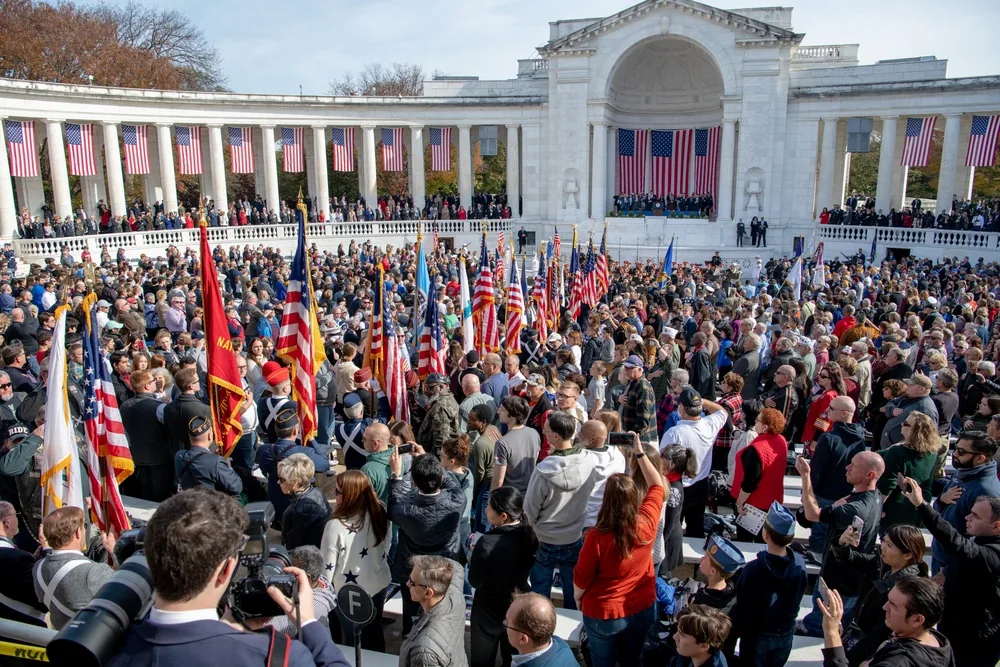
Is the Flag at Half-Staff on Veterans Day?
No—Veterans Day does not automatically call for the U.S. flag to be flown at half-staff. On November 11, the normal position is full staff. Federal flag guidance names Veterans Day as a day to display the flag, while half-staff communicates mourning or marks a separate remembrance established by law or an official instruction. That distinction answers most searches for “Veterans Day flag half-staff rules”: the holiday itself is not a nationwide lowering order.
There is one important exception. A presidential proclamation, governor’s directive, or another instruction that applies to a particular government facility can begin before November 11 and remain effective on Veterans Day. In that case, the flag may properly stay at half-staff for the period and places described in that instruction. The overlap does not change the purpose of Veterans Day; it means two observances happen at the same time.
For the 2026 holiday, November 11, 2026 is still in the future as of this article’s September 3, 2026 research cutoff. No evergreen guide can guarantee the day-of position months in advance. Before raising a flag, check today’s U.S. half-staff status, then read any relevant state or facility notice. Look for four details: who issued it, which flags and locations it covers, when it starts, and exactly when it ends.
For a home or community event with no applicable instruction, display the U.S. flag proudly at full staff. If an official half-staff period does apply, follow its stated scope and duration rather than raising the flag simply because Veterans Day has begun. This approach respects both the service celebrated on November 11 and any distinct period of mourning in force that day.
What the U.S. Flag Code Actually Says About November 11
The clearest evidence is in 4 U.S.C. § 6(d). It says the flag should be displayed on all days and then identifies dates on which display is especially appropriate. Within that list, Congress wrote “Memorial Day (half-staff until noon)” but listed “Veterans Day, November 11” without a lowering instruction. The careful conclusion is that Veterans Day is a flag-display day and that its default position is full staff—not that the statute uses the exact phrase “full staff on Veterans Day.”
This close reading matters because holiday lists are often copied without their qualifiers. The words in parentheses after Memorial Day establish a special morning rule for that observance. Moving those words to Veterans Day, or treating every military-related holiday as a mourning day, changes the guidance. The half-staff calendar can help you distinguish recurring flag dates from separate, event-specific instructions.
Other parts of § 6 supply the ordinary display routine:
- Outdoor flags on buildings and stationary flagstaffs are customarily displayed from sunrise to sunset.
- A flag may remain up for 24 hours when it is properly illuminated during darkness.
- The flag should be hoisted briskly and lowered ceremoniously.
- An all-weather flag may be displayed during inclement weather; a flag not made for those conditions should be protected.
The Flag Code is a national standard of respect and etiquette. VA guidance notes that the federal code does not attach a general penalty to misuse, while states may have their own flag laws or policies. Government employees, schools, military installations, and organizations may also have binding workplace or facility instructions. Therefore, “the Flag Code has no general federal penalty” does not mean “every display choice is acceptable everywhere.” It means a private reader should treat the Code as the authoritative etiquette baseline and separately check rules that apply to the location.
For November 11, begin with that baseline: display the flag at full staff during customary hours, illuminate it if it stays up after dark, and protect it from damaging weather. Change the position only when a distinct, applicable half-staff instruction gives you a reason to do so.
Veterans Day and Memorial Day Have Different Flag Traditions
The common mix-up is understandable: both observances involve military service, remembrance, ceremonies, and American flags. Their purposes and scheduled flag positions are nevertheless different. The Department of Veterans Affairs describes Veterans Day as a day to thank and honor everyone who served honorably in the U.S. military, in war or peace. It has a strong emphasis on living veterans, while still leaving room to remember those who died.
Memorial Day focuses on military personnel who died in service to the country. Its flag sequence expresses both mourning and resolve: half-staff from sunrise until noon, then full staff for the rest of the day. That noon movement is expressly stated in the Flag Code. It belongs to Memorial Day and should not be copied into a Veterans Day ceremony.
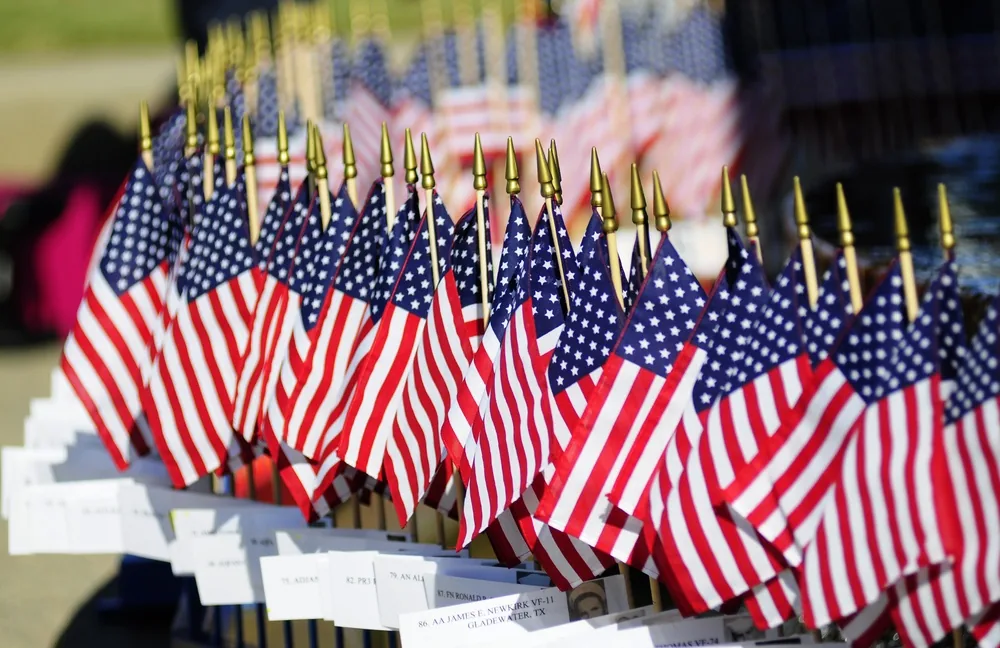
| Question | Veterans Day | Memorial Day |
|---|---|---|
| When? | November 11 every year | Last Monday in May |
| Primary emphasis | Thank all who served honorably | Remember those who died in military service |
| Scheduled U.S. flag position | Full staff, absent another instruction | Half-staff until noon, then full staff |
| Does a separate order still matter? | Yes | Yes |
The date November 11 comes from the armistice that stopped World War I fighting at the eleventh hour of the eleventh day of the eleventh month in 1918. The holiday began as Armistice Day. In 1954, it became Veterans Day so the national observance would encompass American veterans of all wars. After a short period when federal observance moved to a Monday, November 11 was restored beginning in 1978 because of its historic significance.
That history explains why full-staff display is fitting: the raised flag is an affirmative sign of national recognition and gratitude. Yet “celebration” should not be read as a ban on solemnity. The national ceremony at Arlington National Cemetery includes a wreath at the Tomb of the Unknown Soldier, and communities may hold moments of silence or remembrance. Ceremony tone and flag position are related symbols, not interchangeable rules.
If you are planning both holidays, keep two separate instructions. Use the Memorial Day half-staff timeline in May. On November 11, plan for full staff unless a current, independently issued instruction applies.
What If a Half-Staff Order Overlaps Veterans Day?
An active half-staff instruction does not disappear merely because the calendar reaches November 11. Veterans Day sets the normal holiday display; the separate instruction establishes a temporary mourning period. If its stated end falls after Veterans Day, covered flags remain at half-staff unless the issuing authority amends or ends the instruction.
Do not decide from the headline alone. Read the underlying proclamation, order, or agency message and extract these details:
- Issuer: Was it the President, a governor, the mayor of the District of Columbia, or an official responsible for a particular department or facility?
- Reason: Does it honor an official, service member, first responder, foreign dignitary, or victims of a tragedy?
- Scope: Does it name all federal property, all state buildings, a defined geographic area, one agency, or a single campus?
- Flags: Does it address the U.S. flag, a state flag, or both?
- Time: Does it run from sunrise to sunset on one date, for a stated number of days, or until interment?
Scope is the detail most often lost when an alert is reposted. Federal policy tables show that half-staff periods can apply nationwide or only in identified places. State notices commonly direct state-owned facilities while inviting residents and businesses to participate. A governor’s instruction is therefore not automatically identical to a nationwide presidential instruction. There are also narrow statutory situations in which a governor’s proclamation for a service member’s death reaches federal installations in that state.
When the end is expressed as “sunset,” use sunset at the flag’s location. When it says “until interment,” look for an official update rather than guessing the funeral date. If two instructions overlap, complying with the one that applies to your property will usually produce the same physical result—half-staff—but you still need the correct end time.
Check the current national flag status for a federal instruction and the dated half-staff calendar for documented observances and orders. Then consult your governor’s official site or your facility chain of command. For November 11, 2026, make that final check close to the holiday; the position cannot be guaranteed from a September 3 research snapshot.
Which Instruction Applies to Your Flag?
The right answer depends on the property, not simply on who sees the flag. A federal office, a state courthouse, a public school, a rented business suite, and a private porch can receive the same national news but operate under different policies. Identify who is responsible for the pole before changing its position.
| Location | First instruction to check | Practical action |
|---|---|---|
| Federal facility | Presidential instruction plus agency/GSA policy | Facilities staff follow the official operational notice. |
| State or local government property | Governor and controlling state/local policy | Use the notice distributed to the building or agency. |
| Public school | District, state, and facilities guidance | Confirm with the administrator responsible for flags. |
| Private business or nonprofit | Applicable law, property policy, and official notices | Determine whether participation is directed or invited. |
| Private home | Current federal/state notice as guidance, plus local rules | Participate respectfully and match the announced period. |
Federal buildings provide a useful example of why operational responsibility matters. GSA policy assigns flag handling to different people depending on whether a building is GSA-operated, delegated to an agency, or leased. A tenant who notices a position that appears wrong should contact building management or the facilities office instead of changing a shared flag without authorization.
State notices also require careful reading. A governor may direct state facilities and encourage residents, businesses, and organizations to join. The invitation can be meaningful without turning every privately owned pole into state property. Because state laws and institutional policies vary, use your own jurisdiction’s official notice rather than treating another state’s FAQ as a nationwide rule.
When several flags share a display, the U.S. flag retains its position of honor. The Flag Code says a state, local, or organizational flag should not be placed above it; on adjacent staffs, the U.S. flag is raised first and lowered last. If the U.S. flag is ordered to half-staff, facility protocol commonly addresses accompanying flags so none appears superior. Displays involving other nations follow equal-sovereignty rules and deserve advice from a protocol officer rather than improvisation.
For a deeper explanation of issuing authority, see who can order flags to half-staff. For Veterans Day itself, the practical rule remains simple: the holiday establishes the normal full-staff display, while the valid instruction for your property determines any temporary exception.
How to Fly the Flag Correctly on Veterans Day
For a normal Veterans Day with no applicable lowering instruction, use a straightforward full-staff routine. Inspect the flag and halyard before sunrise, attach the flag securely, raise it briskly to the peak, and leave it at full staff through the display period. Lower it ceremoniously at sunset. If you keep it flying after dark, provide lighting that makes the flag recognizable rather than leaving it in darkness.
Weather matters as much as position. A flag designed for outdoor, all-weather use may remain up in poor conditions, but a flag that could be damaged should come down. A wet, tangled, or torn flag does not become a more respectful tribute merely because it stayed outside all day.
If a half-staff instruction applies
- Raise the flag briskly all the way to the peak.
- Pause briefly, then lower it ceremoniously to the half-staff position.
- At the end of the observance or display day, raise it to the peak again.
- Then lower it completely and ceremoniously.
The first and third movements are not optional flourishes. They are the sequence described in 4 U.S.C. § 7(m) and repeated in VA protocol. Half-staff is defined as one-half the distance between the top and bottom of the staff. If the hardware or proportions make that difficult to judge, use the flag position calculator as a practical aid while preserving a clearly intentional space above the flag.
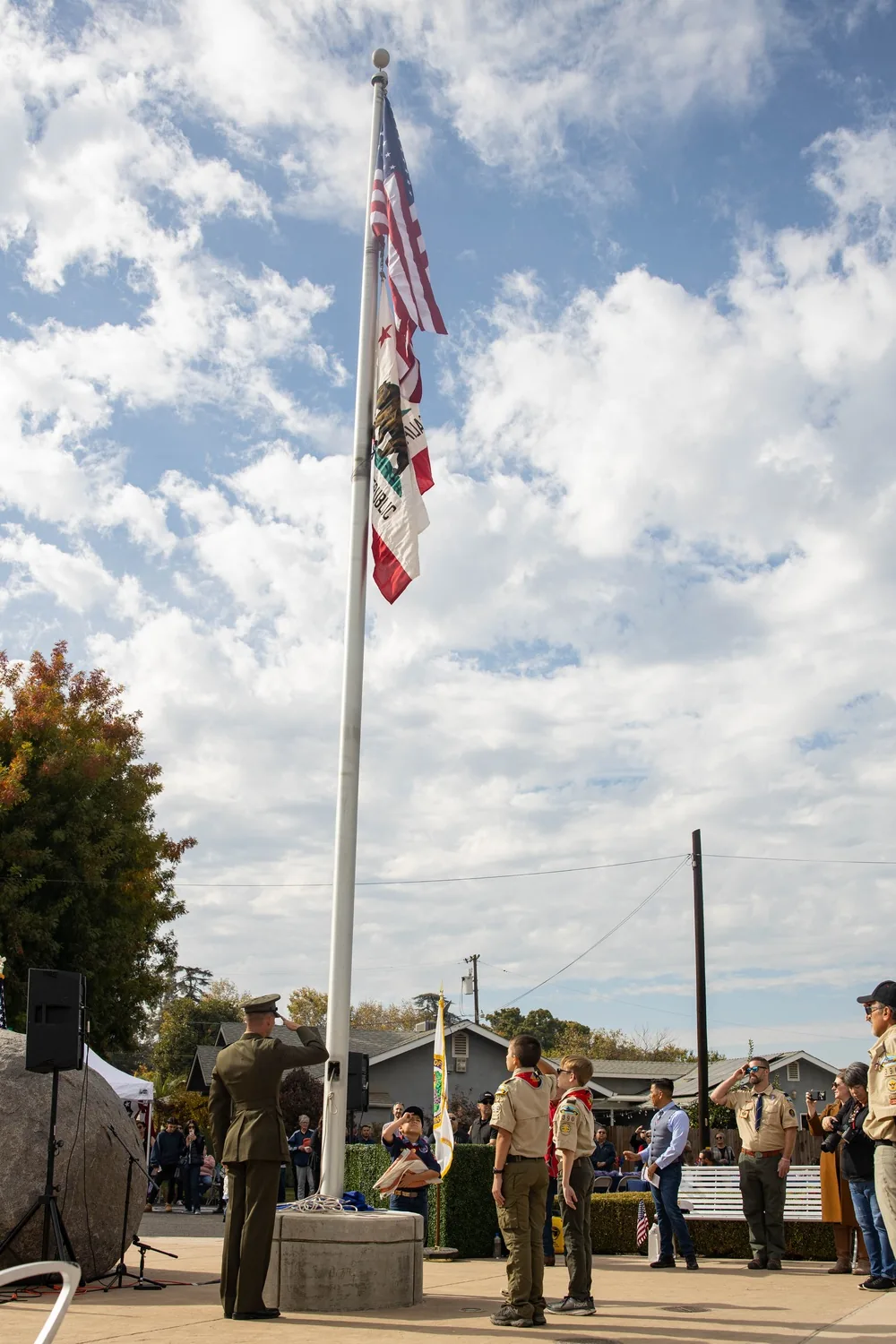
When other flags are present, raise the U.S. flag first and lower it last. Do not allow a state, municipal, or organizational flag to occupy a superior position. For a formal ceremony, assign one person to confirm status and another to check the physical setup; that small separation prevents a copied notice or jammed halyard from dictating the event.
Finally, do not confuse “retreat,” folding, or a solemn wreath-laying with a half-staff order. Those ceremonies can be appropriate on Veterans Day while the flag remains at full staff. Position is determined by the holiday rule and any applicable instruction, not by how formal or emotional the program feels.
What to Do with House-Mounted, Indoor, and Non-Lowerable Flags
Most house-mounted flag sets project from a building at an angle and cannot slide to a true halfway point. On an ordinary Veterans Day, that limitation creates no problem: place the union at the peak of the staff and display the flag at its normal full position. The same principle applies to an indoor flag on a fixed presentation staff. Veterans Day alone does not call for a mourning accessory.
If a separate half-staff instruction applies, begin by asking whether your organization has a written protocol. Government agencies, veterans groups, schools, and ceremonial units may specify how fixed flags are handled. Do not lower an angled pole in its wall bracket, tilt a floor stand, bunch the fabric, or improvise a “halfway” position that looks accidental.
Is a black mourning ribbon required?
No general U.S. Flag Code provision requires a private owner to add a black ribbon to a non-lowerable flag. A black ribbon or crepe streamer is a recognized mourning custom in some American protocol guidance. The American Legion describes a ribbon at the top as an acceptable alternative for flags that cannot be lowered. The State Department uses black crepe in a more specific institutional context when a presidential declaration provides for draping.
Those examples support a cautious choice, not a universal mandate. If your facility authorizes a mourning streamer, attach it at the staff or below the finial as that protocol directs; do not write on, pin through, or otherwise alter the flag itself. Avoid copying precise ribbon dimensions from a military, diplomatic, or vendor document unless that standard governs your display.
For a flag hung flat on a wall or in a window, keep the union uppermost and to the flag’s own right—the observer’s left. A handheld parade flag, desk flag, grave marker flag, or casket flag is not made “half-staff” by lowering the person carrying or holding it. Follow the ceremony’s specific protocol and preserve the flag’s dignity.
If the display can genuinely move on a vertical staff, use the normal half-staff sequence rather than adding a ribbon. The flag position guide can help with a workable halfway point. If it cannot move, full physical lowering is impossible; a policy-approved mourning streamer is an optional symbolic alternative when an actual mourning instruction—not Veterans Day by itself—is in effect.
Veterans Day Flag Questions: A Final Checklist
Is Veterans Day a national half-staff day?
No. Veterans Day is a named day for displaying the U.S. flag, but it has no automatic half-staff period. In the absence of another applicable instruction, fly the flag at full staff on November 11.
What if a governor orders flags lowered on November 11?
Read the governor’s actual notice. State facilities should follow the directive distributed through their official channels. Private participation may be invited rather than required, depending on the notice and state law. Confirm the covered locations, flags, start time, and end time instead of assuming that every pole in the United States has the same status.
Does a local Veterans Day ceremony change the flag position?
No. A parade, wreath-laying, moment of silence, or cemetery program can be solemn without creating a half-staff order. The event should use full staff unless an applicable instruction or controlling facility policy says otherwise. A community may hold its event on a nearby weekend, but VA confirms that the official holiday remains November 11.
Should I say half-staff or half-mast?
For a U.S. flag on land, half-staff is the clearest term and the one used in the U.S. Flag Code. “Half-mast” is widely understood and commonly associated with ships or naval usage. The vocabulary does not change the central Veterans Day rule.
What time should I raise and lower the flag?
The customary outdoor display runs from sunrise to sunset. Raise the flag briskly and lower it ceremoniously. It may remain up after sunset when properly illuminated. If an overlapping order states different operational times, follow the instruction that governs your location.
How do I check the Veterans Day 2026 flag position?
Do not rely on an old search result or an undated image. Review the live flag status and the half-staff order calendar, then confirm your state or facility notice. This article establishes the default; a timely official order establishes the exception.
Two-day display checklist
- On November 10: verify national and state status, identify the person responsible for the pole, inspect the flag and halyard, and note any instruction’s exact end time.
- On November 11: check once more for a late notice, use full staff if no applicable lowering instruction exists, and illuminate the flag if it will remain displayed after dark.
- If half-staff applies: raise to the peak first, lower to the correct position, return to the peak before final lowering, and use the position tool if the pole’s midpoint is unclear.
- After the period ends: restore full staff promptly and remove any optional mourning streamer used under your organization’s protocol.
The respectful choice is not the most solemn-looking position; it is the position supported by the holiday rule and the instruction that actually applies. On Veterans Day, that means full staff by default, careful verification when an exception is reported, and a display that keeps the focus on gratitude for service.
Comments
Comments are reviewed before publication.
Sign in with Google to join the discussion.
Loading comments…