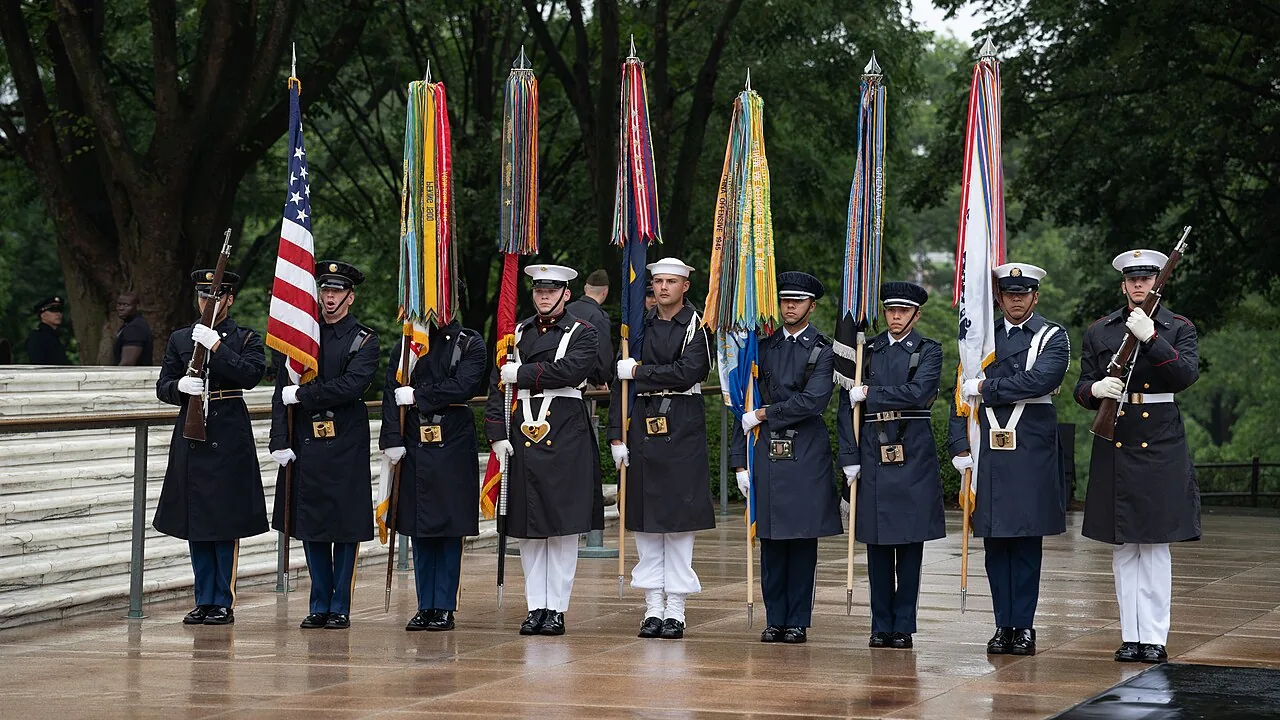
In a typical straight domestic lineup, the order of flags from left to right as the audience sees them begins with the U.S. flag at the far left, followed by state, local, and organization flags under the protocol that governs the event. That is the American flag’s “own right,” or position of honor. But it is not a universal layout: a cluster of staffs puts the U.S. flag at the center and highest point, while flags of other sovereign nations must fly on separate staffs at equal height and be approximately equal in size. Before arranging any display, identify whose viewpoint controls, which kinds of flags are present, and whether the setup is a row, cluster, wall, single halyard, or stage. This guide separates rules stated in the U.S. Flag Code from agency protocol and common practice so you can choose the correct arrangement for the actual setting.
Quick Answer: What Is the Order of Flags from Left to Right?
For a straight row of separate staffs in an ordinary U.S. domestic display, start at the observer’s left with the American flag. A practical sequence is then the relevant state flag, a county or city flag, and an organization or company flag. That example follows the Flag Code’s position-of-honor rule and the general principle that government flags precede private organizational flags. It is not a complete statutory ranking for every specialized flag.
| Display you are facing | Order or position | Important limit |
|---|---|---|
| U.S., state, city, and organization flags in a straight row | Viewer’s left to right: U.S., state, city, organization | Check the facility’s protocol for any special official flags. |
| U.S. flag with state or organization flags in a cluster | U.S. flag at the center and highest point | This is a group rule, not a leftmost-position rule. |
| U.S. and another nation’s flag | U.S. in the place of honor for a U.S.-hosted bilateral display | Use separate staffs of equal height and flags of approximately equal size. |
| U.S., foreign national, and state flags | U.S., foreign national, then state under general federal protocol | Event or diplomatic protocol may prescribe the exact sovereign order. |
Do not arrange the poles until you classify the display. Ask whether the flags represent sovereign countries, governments, military organizations, or private groups, then decide whether the hardware forms a row, a cluster, or one shared halyard. Those two choices determine which rule applies and prevent the common mistake of using one left-to-right formula everywhere.
Why the U.S. Flag’s “Own Right” Is the Viewer’s Left
Flag instructions often describe a position from the flag’s perspective, as though it were a person facing the audience. Its own right is therefore opposite your right when you stand in front of the display. The Flag Code removes the ambiguity in its wall rule: the union belongs at the flag’s own right, “that is, to the observer’s left.” That same translation makes a straight row easier to set up.
Use the audience view for a straight lineup
Stand where the public will normally view the flags. Point to your left; that is the American flag’s own right and the usual honor position in a level domestic row. Place the U.S. flag there before arranging subordinate government or organization flags toward your right. Then walk behind the display and confirm that the American flag is on the displayer’s right. Checking both views prevents a crew working backstage from accidentally reversing the finished lineup.
Use speaker-right on a platform
For a staffed flag in a church or public auditorium, federal text describes the honor position as the speaker’s right while the speaker faces the audience. The audience sees that same spot on its left. Another staffed flag belongs on the speaker’s left, which is the audience’s right. Use those paired phrases in setup notes—“speaker-right/audience-left”—rather than writing only “put it on the right.”
This perspective rule does not turn every display into a left-to-right row. If several staffs form a fan or cluster, the American flag moves to the center and highest point. First identify the shape of the display; only then apply the correct viewpoint.
U.S., State, Local and Organization Flags on Separate Poles
For adjacent poles carrying domestic, non-sovereign flags, place the U.S. flag in the position of honor and do not put a state, city, locality, or society flag above it or to its own right. Section 7(f) also says the American flag should be hoisted first and lowered last. That timing preserves precedence during setup and removal, not just while the completed row is on view.
A useful three-pole example, read from the observer’s left, is U.S. flag, state flag, then company flag. With four poles, a common civic sequence is U.S., state, city or county, then organization. These are practical domestic examples, not a federal master list covering every possible banner. The Flag Code names broad categories, while agencies and institutions may publish more detailed precedence rules for presidential, military, departmental, tribal, POW/MIA, emergency-service, or school flags.
Pole height matters as well as left-to-right order. A subordinate domestic flag should not gain visual precedence because its staff is taller or its mounting point is higher. Some facilities make the rule even more specific: VA design guidance, for example, requires the state and VA flags at a VA site to fly lower than the U.S. flag. That is a facility standard, not a reason to assume every three-pole property must have the same construction.
Before installation, obtain the current protocol from the organization that controls the property. Record the public viewing direction, pole heights, flag types, raising sequence, and who approves changes. For the difference between federal guidance and rules that may apply at a particular property, read the U.S. Flag Code explainer. If the issue is a single bracket or residential pole rather than precedence among several flags, use the separate guide to American flag display rules at home.
Keep foreign national flags out of this shortcut. A flag representing another sovereign country is not a subordinate state or company flag and must follow the equal-height international rule explained below.
One Pole, Grouped Staffs and Crossed Flags Follow Different Rules
The hardware changes the position of honor. A straight row makes left-to-right order visible, but a shared halyard creates a vertical order, a fan creates a center, and crossed staffs overlap. Section 7 addresses each configuration separately.
Flags on one halyard
When the U.S. flag shares a halyard with a state, city, locality, or organization flag, the American flag belongs at the peak, above the other flag. Confirm that the lower flag has enough clearance and will not interfere with clips or movement. Do not use this arrangement for another country’s national flag; sovereign flags belong on separate staffs of the same height. The Flag Code also contains a very narrow exception for a church pennant during Navy chaplain services at sea, not a general exception for religious flags on land.
A fan or cluster of staffs
When several state, local, or society flags are grouped from staffs, put the U.S. flag at the center and highest point. This is the clearest reason “American flag always on the far left” is incomplete. Check the completed fan from the normal public view: the U.S. flag should read as the visual center, while the surrounding staffs remain subordinate and do not obscure it.
Crossed staffs against a wall
With two crossed staffs, place the U.S. flag on its own right, which appears on the viewer’s left. Its staff should cross in front of the other staff. Both details matter: the correct side alone does not complete the display if the American flag’s staff disappears behind the other one.
A half-staff order adds a vertical-position question but does not erase precedence. Determine which flags the active instruction covers, whether the halyard can move, and how the whole display will avoid making another flag appear superior. The half-staff flag position calculator explains movable, fixed, single-pole, and multiple-pole setups. Follow a marked institutional position or controlling facility instruction when it is more specific.
How to Display the U.S. Flag with Foreign National Flags
Flags of sovereign nations are equals in a peacetime display. Section 7(g) says the national flags must fly from separate staffs of the same height, and the flags should be approximately equal in size. Do not elevate the American flag above a guest nation, place both on one halyard, or use a noticeably larger U.S. flag. The domestic “U.S. higher than the state or company flag” shortcut does not apply here.
For a bilateral display in the United States, State Department protocol places the U.S. flag in the honor position at the viewer’s left and the guest country’s flag at the viewer’s right, with matching height and size. For a group of sovereign flags on U.S. Government premises, the Department’s Foreign Affairs Manual places the U.S. flag first—left as the viewer faces the lineup—and arranges the other sovereign flags alphabetically. That alphabetical sequence is protocol guidance; Section 7(g) itself states the separate-staff, height, size, and equality principles rather than spelling out a complete alphabetic lineup.
The host matters. The same State Department manual notes that away from U.S. Government premises, a receiving state may receive the honor position. International conferences, embassies, visiting delegations, tribal governments, and co-hosted events can also have a protocol office or agreed event plan. Ask that office to approve the lineup and the country names used for alphabetization before printing a floor plan.
If a state, city, military, or company flag is also present, do not insert it between sovereign national flags without checking the controlling order. General federal guidance places foreign national flags ahead of state and territorial flags, with organizational flags later. A practical U.S.-hosted row might therefore read U.S., guest nation, state, then organization—but a diplomatic plan controls over a generic example.
Finally, do not automatically lower another nation’s flag because a U.S. half-staff order is active. Confirm the foreign government’s protocol and the event authority’s instruction; equal sovereign treatment may call for a coordinated decision or temporary removal instead.
How to Display Multiple Flags on a Wall
“On a wall” can describe three different displays: flags hanging flat, flags projecting from individual staffs near the wall, or two flags on crossed staffs. Identify which one you have before using a placement rule.
For a U.S. flag displayed flat, horizontally or vertically, keep the union uppermost and at the flag’s own right—the upper left as an observer faces it. Rotating a horizontal flag clockwise for a vertical display puts the union on the wrong side; reorient it so the stars remain at the viewer’s upper left. In a window, use the viewpoint of an observer outside in the street.
For two flags on crossed staffs, place the American flag on the observer’s left and bring its staff in front of the other staff at the crossing. If separate staffs project from brackets instead, treat them as staffed flags and confirm their relative height and honor position. Do not pin fabric into a crossed-staff shape or use the flag as drapery merely to imitate the arrangement.
A wall containing several flat flags needs a documented layout. Begin with the event’s normal viewing side. Preserve the American flag’s correct union orientation, give it the applicable domestic honor position, and keep flags of sovereign nations visually equal in size and prominence. Then apply the controlling order for state, local, agency, military, or organization flags. The Flag Code supplies the American flag’s wall orientation and several precedence principles, but it does not publish a universal grid for every possible set of flat banners.
Mock up the arrangement with labeled paper rectangles before installing hardware. Check sightlines from the doorway and main seating area, leave enough space for each flag to be recognizable, and verify that doors, lights, screens, and curtains will not cover the union or change which flag appears highest. If the wall is behind a speaker, also apply the platform rule: a flat U.S. flag belongs above and behind the speaker. Staffed stage flags use a different speaker-right layout.
U.S. and State Flag Placement on a Stage or Beside a Podium
Section 7(k) gives two different platform instructions. A U.S. flag displayed flat belongs above and behind the speaker. A U.S. flag on a staff in a church or public auditorium belongs at the speaker’s right as the speaker faces the audience—therefore the audience’s left. Another staffed flag belongs at the speaker’s left, or audience’s right.

Two staffed flags beside a podium
Stand in the audience and face the lectern. Mark the audience-left spot for the U.S. flag and the audience-right spot for the state or organization flag. Now stand at the lectern: the American flag should be on your right, the other flag on your left. Use stable bases, keep fabric clear of microphones and screens, and confirm that neither staff blocks an exit or accessibility route.
A flat flag behind the speaker
Mount the U.S. flag above and behind the speaker, with the union at the viewer’s upper left. Do not drape it across the lectern, use it as a table covering, or let it become a low backdrop that the speaker obscures. A projection of flag imagery is not the same physical arrangement as displaying an actual flag, so do not rely on a screen to resolve the placement of staffed flags elsewhere on stage.
A larger ceremonial stage
Classify every flag before building the row. If the stage has U.S., state, city, and organization flags, preserve the American flag’s honor position and apply the event’s approved domestic precedence. If foreign sovereign flags appear, use separate equal-height staffs and the diplomatic lineup. If the staffs form a true cluster instead of a row, the U.S. flag belongs at the center and highest point for the state, local, and organization group.
Run a sightline check from the center and both sides of the audience. Then photograph the empty stage, label speaker-right and audience-left on the floor plan, and have the venue or protocol lead approve it. Do not copy a previous event photo without checking the current flag list. Military, diplomatic, faith, school, or government facilities may have a more specific manual, and a visiting delegation can change the required sequence.
What Order Should Multiple State Flags Use?
When several state flags appear after the U.S. flag, VA guidance recognizes two workable methods. The normal method is order of admission to the Union; the alternative is alphabetical order by the states’ English names. Admission order emphasizes historical sequence, while alphabetical order is easier for an audience to predict and for event staff to audit. Neither choice changes the U.S. flag’s preceding position.
Select one method for the entire state group and document it on the event plan. Do not alphabetize one side of a stage while using admission order on the other, and do not let setup crews improvise based on which cases arrive first. Give every pole a numbered floor mark, label each case, and compare the finished row against the approved list from the normal viewing side.
Territorial flags come after state flags in the VA protocol. They may be ordered by when the territory was recognized by the United States or alphabetically. If your institution has an established ceremony manual, use its method consistently instead of switching for visual convenience.
A host may want the host-state flag beside the national flag and the remaining states in a historical or alphabetical sequence. Do not present that choice as a universal federal requirement. Ask the controlling protocol office whether it permits host-state precedence, a second host flag, or a symmetric arrangement. Record the decision so future planners understand why the sequence departs from the standard list.
Keep military service flags out of the state sequence. They follow their own current departmental order of precedence, which can change as services and governing directives change. A mixed display should have one approved master lineup that identifies where the state block ends and the military or organizational block begins.
A Five-Minute Flag Placement Checklist
- Name the controlling authority. Identify the property owner, event host, agency, school, military command, diplomatic protocol office, or venue lead that can approve the arrangement.
- Classify every flag. Mark each as U.S., foreign sovereign, state or territory, local government, military or agency, POW/MIA, or private organization. Do not infer rank from color, size, or familiarity.
- Define the public viewpoint and hardware. Stand where the main audience will be. Decide whether the display is a row, cluster, crossed pair, wall, stage, or shared halyard.
- Apply the matching rule. Use viewer-left for a typical domestic row, center/highest for a group, U.S.-above for an allowed non-sovereign shared halyard, and equal separate staffs for foreign nations.
- Verify today’s vertical position. Check today’s U.S. half-staff status and the original government notice before the event. If lowering applies, use the flag position calculator for the physical setup, then follow any more specific facility marking.
- Inspect and document. Confirm heights, sizes, union orientation, staff stability, clearances, lighting if displayed after dark, and the hoisting order. Photograph the final empty setup and save the approved lineup.
The most common errors are easy to spot once this sequence is followed: reading “right” from the viewer’s perspective, raising the U.S. flag above a foreign sovereign flag, treating a center cluster as a straight row, placing a state or company flag in the U.S. honor position, or reusing a military list that no longer matches the controlling directive.
If two credible instructions conflict, stop setup and ask the authority responsible for the venue or ceremony. Do not solve a diplomatic, military, or agency conflict by choosing the rule that looks more patriotic. Record which source and date controlled the decision so the next crew can audit it.
Precedence answers “which flag receives which place.” Current status answers whether an applicable flag should be at full-staff or half-staff today. Hardware and safety answer whether the plan can be carried out. Treat those as three separate checks, then combine them in the final approved layout.
Order of Flags Left to Right FAQ
Does the U.S. flag always go on the far left?
No. It normally appears at the viewer’s left in a straight domestic row, but a grouped fan of state, local, or organization staffs puts it at the center and highest point. A single halyard puts it vertically above eligible subordinate flags. The hardware and flag types determine the rule.
Is the order U.S. flag, state flag, then company flag?
Yes, that is a sound viewer-left-to-right sequence for an ordinary three-pole domestic display. Keep the U.S. flag in the honor position and do not put the state or company flag above it. Check property policy before adding agency, military, POW/MIA, tribal, or other special flags, because they may require a more detailed lineup.
Can a state flag be the same height as the U.S. flag?
On adjacent staffs, the Flag Code says a state flag may not be above the U.S. flag or to its own right; it does not require every adjacent state staff to be shorter. Equal-height adjacent poles can therefore preserve the U.S. honor position through placement and raising order. A facility standard may require the state pole or flag to be lower, so check the controlling manual.
Where do foreign flags go?
Another sovereign nation’s flag goes on a separate staff of the same height, and the flags should be approximately equal in size. State Department bilateral guidance puts the U.S. flag at viewer-left in the United States. In a multinational or receiving-state event, use the host’s approved diplomatic order; do not raise one country’s flag above another in peacetime.
Which side is the U.S. flag on a stage?
A staffed U.S. flag in a church or public auditorium goes at the speaker’s right as the speaker faces the audience, which is the audience’s left. Another staffed flag goes at speaker-left/audience-right. If the U.S. flag is displayed flat on the platform instead, it belongs above and behind the speaker with the union at the audience’s upper left.
The safest summary is simple: identify the viewer, classify the flags, identify the hardware, and then apply the matching rule. A memorized left-to-right sequence is useful only after those four questions are answered.
Comments
Comments are reviewed before publication.
Sign in with Google to join the discussion.
Loading comments…