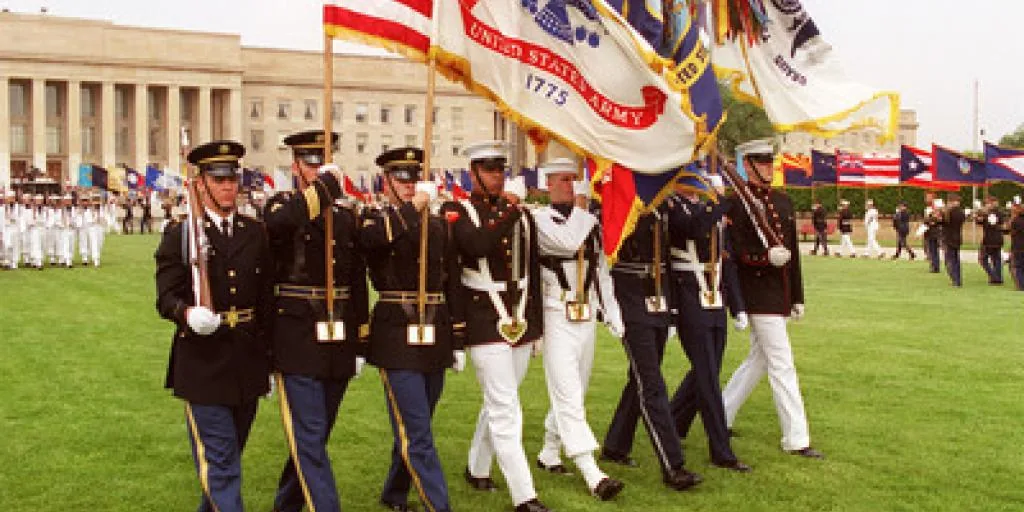
For an ordinary 2026 stationary display that includes POW/MIA, the common left-to-right order as an observer faces it is United States, POW/MIA, Army, Marine Corps, Navy, Air Force, Space Force, and Coast Guard. VA guidance describes the POW/MIA flag immediately below or adjacent to the U.S. flag as second in precedence; federal law does not assign that slot universally to every event. Official color guards, military installations, veterans facilities, and event hosts may use a more specific protocol. Coast Guard precedence can also change when the service is formally operating as a service in the Navy. Before setting up a display, identify the setting, decide whose right and left govern, and obtain the host organization’s current instructions.
The Quick 2026 Military Flag Order From Left to Right
For a straight row of stationary flags, read the sequence from the viewpoint of a person standing in front of the display. The ordinary current order is:
| Viewer’s position | Flag | Why it is there |
|---|---|---|
| 1 — far left | United States | National flag in the position of honor |
| 2 — when included | POW/MIA | VA guidance generally places it adjacent to the U.S. flag as second in precedence |
| 3 | U.S. Army | First service flag in ordinary service precedence |
| 4 | U.S. Marine Corps | Follows Army and precedes Navy |
| 5 | U.S. Navy | Third service flag |
| 6 | U.S. Air Force | Fourth service flag |
| 7 | U.S. Space Force | Included in the current six-service sequence |
| 8 | U.S. Coast Guard | Ordinary placement while operating in the Department of Homeland Security |
This is not an old five-branch chart. A 2022 VA National Cemetery Administration notice expressly includes Space Force and gives the service order as Army, Marine Corps, Navy, Air Force, Space Force, and Coast Guard. In the national-cemetery display governed by that notice, those service flags are the same size and height and each uses its own fixed pole. Those extra details belong to that facility policy; they do not automatically govern every school, home, parade, or veterans hall.
Protocol describes the place of honor as the U.S. flag’s own right. In a simple row viewed from the front, that normally appears on the observer’s left. Do not memorize “left” without the viewpoint: a speaker’s platform and a moving color guard use more specific wording. The federal baseline is 4 U.S.C. § 7, explained in more depth in our U.S. Flag Code guide. The table’s POW/MIA row follows VA guidance that generally gives it the adjacent second position; § 902 does not add it as a seventh Armed Forces service or dictate every ceremony’s lineup.
What Rules Actually Control Military Flag Precedence?
No single paragraph of the U.S. Flag Code contains the entire military-and-POW/MIA lineup. The correct setup comes from several authorities, each answering a different question. Treating one source as though it answers all of them is why otherwise polished displays can still be wrong.
- Start with 4 U.S.C. § 7. It protects the national flag’s position of honor and provides rules for processions, crossed staffs, adjacent poles, walls, and speaker’s platforms.
- Use the responsible military or agency protocol for service colors. DoD Directive 1005.8 is titled “Order of Precedence of Members of Armed Forces of the United States When in Formations.” A historical federal color-guard regulation, 32 CFR § 238.11 in the 2002 annual edition, directed DoD components to use that table for a joint color guard. That shows how formation precedence informed flag-bearing order, but the 1977 directive is not a newly written 2026 flag code.
- Use 36 U.S.C. § 902 for POW/MIA display duties. It designates the flag and names federal locations and display days. It does not rank the POW/MIA flag among the six Armed Forces flags in every conceivable arrangement.
- Follow the host’s current written instruction. A base protocol office, national cemetery, VA medical center, honor guard, school district, or veterans organization may specify the exact stands, bearers, sequence, and ceremony movements within its authority.
The date on a source matters. DoD Directive 1005.8 was issued on October 31, 1977, decades before the Space Force was established in 2019. It therefore cannot literally contain “Space Force” in its original table. Current official publications that add Space Force must be read alongside the older precedence framework. Likewise, an archived regulation can explain historical application without proving that its wording is the current CFR.
For a private hall or home display with no controlling manual, the ordinary table above is a careful protocol default. It is not a claim that federal criminal law assigns every stand. For residential mounting, lighting, weather, and care questions outside military ceremonies, use the separate American flag display rules at home guide.
Where Space Force and Coast Guard Fit in 2026
Space Force belongs after Air Force
The ordinary current service sequence places Space Force after Air Force and before Coast Guard. Space Force was established on December 20, 2019, so a five-service chart or a 1977 precedence table is incomplete for a 2026 display. Department of the Air Force drill guidance now expressly addresses ceremonies in which U.S., Air Force, or Space Force flags are carried. VA’s dated 2022 national-cemetery notice also integrated Space Force between Air Force and Coast Guard. These newer official materials supply what the older directive could not have named.
Coast Guard has a conditional Navy-service rule
In the ordinary lineup, Coast Guard follows Space Force because the Coast Guard is a service in the Department of Homeland Security. The exception is narrower than the phrase “during wartime” suggests. Under 14 U.S.C. § 103, Coast Guard operates as a service in the Navy upon a declaration of war if Congress so directs in that declaration, or when the President directs. It remains there until the President transfers it back by executive order.
The 1977 precedence directive says that, during a period when Coast Guard operates as part of the Navy, Coast Guard takes precedence next after Navy. But that table predates Space Force. Therefore, an organizer handling a real official ceremony during a confirmed transfer should obtain a current implementing order from the responsible protocol office. Do not create a new seven-flag order by combining a 1977 exception with a 2019 service on your own. A deployment, combat mission, emergency, or news description of “war” is not proof that the statutory transfer occurred.
Finally, make sure you have the right Coast Guard flag. The Coast Guard’s official explanation distinguishes the ceremonial standard—the white service flag used in parades and ceremonies—from the striped Coast Guard ensign, which represents law-enforcement authority and is restricted to official use. A multi-service floor display normally calls for the service standard, not the cutter ensign.
Where Does the POW/MIA Flag Go With Service Flags?
The POW/MIA flag is a national memorial symbol, not a seventh Armed Forces service flag. 36 U.S.C. § 902 designates it and requires public-visible display at named federal locations. Those include the Capitol, White House, three national war memorials, national cemeteries, designated major military installations, VA medical centers, post offices, and specified federal offices. Since the National POW/MIA Flag Act amendment enacted on November 7, 2019, the statutory display days at those sites are all days on which the U.S. flag is displayed. The law answers when and where; it does not assign one left-to-right slot for every event.
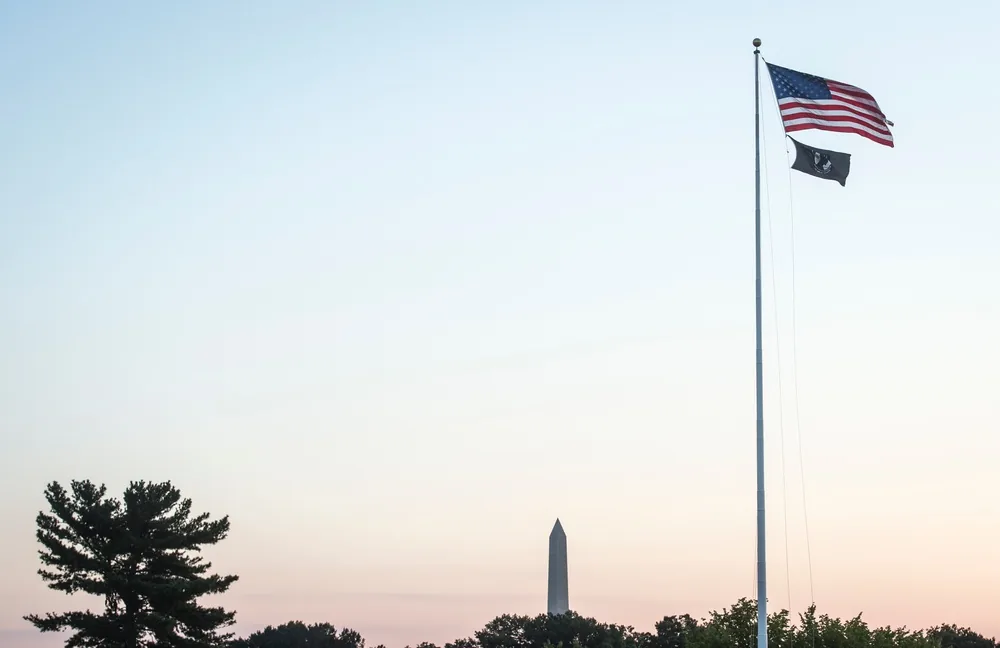
Use the configuration, not one slogan
- One halyard: VA guidance places the POW/MIA flag directly below the U.S. flag and makes it no larger than the national flag. The U.S. flag remains at the peak.
- Separate floor stands or adjacent poles: keep the U.S. flag in its position of honor, place POW/MIA adjacent as second under VA guidance, and then arrange the service flags in their six-service order. Ask the host before treating that general guidance as its controlling rule.
- Official color guard: use the color guard’s current drill and protocol instructions. Section 902 does not decide how many bearers participate or where a memorial color enters a military formation.
- Federal or VA facility: follow the facility instruction. A dated 2022 National Cemetery Administration notice, for example, preferred a separate fixed pole when available and otherwise placed POW/MIA subordinate to the U.S. flag on the main pole.
Congress also specified that the POW/MIA law must not be read to require the government to acquire or erect a new flagpole. That detail helps explain why legitimate federal arrangements can look different from one property to another. The same duty may be satisfied on a separate pole at one site and below the U.S. flag at another.
For a home, business, school, or local club, § 902’s list does not create a general federal command to display POW/MIA. If you choose to honor prisoners and missing personnel, preserve the U.S. flag’s superior position, use a respectful visible location, and document the host’s chosen order so setup crews do not rearrange it inconsistently.
How the Order Changes by Stage, Wall, Parade, and Outdoor Pole
The straight-row table works only after the display’s orientation is fixed. Use the rule for the actual configuration:
| Setting | U.S. flag position | How to handle the other flags |
|---|---|---|
| Speaker’s platform | Speaker’s right as the speaker faces the audience; normally audience left | A second flag goes at the speaker’s left. For a multi-flag bank, follow the host protocol for expanding the arrangement. |
| Flat on a wall | Union uppermost and to the flag’s own right, which is observer left | Do not reverse the union because the audience is facing the flag. |
| Crossed staffs | U.S. flag on its own right, with its staff in front | The other flag’s staff crosses behind. |
| Procession or color guard | Marching right, or in front of the center of a line | Use the responsible drill manual for bearer order and movements. |
| Adjacent outdoor staffs | Position of honor; hoisted first and lowered last where 4 U.S.C. § 7(f) applies | Sequence service flags by the facility’s current protocol and keep the national flag from being subordinated. |
| Same halyard | At the peak | An authorized organizational or POW/MIA flag remains below; do not crowd flags together. |
The governing language is in 4 U.S.C. § 7. Its speaker rule is especially easy to reverse: “speaker’s right” means the right-hand side of the person facing the audience, so the U.S. flag appears on the audience’s left. If the flag is displayed flat behind the speaker instead of on a staff, it should be above and behind the speaker with the union correctly oriented.
A moving color guard is not a row of floor stands. Department of the Air Force drill guidance, for example, places an Air Force or Space Force flag on the marching left of the U.S. flag and gives the senior flagbearer command responsibilities. A joint guard may have additional bearers and service-specific procedures. Event volunteers should not invent turns, countermarches, or a reversed lineup from an audience-view chart; ask the trained honor guard how it will enter, face, post, and retire the colors.
Do not apply military service precedence to foreign sovereign flags. Section 7 requires flags of two or more nations to use separate staffs of the same height and to be approximately equal in size, reflecting equal national dignity in peacetime. If a display combines foreign nations, states, services, and organizational flags, professional protocol review is safer than forcing every category into one left-to-right formula.
What Happens When the U.S. Flag Is at Half-Staff?
Half-staff changes a flag’s vertical position; it does not rewrite the service order. The U.S. flag retains national precedence even when it is below the peak. Keep the same left-to-right or formation order unless the governing instruction changes the ceremony for another reason.
Under 4 U.S.C. § 7(m), raise the U.S. flag briskly to the peak for an instant and then lower it ceremoniously to half-staff. Before lowering it for the day, first return it to the peak. The statute defines half-staff as one-half the distance between the top and bottom of the staff. Memorial Day is a special scheduled case: the U.S. flag is at half-staff until noon and then raised to the top for the rest of the day.
Do not assume that an instruction naming the U.S. flag automatically lowers every service, state, foreign, agency, or POW/MIA flag on a separate pole. Read the actual order and the responsible organization’s rules. Army heraldry guidance, for example, says flags carried by troops are not placed in mourning unless ordered and describes a black-crepe treatment when mourning is ordered. It also recognizes a directed U.S. half-staff display at overseas military sites even when another nation’s flag remains at full staff. Those examples show why one blanket rule for all accompanying flags would be misleading.
A same-halyard arrangement needs special care. The U.S. flag must remain above the subordinate flag, including POW/MIA, with enough physical separation for both to fly freely. Lowering the set can create an awkward or crowded position on a short pole. If the instruction, hardware, or safe spacing is unclear, use separate staffs if authorized or ask the facility protocol office rather than improvising.
Verify the current nationwide or state instruction through the relevant government source. Half Staff Today’s current U.S. flag status can help you find the active reason and source, while the flag position calculator helps estimate the midpoint on a pole. Those tools answer “how high today”; the precedence table answers “which flag comes first.”
A Setup Checklist and Common Mistakes to Avoid
Run this checklist before an audience arrives:
- Inventory every flag. Separate national, state, Armed Forces service, agency, unit, and memorial flags. Confirm that a Coast Guard flag is the ceremonial standard, not the restricted law-enforcement ensign.
- Name the setting. Record whether the display uses a stage, wall, floor stands, adjacent outdoor poles, one halyard, or a moving color guard.
- Identify the authority. Check the base, service, agency, cemetery, school, venue, or veterans organization’s current written instruction and its date.
- Place the U.S. flag first. Determine its own right, speaker’s right, or marching right before arranging anything else.
- Place POW/MIA by the applicable rule. Follow the host instruction; without one, current VA guidance generally places it adjacent to the U.S. flag as second in precedence.
- Sequence service flags. After that memorial position, use Army, Marine Corps, Navy, Air Force, Space Force, and Coast Guard for the ordinary current display; do not copy a pre-2019 chart.
- Inspect and rehearse. Check flag identity, size, height, condition, finials, clearance, lighting, halyards, entry route, commands, and safe spacing.
Common errors include omitting Space Force; moving Coast Guard because someone casually called an operation “wartime”; putting POW/MIA into a service slot as though it were another branch; reversing speaker and audience viewpoints; placing an organizational flag above the U.S. flag; and using a stationary audience-view row for a moving color guard. Another subtle error is mixing unlike rule sets—for example, applying sovereign-equality rules for foreign national flags to military service colors.
Save the source or policy used with the event plan. A dated diagram lets the next crew reproduce the setup and makes later updates visible. Policies do change: a February 12, 2025 VA facility flag memorandum lists authorized flag categories and specifically preserves separate National Cemetery Administration guidance. That is a useful reminder that even one department can have multiple instructions for different spaces.
When two credible instructions conflict, stop and ask the responsible protocol office, honor guard leader, cemetery director, or event host. Do not settle an official ceremony by polling social media or choosing the diagram that looks most symmetrical.
Frequently Asked Questions
Is the order Army, Marine Corps, Navy, Air Force, Space Force, Coast Guard?
Yes. That is the ordinary current order of the six Armed Forces service flags. If the U.S. flag is present, it takes the national position of honor before the service colors. Coast Guard has a conditional exception only when it is formally operating as a service in the Navy; obtain current protocol for that official situation.
Does the POW/MIA flag go before or after military branch flags?
For a simple stationary display with no governing instruction, current VA guidance generally puts POW/MIA immediately after the U.S. flag and before the service flags. A single halyard places it directly below the U.S. flag. This is not a universal placement command in 36 U.S.C. § 902, so an official color guard or federal facility still follows its own current instruction.
Why does the Marine Corps flag come before the Navy flag?
Marine Corps before Navy is the established service precedence. The historical reason is more complicated than comparing today’s official birthdays. A Defense Logistics Agency review notes competing explanations involving institutional lineage, periods of disbandment, flag adoption, and older naval parade practice. The reliable action is to follow the established order, not to resolve the historical debate at setup time.
Does Space Force come before Coast Guard?
Yes, in the ordinary current display. Space Force follows Air Force, and Coast Guard follows Space Force while Coast Guard operates in the Department of Homeland Security. Old charts that jump directly from Air Force to Coast Guard are out of date.
What side is the position of honor?
It is the U.S. flag’s own right. In a straight stationary row facing the observer, that usually appears on the observer’s left. On a stage, use the speaker’s right as the speaker faces the audience. In a procession, use marching right or the front-center position specified by 4 U.S.C. § 7.
Is the POW/MIA flag required at a private home or business?
Not generally under 36 U.S.C. § 902. That section names specific federal locations and requires display there on days the U.S. flag is displayed. A homeowner or private business may display POW/MIA voluntarily and respectfully, subject to any applicable property or organizational rules.
Comments
Comments are reviewed before publication.
Sign in with Google to join the discussion.
Loading comments…