July 27 is not an automatic, permanent nationwide half-staff date under the current text of 36 U.S.C. §127. The statute created a National Korean War Veterans Armistice Day program and requested presidential half-staff proclamations only through 2003. A current President, governor, or authorized agency can still issue a separate instruction for July 27, so the operational answer depends on the order that applies to your flag and location.
This distinction is easy to miss. Commercial calendars and older articles often list Korean War Veterans Armistice Day beside continuing annual observances, while search results may quote a proclamation from 2003 or 2009 without its year. An historical document shows what happened on that date in that year; it does not automatically direct a flag owner decades later. For the current national and state picture, check today’s half-staff status and then read the linked official notice.
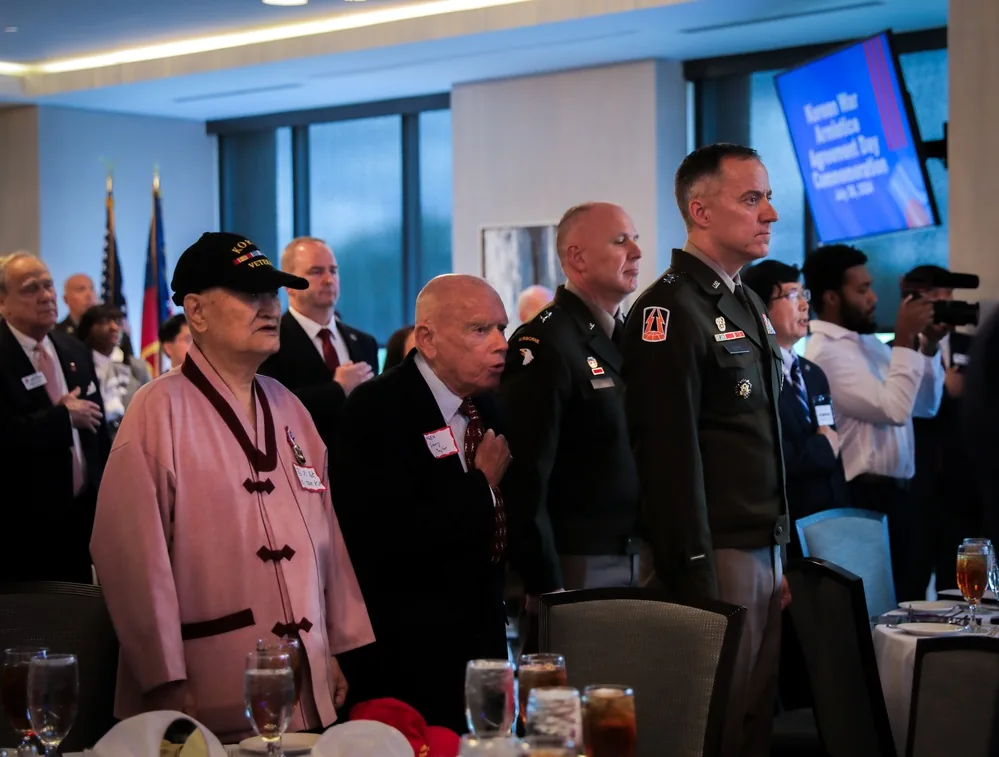
July 27 remains a meaningful day to honor those who served and died in the Korean War and to remember the 1953 armistice. Respectful remembrance does not require inventing a standing legal order. This guide explains the “until 2003” wording, why later proclamations differ, how to verify a valid instruction, and how to follow correct procedure if lowering is actually directed. Use the flag observance calendar for planning, but treat the current issuer’s document—not a copied date list—as the final operational source.
Are Flags Automatically at Half-Staff on July 27?
No. The date by itself does not activate a current nationwide half-staff requirement. Start with the flag owner and property, then look for a current document whose scope reaches that property. If no applicable order exists, full staff is the defensible position while the organization observes Korean War Veterans Armistice Day in another respectful way.
| Flag or property | What controls the decision | July 27 action |
|---|---|---|
| Federal building or installation | A current presidential direction or authorized department/agency instruction | Lower only if the current instruction covers the site and date; otherwise follow the facility’s official flag office. |
| State-controlled facility | The governor’s current order and the state’s flag protocol | Follow the stated scope and time. A state order can differ from the federal status. |
| County, city, school, or special district | Applicable state direction plus the local entity’s policy | Confirm whether “all state facilities” includes the entity; do not assume that it does. |
| Business, nonprofit, or private home | The owner’s policy and any invitation in an official notice | Participation is often invited rather than commanded. Verify the current reason before lowering. |
This framework also handles overlapping orders. Suppose a valid national mourning proclamation already requires half-staff through July 28. The flag remains lowered on July 27 because of that active proclamation, even though Korean War Veterans Armistice Day is not an automatic recurring reason. Record the controlling order and its end time; do not raise the flag merely because one commemorative date has ended.
Wording matters. “Ordered on all state facilities” identifies controlled property. “Invites citizens and businesses” describes voluntary participation. “Federal departments and agencies” does not silently expand to every storefront. If the notice is unclear, ask the organization responsible for the pole rather than copying the practice of a nearby building. Our guide to official half-staff alerts and source verification explains how to build that chain of confirmation.
What 36 U.S.C. §127 Actually Says About “Until 2003”
The limiting words are part of the law, not a footnote. Public Law 104-19, enacted in 1995, created the observance as part of the approach to the Korean War armistice’s 50th anniversary. Its first operative clause designated July 27 in each year through 2003. Its next clause authorized and requested annual presidential proclamations that would encourage appropriate ceremonies and urge federal bodies and interested participants to fly the flag at half-staff—again only through 2003.
When Congress reorganized the patriotic observances in Title 36, that substance became 36 U.S.C. §127. Subsection (a) retains the end date in the designation. Subsection (b) retains it in the requested flag-lowering language. Reading only the section heading, “National Korean War Veterans Armistice Day,” while skipping the operative sentences produces the mistaken idea that every future July 27 automatically requires half-staff.
Congress took a different step in 2009. Public Law 111-41 amended 4 U.S.C. §6(d), the Flag Code’s list of occasions on which the flag should especially be displayed, by adding National Korean War Veterans Armistice Day, July 27. That law encourages display of the flag; it does not use “half-staff,” does not amend §127’s end date, and does not create a permanent lowered-position command. A full-staff flag can therefore be an entirely appropriate July 27 commemoration when no current lowering order applies.
The wording differs from continuing recurring statutes. For example, the current Pearl Harbor provision uses December 7 “of each year” without a 2003 cutoff and requests a recurring half-staff proclamation. See the source-by-source explanation in our Pearl Harbor Remembrance Day flag protocol. The comparison is useful precisely because similar-looking calendar labels can rest on materially different operative text.
Why Past Proclamations and Online Calendars Conflict
Presidential records show that July 27 flag language has not been uniform. The variation is the strongest reason to open the document for the year in question instead of treating the title of the observance as an order.
- 2003: President George W. Bush’s proclamation identified July 27, 2003 as the observance and asked federal departments, agencies, and interested participants to fly half-staff that day. It matched the final year named in §127.
- 2009: President Barack Obama’s Proclamation 8399 separately asked for half-staff on July 27, 2009. Its authority clause and named date made it an action for 2009; it did not erase the statutory endpoint or promise the same wording forever.
- 2010: the next year’s proclamation encouraged Americans to “raise our flags high” in honor of veterans and did not request a lowered position. That contrast within two consecutive years disproves the idea that the 2009 text automatically carried forward.
- 2026: the White House published a presidential message honoring Korean War service and the armistice. The opened message contains no direction or request to lower flags.
Online calendars often flatten this history. A list may copy the 2003 rule, notice the 2009 proclamation, and then label July 27 “annual” without showing the source’s end date. A search snippet can make the problem worse by displaying the half-staff sentence while hiding the year at the beginning and end of the document. Even a government page that lists July 27 as a flag holiday may be listing occasions for display, not declaring the position for the current year.
Use a simple document test: confirm the issuer, document type, publication date, operative year, covered property, exact position, and end time. A historical proclamation is excellent evidence about historical practice. It is not a current work order. Likewise, a ceremonial message may deserve attention without containing any operational flag direction. The question is not merely “Did the President mention July 27?” but “Does the current document actually say to fly at half-staff, where, and for how long?”
How to Verify a July 27 Flag Order for Your Location
Check sources from the broadest relevant authority down to the organization that operates the pole. Do this again each year; a saved browser bookmark is useful, but a saved screenshot from last July is not current authority.
- Read the current White House record. Search Presidential Actions and proclamations, not just general news or remarks. Open the document and look for an operative sentence directing or requesting half-staff display.
- Check the current national/state status. Start with Half Staff Today’s live status, then follow the cited official source. A different nationwide mourning order may cover July 27 even when the armistice observance does not.
- Open your governor’s flag page. Confirm whether it says state facilities, state and local buildings, a named county, or another boundary. Note whether private participation is ordered, encouraged, or merely invited.
- Check the facility or agency notice. Military installations, federal agencies, universities, school systems, and municipalities may distribute instructions for property they control. Use the designated facilities, protocol, public-affairs, or executive office—not an employee’s repost.
- Record the complete instruction. Save issuer, publication date, reason, covered flags/property, start time, end time, and source URL. If the end depends on an interment or later notice, assign someone to watch for the update.
Do not infer a lower position from the word “observance.” The 2026 White House item, for example, is labeled a presidential message. Recognition language and historical tribute appear in it, but the opened text does not instruct flags to be lowered. Conversely, a governor’s page may use precise mandatory language for state buildings even when the national flag is otherwise at full staff.
For a multi-site organization, send one written instruction that quotes the controlling start/end fields and identifies affected locations. Require each site to acknowledge completion. This avoids a common error: one branch finds an old calendar, another follows the current governor, and a third leaves the flag lowered after the valid order expires. The official alert workflow gives practical subscription and escalation options.
Correct Half-Staff Procedure If an Order Applies
Once you have a valid instruction, copy its dates and times exactly. July 27 does not supply a default sunrise-to-sunset schedule by itself. If the controlling notice says sunrise to sunset, use local solar times for the pole’s location. If it says “immediately,” “until interment,” or gives clock times, those words control. Keep any longer overlapping order in effect after the July 27 observance ends.
- Inspect the pole, halyard, clips, and weather conditions. Do not risk a fall, electrical contact, or equipment failure to meet a ceremonial minute.
- Hoist the U.S. flag briskly to the peak. Even when beginning the day at half-staff, it goes to the top for an instant first.
- Lower it ceremoniously to the midpoint. The working position is approximately halfway between the top and bottom of the staff, not a small token drop below the finial.
- Keep companion flags subordinate. Follow the facility’s written policy for state, organizational, service, or POW/MIA flags. Never leave another flag visually above the half-staff U.S. flag.
- At the stated end, raise the U.S. flag to the peak again. If the flag remains displayed, stop at full staff. If it is being retired for the day, pause at the peak and then lower it completely.
Outdoor flags are customarily displayed from sunrise to sunset. A flag may remain displayed around the clock when properly illuminated, but illumination does not extend an order beyond its stated expiration. At an unattended site, arrange responsible staff in advance; do not simply lower the flag the preceding evening unless the controlling authority or facility policy permits that operational accommodation.
Document completion, especially across several properties. A simple log should name the source, lowering time, person responsible, scheduled return time, and any exception such as unsafe wind or damaged equipment. If a later correction changes the order, distribute the correction and preserve both notices. Correct ceremony depends as much on accurate timing and source control as on the movement of the halyard.
How to Honor Korean War Veterans When Flags Stay at Full Staff
A full-staff flag is not a failure of remembrance when no current lowering order applies. In fact, Congress added July 27 to the Flag Code’s special display days in 2009, making an accurately displayed full-staff flag a strong commemorative choice. Pair the display with an explanation so visitors understand why the date matters.
The armistice was signed at Panmunjom at 10 a.m. on July 27, 1953; its principal cease-fire provisions took effect at 10 p.m. The National Archives describes it as a military document that stopped open hostilities and established mechanisms including the Demilitarized Zone and Military Armistice Commission. It was not a permanent peace treaty. A program can mark the signing time, the effective time, or another locally practical moment, provided it does not falsely present a chosen ceremony time as a national flag order.
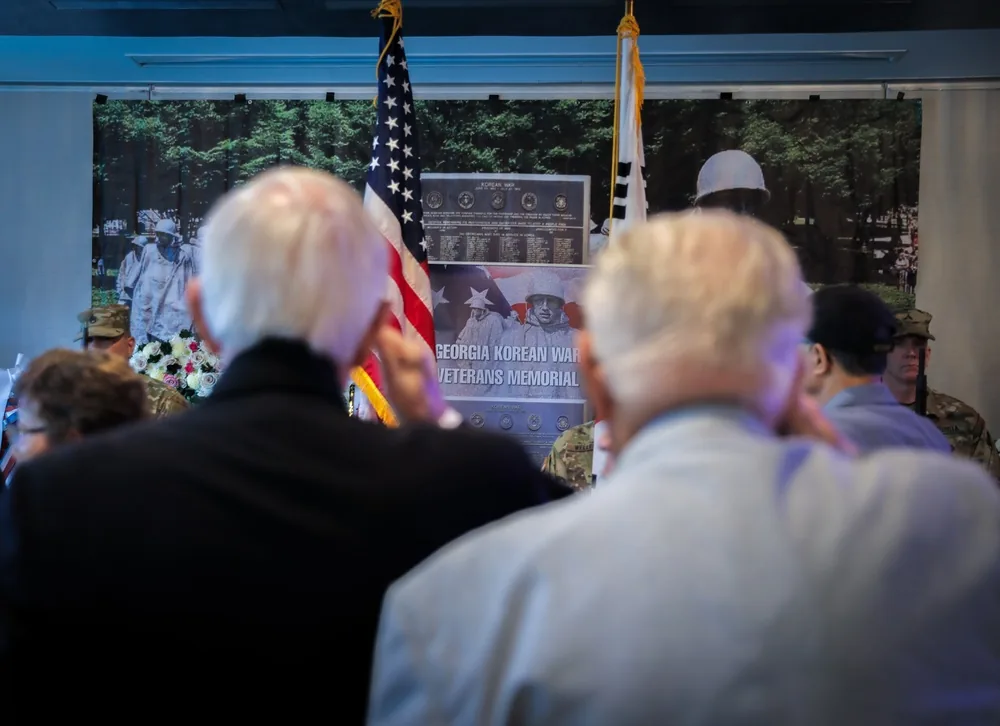
Meaningful options include inviting a Korean War veteran or family member to speak, reading verified names from a local memorial, laying a wreath, holding a moment of silence, supporting an oral-history project, or teaching the difference between armistice and peace treaty. Organizations can also share the location and history of the Korean War Veterans Memorial rather than reducing the day to a pole position.
The National Park Service notes that the Washington memorial was dedicated on July 27, 1995, the armistice’s 42nd anniversary. Its 19 patrol figures, Wall of Remembrance, and Pool of Remembrance honor service members killed, wounded, missing in action, or held as prisoners of war. A local gathering can use those themes—service, absence, captivity, alliance, and memory—without borrowing statistics from an unverified graphic.
If your facility ordinarily displays a POW/MIA flag, keep following the applicable federal, state, or organizational placement policy. Do not add or rearrange companion flags based solely on a social post. The most respectful program is one that gets both history and protocol right: verify the current U.S. flag position, explain the 1953 armistice accurately, and center veterans and families rather than the correction of someone else’s flag.
July 27 Flag FAQ
Is July 27 still observed as National Korean War Veterans Armistice Day?
Yes, it remains widely and officially recognized as a commemorative occasion. GovInfo published a 2026 feature, and presidents continue to issue proclamations or messages in some years. That contemporary recognition does not remove §127’s explicit “until 2003” limit on its original annual designation and half-staff program.
Is July 27 a federal holiday when offices close?
No. It does not appear on the Office of Personnel Management’s federal holiday schedule established for federal employee pay and leave. An agency may hold a ceremony or issue flag guidance without closing offices.
Did Congress repeal 36 U.S.C. §127?
The section remains published. Its operative language, however, contains its own ending: “until 2003.” Saying that its time-limited program expired is more precise than saying the section was repealed.
Did the 2009 law make July 27 a permanent half-staff day?
No. Public Law 111-41 added July 27 to 4 U.S.C. §6(d)’s special flag-display dates. That subsection explicitly says “half-staff until noon” for Memorial Day but does not attach half-staff language to Korean War Veterans Armistice Day. The separate 2009 presidential proclamation did request half-staff for July 27, 2009.
What if my governor orders half-staff on July 27?
Follow the governor’s order for the buildings, grounds, flags, and times within its stated scope. A valid state order supplies an independent current reason to lower even though July 27 is not automatically a nationwide half-staff day.
What if a printed calendar says “sunrise to sunset”?
Use the calendar as a reminder to investigate, not as final authority. Find the current official order and copy its exact times. Without that source, neither sunrise-to-sunset nor any other lowered-position schedule should be inferred merely from the date.
What should a private citizen do?
Check the current national and state notices. If an official invitation applies and you choose to join, use the proper peak-first procedure and stated duration. If there is no current lowering instruction, display the flag correctly at full staff and honor Korean War veterans through remembrance, education, or service.
Comments
Comments are reviewed before publication.
Sign in with Google to join the discussion.
Loading comments…