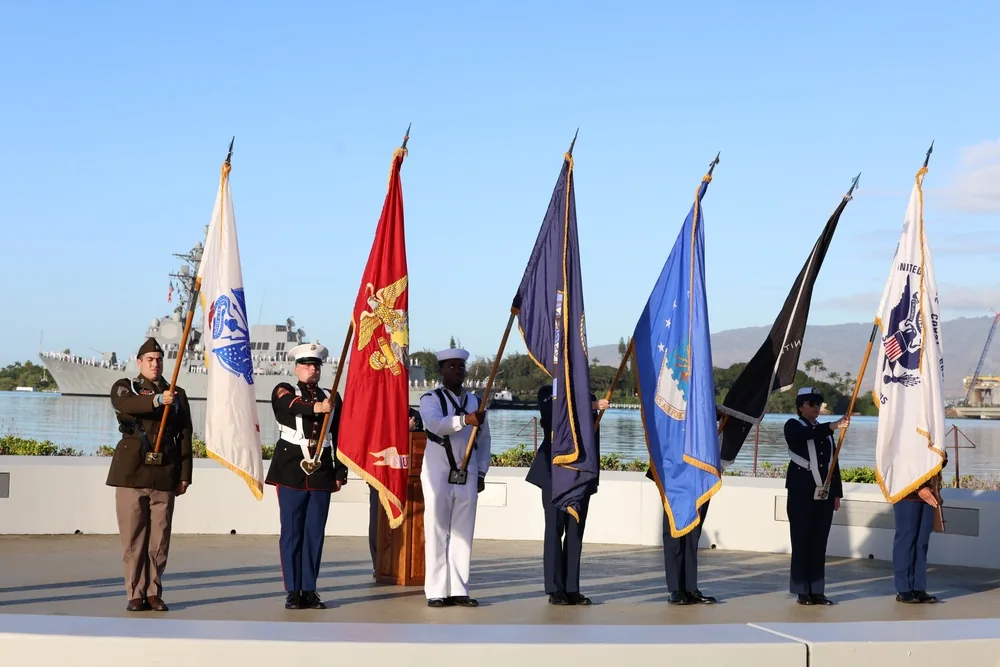
Yes. The U.S. flag is flown at half-staff on December 7 for National Pearl Harbor Remembrance Day. The normal operating schedule is sunrise through sunset for the entire day. Unlike Memorial Day, there is no noon switch to full staff. December 7 remains the observance whether it falls on a weekday or weekend.
The legal foundation is 36 U.S.C. §129, which designates December 7 each year and requests an annual presidential proclamation calling on federal bodies and interested organizations, groups, and individuals to participate. Governors frequently publish state instructions identifying the U.S. and state flags and the facilities they control. Private flag owners are commonly urged or invited to join, but should read the current notice rather than assume every order has identical scope.
This guide explains the law, annual proclamation, timing, participating properties, correct peak-to-half-staff procedure, and treatment of companion flags. It also covers overnight displays and overlapping mourning orders. If you are checking a live situation rather than planning for the annual observance, confirm today's flag status and open the cited government record before changing a flag.
Are Flags at Half-Staff on December 7?
December 7 is the recurring date for half-staff display in remembrance of Pearl Harbor. Raise the flag at local sunrise, first taking it to the peak for an instant, and then lower it to half-staff. At local sunset, raise it briefly to the peak again before lowering it completely. The observance lasts the full display day.
Do not use the Memorial Day schedule. Memorial Day uniquely changes from half-staff to full staff at noon. On Pearl Harbor Remembrance Day, the flag remains at half-staff after noon and through sunset. The annual half-staff calendar is useful for keeping those two instructions separate.
Common December 7 situations
- December 7 falls on Saturday or Sunday: the date does not move to Monday. Connecticut's 2025 instruction applied on Sunday from sunrise to sunset.
- A building is closed: follow the responsible agency or organization's operating policy. USPS specifically instructed facilities open on Sunday in 2025; that wording should not be rewritten as a rule for every closed site.
- The flag normally flies 24 hours: it may remain displayed after dark only when properly illuminated. Put it at half-staff for the applicable December 7 period and follow the current instruction for the return.
- The pole is not illuminated: custom calls for taking the flag down at sunset. Use the peak-first sequence before lowering it for the night.
- The flag is indoors: a fixed indoor flag cannot literally be lowered on a halyard. Do not invent a half-staff position on a wall; follow the facility's approved mourning display policy.
“Sunrise to sunset” means the solar times at the flag's location, not a national Eastern Time window. A multi-state operator should schedule each site locally. Assign the return-to-full-staff task at the same time as the lowering task, because an all-day observance still has a definite end.
What 36 U.S.C. §129 and the Annual Proclamation Do
Congress established the recurring observance in 1994 through Public Law 103-308. The measure designates December 7 of every year as National Pearl Harbor Remembrance Day and authorizes and requests the President to issue an annual proclamation. The provisions were later codified in 36 U.S.C. §129.
Section 129 asks the proclamation to do two things. First, it calls on the American people to observe the day with appropriate ceremonies and activities. Second, it calls on U.S. government departments, agencies, and instrumentalities—and interested organizations, groups, and individuals—to fly the U.S. flag at half-staff each December 7 in honor of those who died as a result of their service at Pearl Harbor.
Three records, three jobs
- Public Law 103-308: the 1994 enactment that created the recurring national observance.
- 36 U.S.C. §129: the current codified provision where readers can verify the annual date and requested proclamation.
- The year's presidential proclamation: the current White House record that proclaims that year's December 7 observance and supplies its commemorative language.
This distinction prevents two common errors. December 7 is not a surprise, event-specific lowering that exists only if a social post appears. It is a recurring statutory observance. At the same time, facility managers should still locate the annual proclamation and any applicable agency or governor instruction, because those records confirm current wording, channels, flags, and property scope.
The statutory wording also explains why careful articles use “calls on,” “urges,” or “requests” when discussing interested private participants. A governor can issue binding operational direction for the state facilities within the governor's authority while inviting homes and businesses to join. Converting every invitation into a universal legal command loses that distinction.
Patriot Day uses a related annual-proclamation structure, though it rests in a different section of Title 36. The comparison is covered in the September 11 flag protocol guide. Always cite the provision for the observance actually being discussed.
Which Buildings, Organizations, and Private Flag Owners Participate?
The broad national call includes U.S. government departments, agencies, and instrumentalities, plus interested organizations, groups, and individuals. Day-to-day implementation is then communicated through federal agencies and state or facility chains. The safest question is not merely “Does December 7 count?” but “Which current instruction governs this pole?”
| Flag or property | What to verify | Typical source |
|---|---|---|
| Federal facility | Agency implementation and operating instructions | Presidential proclamation plus agency notice |
| State-owned building | U.S. and state flags, named facilities, start/end | Governor or state facilities office |
| City, county, or public school | Whether state language directs or encourages the entity and any local policy | Governor notice plus local administration |
| Business, nonprofit, or home | Invitation language and correct display procedure | Annual proclamation and state notice |
Examples show why scope words matter. Utah's 2025 order applied to U.S. and Utah flags on all state facilities, then invited private citizens, businesses, and other organizations. Iowa identified the State Capitol, public buildings, grounds, and facilities, while encouraging individuals, businesses, schools, municipalities, counties, and other subdivisions to join for the same period.
A statewide notice does not automatically answer every employer's staffing or access question. One Washington directive expressly allowed agencies to lower at the prior close of business for a Sunday observance and return at the next opening. That was an operational permission in that directive, not a nationwide rule that any business may silently add two days to the commemorative period.
Private owners who participate should follow the same dignity and timing: use a serviceable flag, lower it through the peak-first procedure, keep it clear of the ground, and return it at the stated end. If a landlord, campus, or franchise controls the pole, coordinate with that authority instead of having two teams issue conflicting instructions.
For state-specific notices and explainers on how authority changes by property, use the Half Staff Today article archive. Save the exact source used in the site's facilities log so the decision can be traced later.
How to Lower and Raise the Flag Correctly
Half-staff is not reached by simply stopping the flag wherever it looks low. Section 7(m) of the Flag Code defines the position as one-half the distance between the top and bottom of the staff and specifies a peak-first sequence. Perform the movement deliberately and make sure the halyard, cleat, and path around the pole are safe before sunrise.
- Prepare: inspect the flag and hardware, untangle the halyard, and assign one trained operator or a coordinated detail.
- Raise to the peak: hoist the U.S. flag briskly all the way to the top and hold it there for an instant.
- Lower to half-staff: bring it down slowly and ceremoniously to the halfway position, then secure the halyard.
- Monitor: keep the flag free of trees, roofs, the ground, and other objects. Correct a slipping halyard promptly and safely.
- End at sunset: raise the flag from half-staff to the peak for an instant, then lower it ceremoniously for the day.
If a site normally keeps a properly illuminated flag flying overnight, the final action depends on the applicable order and local operating policy. For the recurring December 7 period, return it to full staff after the observance ends unless a separate mourning order continues. Record that overlap rather than moving the flag twice unnecessarily.
Position and handling checks
- The midpoint refers to the flag's position on the full staff, not half of the exposed rope.
- Keep the union uppermost; do not invert the flag as a mourning substitute.
- Never allow the flag to touch the ground, water, merchandise, or objects below it.
- Do not fasten a black streamer to an ordinary halyard as a replacement for a functioning half-staff procedure unless an applicable protocol specifically covers an unlowerable staff.
A respectful ceremony does not require a military formation. A home, school, or business operator can follow the same sequence quietly. The essential elements are a serviceable flag, the brief trip to the peak, the correct halfway position, and the return through the peak at the stated end.
What Happens to State, POW/MIA, and Other Flags?
Do not leave a state, city, corporate, service, or organizational flag visibly higher than the U.S. flag during the half-staff observance. The Flag Code says no other flag or pennant should be above the U.S. flag or, at the same level, to its right. On adjacent staffs, the U.S. flag is raised first and lowered last.
The exact operational method can depend on the facility's rules. NASA, for example, directs its facilities with multiple poles either to fly only the U.S. flag at half-staff or to fly the other flags at half-staff below it. On a single pole, NASA removes the other flags. That is a clear federal-agency procedure, but it should be cited as NASA policy rather than announced as the only method for every private property.
Practical display checklist
- One pole, several flags: consult the controlling facility policy. Removing subordinate flags during half-staff display is often the clearest way to avoid crowding and precedence problems.
- Several equal-height poles: lower companion flags as directed or remove them; never allow one to remain above the U.S. flag.
- Foreign national flags: international display rules require special care and equal status in peacetime. Do not unilaterally lower another nation's flag; use the host organization's protocol.
- POW/MIA flag: placement requirements vary by property and law. Confirm the applicable federal, state, veterans-affairs, or agency instruction instead of assuming December 7 changes every established arrangement.
- Indoor and decorative flags: preserve normal position and dignity unless an approved policy supplies a mourning treatment.
Sequence also matters when several poles are used. A written site procedure should identify which flag goes up first, how companion flags reach their authorized position, and which comes down last. That keeps an operator from improvising while multiple halyards are moving.
If a governor's December 7 notice expressly orders both the U.S. and state flags to half-staff, follow that instruction for the named property. If it speaks only to the U.S. flag, use the site's standing companion-flag policy and the Flag Code's precedence rules. Document the choice so the display is consistent across buildings.
How to Verify the December 7 Order Each Year
Begin with the White House presidential-actions archive and search for the year's National Pearl Harbor Remembrance Day proclamation. Confirm the date on the page, not just the year in a search-result title. Then check the governor or state facilities page for the flags and properties under state control. Federal employees should also follow their agency's operational notice.
- Open 36 U.S.C. §129 to confirm the recurring legal foundation.
- Open the current White House proclamation and note its publication date and participation language.
- Open the governor, secretary of state, general services, or military affairs flag-status page for the relevant state.
- Read the detailed order for covered flags, property, start, end, and any weekend instructions.
- Check whether a second federal, state, agency, or local mourning order is active.
- Save the source links and action times in the facility log.
Do not assume that a scheduled-date table is the final word. New Jersey's status page, for example, combines scheduled observances, current full/half-staff information, a notification list, and archived orders. The current order or directive supplies details that a calendar row cannot. USPS separately publishes instructions for its facilities.
When two orders overlap
Compare the two end conditions. Suppose the December 7 observance ends at sunset, but a presidential mourning order continues through sunset on December 9. The flag stays at half-staff after December 7 because the second authority remains active. Do not raise it merely to mark the close of the Pearl Harbor observance. Conversely, a state-only order may affect state-controlled property without extending a federal order everywhere.
Use the current-status page for a quick overlap check and the annual calendar for planning, but follow through to the original government source. Aggregated status can help find a notice; the issuer's text determines the operational scope and expiration.
Set a reminder in late November rather than waiting for a December 7 social-media post. Verify bookmarks, subscription recipients, staff coverage, and pole access. A planned annual check leaves time to resolve a broken halyard or an ambiguous facility rule before the day of remembrance.
Pearl Harbor Day Flag FAQ
Is National Pearl Harbor Remembrance Day a federal holiday with offices closed?
It is a national observance, but December 7 is not on OPM's regular federal holiday schedule for employee pay and leave. The half-staff observance does not by itself close federal offices, schools, banks, or businesses. Check the institution's own calendar for operating hours.
Do flags return to full staff at noon on December 7?
No. The noon change belongs to Memorial Day. Pearl Harbor Remembrance Day uses the full sunrise-to-sunset display period. At sunset, raise the flag to the peak before lowering it for the night, unless another active order continues.
What if December 7 is on a weekend?
The national observance remains on December 7; it is not transferred to a weekday. A government directive may give closed facilities specific early-lowering or next-opening instructions, so read the current notice. Private owners can observe on the calendar date.
Can an all-weather flag stay out in rain or snow?
Section 6 of the Flag Code says the flag should not be displayed in inclement weather unless it is an all-weather flag. Weather resistance does not remove the need for safe access, a secure halyard, proper illumination after dark, and the correct half-staff position.
What can I do with a wall flag or fixed pole that cannot be lowered?
Keep a wall flag in its normal dignified orientation; do not fold it halfway or invert it. Some written government protocols, including the District of Columbia manual, use a black mourning streamer for a fixed staff that cannot be half-staffed. Because that treatment is policy and tradition rather than a universal Flag Code command, follow the rule governing your facility.
What if I learn about the observance after sunrise?
Verify that it is December 7 locally and that no conflicting instruction applies, then carry out the approved half-staff procedure when safely practicable. Record the actual action time. Do not keep the flag lowered past the proper end simply to compensate for a late start.
Does “Pearl Harbor Day” mean the same thing?
It is a common shortened name. The statutory title is National Pearl Harbor Remembrance Day. Using the official title in logs and searches makes it easier to find the correct proclamation.
Where can I see other recurring half-staff dates?
Use the U.S. half-staff calendar, then open the applicable law, proclamation, or order. A calendar is a planning tool; it is not a substitute for a current source when property scope or an overlapping order matters.
Comments
Comments are reviewed before publication.
Sign in with Google to join the discussion.
Loading comments…