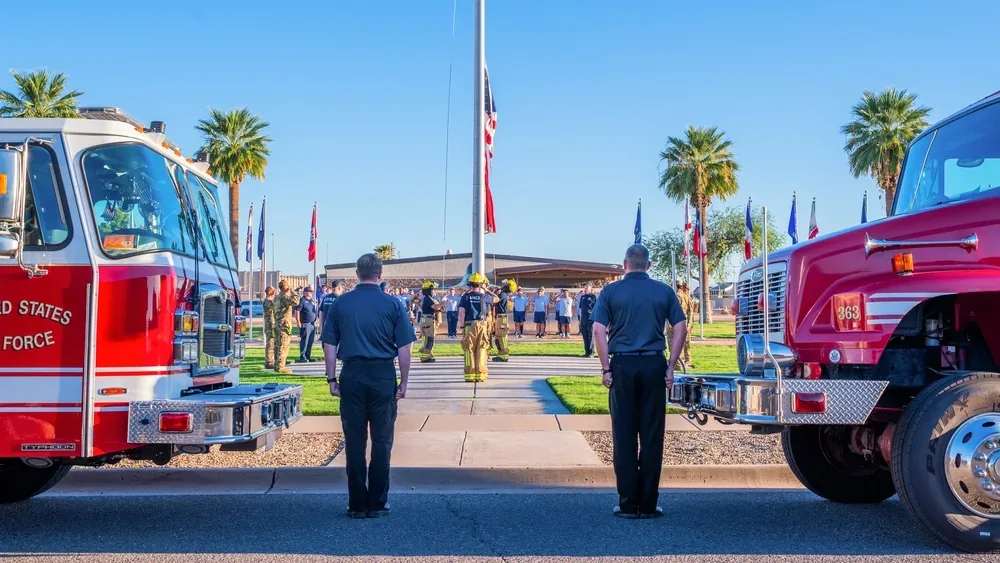
On September 11, the U.S. flag is displayed at half-staff for Patriot Day, honoring the people killed in the terrorist attacks of September 11, 2001. The annual observance is rooted in federal law and implemented through a presidential proclamation. For most outdoor displays, the practical schedule is half-staff from sunrise until sunset in local time. Federal agencies follow the presidential direction; governors and public institutions often issue their own operational notices, while businesses and private citizens are invited to participate respectfully.
Patriot Day is a national observance, but it is not a federal holiday. That distinction matters: the purpose is remembrance, not a general closure of offices or schools. This guide explains the legal basis, who should act, how to move the flag correctly, and how to verify the current year's instruction. If you are checking an unexpected lowering or an order that extends beyond September 11, consult today's U.S. half-staff status before relying on an old social post or photograph.
Why the Flag Flies at Half-Staff on September 11
Congress established the recurring framework after the attacks. Public Law 107-89, approved on December 18, 2001, added what is now 36 U.S.C. § 144. It designates September 11 as Patriot Day and asks the President to issue a proclamation every year. That proclamation is to call on federal departments, agencies, and instrumentalities—and interested organizations and individuals—to display the U.S. flag at half-staff in honor of those who lost their lives in the attacks.
This creates a useful two-part distinction. The statute makes Patriot Day an annual national observance; the presidential proclamation communicates that year's observance to federal entities and invites broader participation. A governor or agency may then publish a shorter directive telling its own facilities exactly what to do. Those documents work together, but they are not interchangeable. An old governor's bulletin is evidence of that state's instructions for that year, not proof of a new order today.
The meaning of the day also extends beyond flag position. Section 144 calls for appropriate programs and activities and a moment of silence. In 2009, Public Law 111-13 recognized September 11 as a National Day of Service and Remembrance, linking remembrance with community service. Neither designation made Patriot Day a federal holiday, according to the Congressional Research Service. Offices may remain open, classes may meet, and ordinary services may continue while flags are lowered and commemorations take place.
For readers maintaining an annual display plan, treat September 11 as a recurring observance and still verify the current proclamation and any local instruction. The site's half-staff calendar helps place Patriot Day beside other scheduled dates without confusing it with an unscheduled mourning order.
What Time the September 11 Half-Staff Display Begins and Ends
The standard Patriot Day plan is half-staff from sunrise through sunset on September 11, using sunrise and sunset at the flag's location. Do not convert an Eastern Time sunrise into a nationwide start time. A school in California and a courthouse in Maine begin when morning reaches their own locations, unless their controlling facility notice specifies an operational time.
Traditional Flag Code guidance says a flag displayed outdoors is normally flown from sunrise to sunset. The Department of Veterans Affairs also explains that it may remain displayed after dark when properly illuminated. Therefore, a continuously operated flag may stay up overnight if it has suitable lighting; the September 11 half-staff observance still ends at local sunset unless another valid order continues it. Illumination does not convert a one-day observance into an extra day.
Agency notices sometimes translate the general schedule into workplace terms. Washington's 2025 Patriot Day directive, for example, told state-agency facilities to remain at half-staff until close of business or sunset. Arizona's notice used sunrise until sunset. A facility manager should follow the exact controlling notice for that property and preserve it with the day's maintenance log.
Use this simple timing checklist
- Before sunrise or opening: confirm the annual proclamation, state notice, and any longer overlapping mourning order.
- At the first raising: hoist the flag to the peak briefly, then lower it to half-staff.
- At sunset or the directed closing time: check whether another order remains active. If none does, raise the flag to the peak before lowering it for the night or returning it to full-staff service.
An overlapping presidential or governor order controls its own stated end date. If it runs through September 12 or later, do not return the flag to full staff merely because Patriot Day ended. Check the current flag-lowering status and read the cited order's start and end language.
Who Should Lower Flags for Patriot Day
The annual presidential proclamation tells federal departments, agencies, and instrumentalities to display the U.S. flag at half-staff. That category includes facilities whose flag operations are controlled by a federal agency, but the facility's own administrative notice remains the best source for staff assignments and timing. USPS guidance illustrates this operational layer: its notices tell postal facilities how to handle a Sunday observance or a building that flies the flag continuously.
Governors commonly issue corresponding notices for property under state control. Pennsylvania's 2025 notice covered the U.S. and Commonwealth flags on Commonwealth facilities, public buildings, and grounds. It separately invited all Pennsylvanians to participate. The first sentence defines an institutional scope; the invitation encourages a wider tribute. It does not turn every privately owned flagpole into state property.
| Flag operator | Best controlling source | Practical response |
|---|---|---|
| Federal facility | Presidential action plus agency instructions | Follow the agency's assigned schedule and log the change. |
| State building | Governor or state facilities notice | Lower every flag named in the notice for its stated period. |
| City, county, or school | Local policy and state/federal notices | Confirm who maintains the pole; do not assume another entity has acted. |
| Business, nonprofit, or home | Current proclamation and voluntary display practice | Participation is appropriate; use the same respectful procedure and timing. |
When several flags stand together, preserve the U.S. flag's position of honor. If a state or organizational flag cannot be lowered without appearing above a half-staff U.S. flag, consult the property's written flag policy; lowering the companion flags together is a common operational solution. Never invent a blanket rule from a photograph of one building, because pole arrangements vary.
Responsibility should be assigned before September 11. Schools and businesses can name a trained person, retain access to the halyard, record local sunrise and sunset, and identify an alternate for weekends. For deeper explanations of presidential and governor authority, consult the Half Staff Today blog.
How to Raise and Lower the Flag Correctly
The movement matters as much as the final position. Section 7(m) of Title 4 gives a clear sequence: a flag going to half-staff is first hoisted to the peak for an instant and then lowered. Before it comes down for the day, it is raised to the peak again. That brief peak-to-peak sequence recognizes the flag's full position before entering and leaving the mourning display.
- Inspect the equipment. Make sure the halyard, clips, and cleat move safely and the flag will not touch the ground.
- Raise briskly to the peak. Pause only for an instant; the flag is not meant to remain at full staff during the opening movement.
- Lower slowly to half-staff. Title 4 defines this as one-half the distance between the top and bottom of the staff. Use the flag position calculator when the pole's proportions make the midpoint difficult to judge.
- Close ceremoniously. At the end of the display, raise the flag to the peak, then lower it slowly, keeping it clear of the ground and storing it dry and protected.
“Half-staff” does not mean a token drop of a few inches. The flag should be visibly centered in the vertical travel available on the staff. On a pole with an ornament, judge the working distance along the halyard rather than trying to measure from the tip of a decorative finial. Safety comes first: do not climb a damaged pole or work near power lines merely to correct a small positioning error.
A wall-mounted indoor flag, a hand flag, or a fixed staff may not have a meaningful half-staff position. Keep it in its normal position unless the institution has an approved mourning-display policy. Do not pin a homemade streamer through the flag, write on it, or bunch it up to simulate lowering. A separate respectful memorial display is better than altering or damaging the U.S. flag.
People present during raising or lowering should face the flag and stand respectfully. Uniformed service members follow their applicable salute rules; civilians commonly place the right hand over the heart. A quiet, controlled movement is appropriate for Patriot Day—there is no need for theatrical gestures beyond the established procedure.
How to Verify the Current Year's Patriot Day Order
Begin with the White House Presidential Actions section and filter for proclamations. Search for “Patriot Day” plus the current year, then open the actual action—not a screenshot or a search snippet. Confirm its publication date, the named observance, the facilities addressed, and any language inviting governors or private organizations. The 2025 proclamation was dated September 11 itself, which demonstrates why the absence of a document far in advance does not cancel the recurring observance.
Next, check the governor's official flag-status, newsroom, or facilities page for the state where the flag stands. A state notice can name the state flag, state-controlled buildings, and a closing time that the federal proclamation does not specify. Some states offer email subscriptions. If you operate a federal or state workplace, also check the responsible agency's internal or public bulletin, because it may assign the task or adapt it for a closed facility.
Finally, compare the current documents with the live U.S. flag status. A reliable status entry should point back to an issuing government page. Use the half-staff calendar to plan for September 11, but use the order text to resolve an overlap. This site explains and organizes the records; it does not replace the President, governor, or agency as the issuing authority.
A quick authenticity test
- The web address belongs to the White House, a government domain, or the responsible agency.
- The page identifies a publication date and the year of the observance.
- The text states who is directed or invited and when the display ends.
- A forwarded email can be matched to the same notice on an official page.
- A past-year document is labeled as an archive, not presented as today's authority.
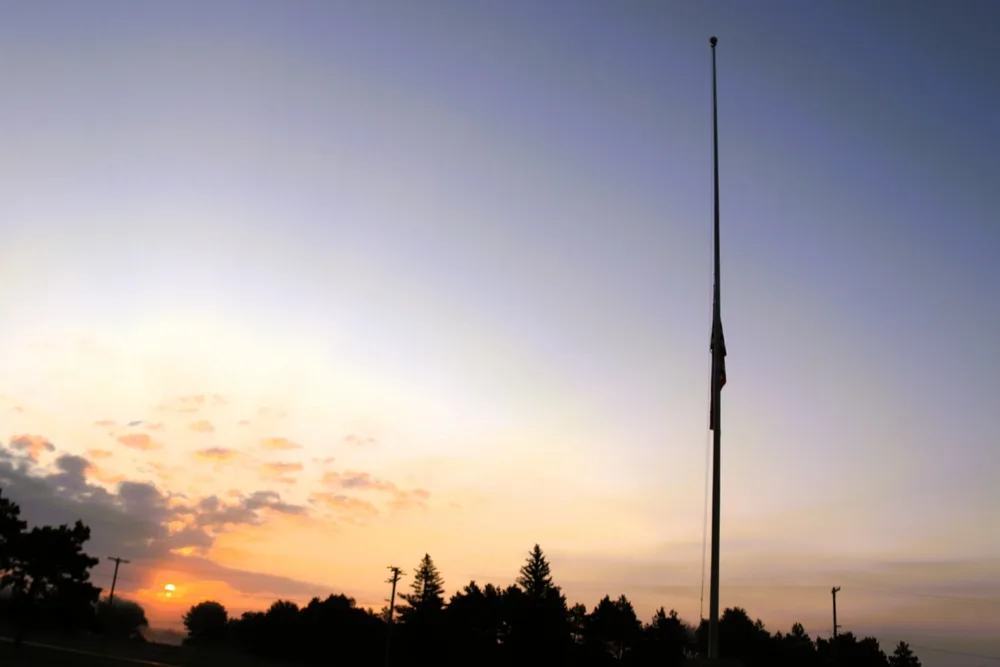
Common September 11 Flag Protocol Mistakes
Most Patriot Day errors come from mixing rules for different observances or using a document from the wrong year. Correct the schedule and procedure calmly; the purpose is respectful remembrance, not catching people in a vocabulary test.
| Mistake | Why it is wrong | Better practice |
|---|---|---|
| Raising to full staff at noon | The noon transition belongs to Memorial Day, not Patriot Day. | Remain at half-staff through local sunset unless another official instruction applies. |
| Lowering directly from storage to the midpoint | It skips the peak-first movement in 4 U.S.C. §7(m). | Hoist to the peak briefly, then lower ceremoniously. |
| Using a past proclamation as a current order | Its names, date, and scope belong to that year. | Use the archive for history and verify the current White House/state notice. |
| Assuming every flag everywhere is legally compelled | Official documents distinguish federal direction, state-property scope, and invitations to others. | Identify who owns the property and which policy controls it. |
| Ending every order on September 11 | A separate mourning order may extend beyond Patriot Day. | Compare end dates and follow the longest applicable active instruction. |
On land, half-staff is the term used in the U.S. Flag Code and modern presidential proclamations. “Half-mast” is common in nautical usage and everyday speech, and USAGov recognizes both terms. If someone asks why a flag is “half-mast” on September 11, answer the underlying question instead of treating the wording as disrespectful. Accuracy about the date, authority, and position is more useful.
Another frequent error is treating the recurring date as proof of every unusual display seen nearby. Patriot Day explains half-staff on September 11, but a flag still lowered several days later may be following a separate national, state, local, or institutional instruction—or may simply not have been corrected. The annual observance calendar provides context, while the current status and source notice provide the answer.
Patriot Day Flag Protocol FAQ
Is Patriot Day a federal holiday?
No. The Congressional Research Service states that Patriot Day is not a federal holiday. It is a national observance, and schools, businesses, and government services may remain open while flags are at half-staff and remembrance activities occur.
Should the flag return to full staff on September 12?
Normally, yes, because the recurring Patriot Day display ends at sunset on September 11. First check for an overlapping order with a later expiration. A next-day lowering may be correct for a separate reason, so verify it through the current status page.
What if September 11 is rainy or windy?
VA guidance says the flag should not be exposed to damaging rain, snow, or wind unless it is an all-weather flag. Protecting the flag is not a failure to honor the day. An indoor display or remembrance program can continue when outdoor conditions are unsafe.
Can the flag remain outside after sunset?
It may be displayed during darkness when properly illuminated. If no other order continues, return it to full staff at the end of the Patriot Day period before continuing an illuminated nighttime display.
Is a moment of silence required at 8:46 a.m.?
Section 144 calls for a moment of silence but does not prescribe a clock time in the statutory text. Many historical proclamations and ceremonies have used 8:46 a.m. Eastern, when the first aircraft struck the World Trade Center. Check the current proclamation and the ceremony organizer's plan rather than presenting one historical instruction as permanent wording.
Do small handheld or indoor flags move to half-staff?
Only a flag on an adjustable staff can be lowered meaningfully. Keep fixed, handheld, or wall-mounted flags displayed correctly and respectfully. Do not fold, pin, or damage them to imitate an outdoor pole.
What is the most important action for a facility manager?
Assign responsibility in advance, verify the current official documents, and record both the lowering and the planned return time. That simple chain prevents stale notices, missed weekend changes, and accidental conflicts with a longer mourning order.
Comments
Comments are reviewed before publication.
Sign in with Google to join the discussion.
Loading comments…