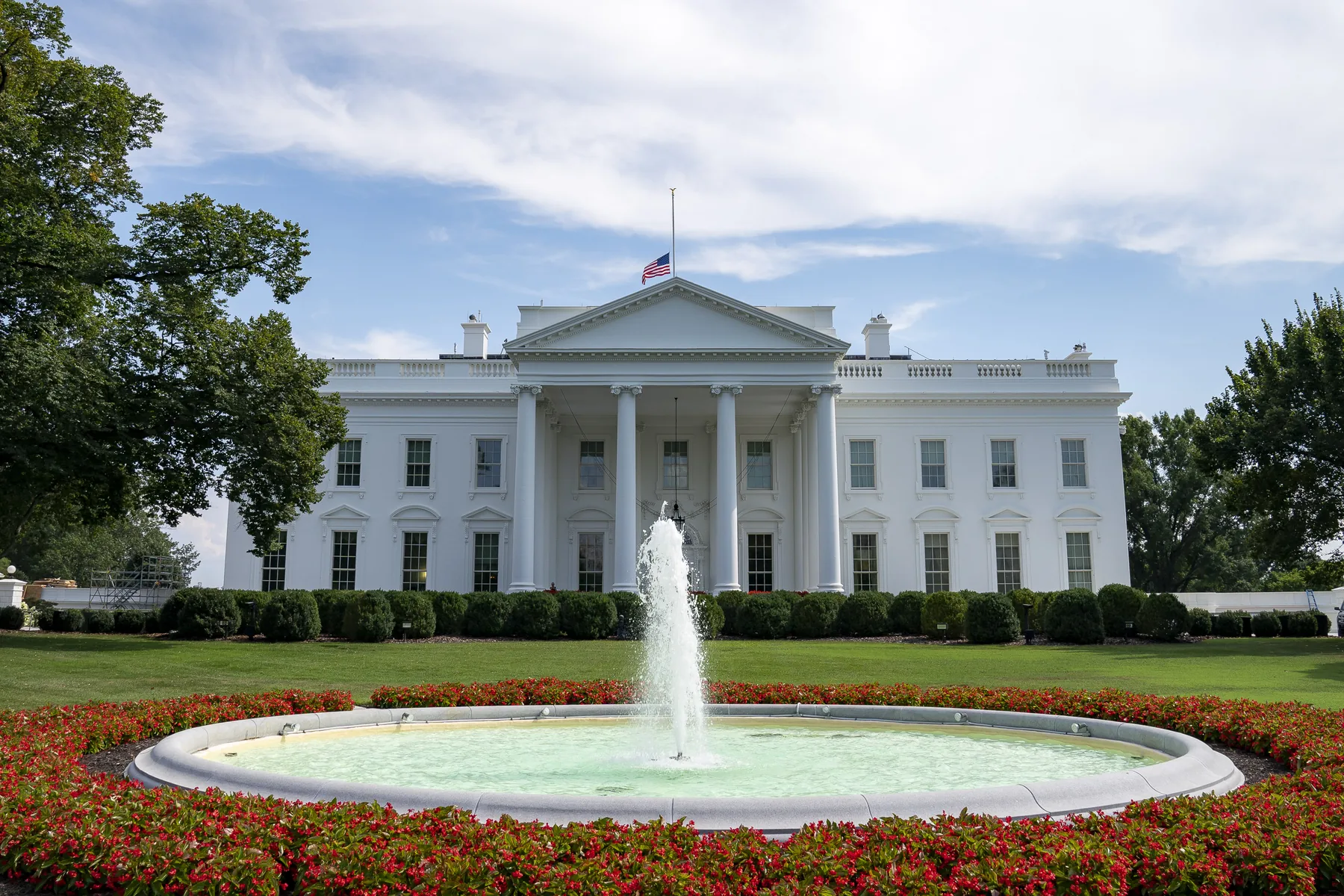
In ordinary U.S. usage, a flag on land flies at half-staff; aboard a ship or at a U.S. naval station, the official naval term is half-mast. Both expressions describe the same visible act: lowering a flag below the top of its pole as a sign of mourning, respect, or remembrance. “Half-staff” is the wording used in 4 U.S.C. § 7, while Department of Defense style preserves “half-mast” for naval settings.
That distinction is useful, but it is not a reason to scold someone who says “half-mast” beside a city hall. The phrase is widely understood, and even USAGov introduces the display as “half-staff or at half-mast.” The most accurate U.S. wording depends on the setting; the meaning remains solemn in either case.
If a lowered flag prompted your question, terminology alone cannot identify the honoree, the issuing authority, the geographic scope, or the end time. Check today’s U.S. half-staff status and the linked government notice before acting. The sections below explain the official word choice, what the position communicates, how the flag moves to and from it, and the common exceptions that matter in practice.
The short answer: use half-staff on land and half-mast in naval settings
The most useful U.S. rule is simple: choose the term that matches the institution and the place of display. The federal statute governing the position says “half-staff.” Department of Defense editorial guidance adds the naval distinction, reserving “half-mast” for ships and naval stations ashore. That last phrase matters. A naval station may be on land, yet its official vocabulary still follows naval custom.
| U.S. setting | Preferred term | Natural example |
|---|---|---|
| Home, school, city hall, state capitol, or most federal grounds | Half-staff | “The flag at the courthouse is at half-staff.” |
| Navy ship or other shipboard context | Half-mast | “The national ensign is at half-mast.” |
| U.S. naval station, including one ashore | Half-mast in DoD style | “Flags at the naval station are at half-mast.” |
| Casual conversation | Either will usually be understood | Use the setting-specific term when precision matters. |
The familiar mnemonic “staff on land, mast at sea” gets most civilian situations right, but “staff for ordinary land displays, mast for naval displays” is more accurate. A staff is the support named in the Flag Code’s definition; a mast belongs to nautical vocabulary. Navy training material accordingly describes the ensign as being at “half-mast,” while also acknowledging “half-staff ashore.”
This is a usage rule, not a test of respect. If you are writing a school notice, municipal policy, or general U.S. news caption, half-staff is the safest formal choice. If you are describing Navy colors or quoting a naval source, preserve half-mast. In ordinary speech, either phrase will communicate the lowered position, and USAGov itself places them side by side. Accuracy is helpful; the respectful act and the verified instruction matter more than correcting a neighbor’s vocabulary.
What do flags at half-staff or half-mast mean?
A public sign of mourning, respect, and remembrance
A flag below the peak is a public signal that normal display has been interrupted for a solemn purpose. U.S. law describes some death-related lowering as a “mark of respect” to the person’s memory. Navy training material calls the equivalent naval display an internationally recognized symbol of mourning. In both settings, the lowered position asks viewers to pause, remember, and recognize a loss or observance.
Death is common, but it is not the only useful category. USAGov groups the usual reasons into three broad types: the death of a government official, military member, or emergency first responder; a national tragedy; and Memorial Day or another national day of remembrance. The gesture can therefore honor one named person, a group of victims, or people remembered on a recurring observance. It does not mean that the flag itself is in distress, damaged, or being displayed casually.
The position does not reveal the whole order
What the eye sees is the symbol, not the instruction behind it. A flag at half-staff does not by itself tell you who authorized the lowering, whether it is national or limited to one state or agency, when it began, or when the flag should return to the peak. Two nearby flagpoles can even show different positions because they belong to institutions covered by different notices.
Before changing a flag, verify four details:
- Reason: the person, tragedy, or observance being recognized.
- Authority: the President, a governor, the mayor of the District of Columbia, or another institution acting within its jurisdiction.
- Scope: the buildings, grounds, vessels, state, or organization named in the notice.
- Timing: the effective date and exact endpoint, such as noon, sunset, interment, or a stated date.
Use the half-staff calendar to investigate a scheduled or past date, and use the current U.S. status for a flag you see today. Then open the linked government source. That sequence preserves the gesture’s meaning without turning a visual clue into an unsupported claim.
Why U.S. law says “half-staff”
The clearest official reason to prefer half-staff on land is that Congress uses that term in the U.S. Flag Code. Section 7(m) does more than name the display. It tells how to reach the position, addresses who may direct it in specified circumstances, sets several mourning periods, and defines the term itself. Under that definition, half-staff is the position one-half the distance between the top and bottom of the staff.
The wording gives public agencies, proclamation writers, schools, and newsrooms a common U.S. reference point. A presidential proclamation may cover named federal buildings, grounds, military posts, naval stations, vessels, and overseas facilities. A governor’s proclamation has a different jurisdiction and can interact with federal facilities in particular circumstances described by the statute. The word half-staff identifies the position; it does not erase those scope differences.
Section 7 also alternates between “should,” “shall,” and “may” as it describes display practices and official authority. That is one reason to read the actual provision and the applicable order instead of reducing the Flag Code to a slogan. This terminology guide does not decide legal duties for a particular agency, employee, or private flag owner. Agency regulations, state rules, and workplace policy can add requirements beyond a general etiquette explanation.
Just as important, § 7 does not create a vocabulary offense for saying “half-mast” beside a land flagpole. The statutory choice tells you the established U.S. term to use in a formal land-based notice; it does not make every conversational alternative unlawful. A respectful correction is therefore: “U.S. law calls that position half-staff,” not “half-mast has no meaning.”
For the provision’s broader rules on display, authority, and respect, see our plain-language guide to the U.S. Flag Code. For this article’s narrower question, the takeaway is enough: use half-staff when you want your U.S. land-based wording to match the statute.
Why the Navy says “half-mast”
Naval language developed around ships, their equipment, and the ceremony of colors. The U.S. flag in that setting is commonly called the national ensign. Depending on whether a ship is in port or underway, the ensign may be displayed from a flagstaff, a gaff, or another prescribed point. Navy instructions nevertheless describe lowering the ensign as half-masting, and U.S. Navy Regulations use “half-mast” for ships and naval stations.

The Department of Defense makes the editorial boundary explicit: use half-mast on ships and at naval stations ashore; use half-staff elsewhere. That guidance explains the apparent exception that a short mnemonic can hide. A flag at a naval installation can be physically over dry ground while the institution still follows naval terminology. The relevant distinction is therefore not simply whether salt water is underneath the flagpole.
The Navy’s own training material illustrates the overlap. It describes the ensign as being at “half-mast, or half-staff ashore,” then gives a shipboard sequence using the words peak, flagstaff, and jackstaff. When a ship in port displays the union jack at the bow, the manual explains that the jack is also half-masted when the national ensign is half-masted. These are operational terms attached to naval routines, not rival descriptions of a different symbol.
This can produce two correct-looking phrases in documents about the same event. A presidential proclamation written in the language of 4 U.S.C. § 7 may direct the flag to “half-staff” on federal buildings, grounds, naval stations, and naval vessels. A Navy caption or command instruction carrying out that direction may say the ensign is at “half-mast.” The first follows statutory drafting; the second follows naval usage.
When quoting an official Navy caption, regulation, or command message, keep its terminology. When translating the event for a general U.S. audience, you can explain once that half-mast is the naval equivalent of half-staff. That preserves institutional accuracy without suggesting that sailors are performing a different gesture.
How to raise and lower a flag correctly
Peak first, then lower to the mourning position
The Flag Code builds a brief salute into the movement. Do not attach the flag and stop it halfway on its first trip upward. Section 7(m) says it should reach the peak for an instant before descending to half-staff. Section 6 adds that the flag should be hoisted briskly and lowered ceremoniously.
- Confirm the notice. Check that the lowering applies to your location or organization and note its start and end time.
- Hoist to the peak. Raise the flag briskly all the way to the top. If it is already flying at the peak when an order takes effect, begin from there.
- Lower to half-staff. Bring it down ceremoniously to the statutory position, one-half the distance between the top and bottom of the staff.
- Return to the peak before taking it down. At the end of the display day or order, raise the flag to the top for an instant, then lower it completely and ceremoniously.
The same basic sequence appears in Navy training for half-masting an ensign: peak or truck first, then the mourning position, and back to the peak before final lowering. Vocabulary changes with the setting; the respectful transition remains recognizable. For a movable land-based pole, the half-staff position calculator can turn the statutory midpoint into a practical height for your setup.
Memorial Day is the major timing exception
Many lowering notices run until sunset or another endpoint printed in the order. Memorial Day follows a different two-part display. Under 4 U.S.C. § 7(m), the flag is at half-staff until noon only and then rises to the top of the staff. The full-staff afternoon is part of the observance, so leaving the flag lowered all day misses the prescribed transition.
Treat noon as local noon unless an applicable instruction states otherwise, and make the change promptly. Do not confuse the National Moment of Remembrance at 3:00 p.m. local time with the flag's noon movement; they are separate parts of Memorial Day practice. Naval ceremonies may include a 21-minute-gun salute and more detailed timing under Navy Regulations, while an ordinary home or municipal display follows the applicable public instruction.
For a full explanation of recurring dates, special orders, private displays, and who can direct lowering, read when the U.S. flag should fly at half-staff. The essential procedure here is concise: peak, half-staff, peak, down—with Memorial Day's return to full-staff at noon.
Is “half-mast” wrong on land? Everyday and international usage
For a formal notice about an ordinary U.S. land flagpole, half-mast is not the preferred term. Half-staff matches the U.S. Code and Department of Defense style outside naval settings. But calling the land display half-mast does not make the sentence incomprehensible, disrespectful, or automatically unlawful. It is better described as less precise in that U.S. context.
Official public language is not perfectly rigid. USAGov says the American flag flies “at half-staff or at half-mast” when the country or a state is in mourning, even though the page's heading and authority explanation use half-staff. That pairing is a useful model for answering a neighbor: acknowledge what the speaker means, then offer the more specific American term if the distinction matters.
Usage also changes across borders. The United Kingdom provides a clear land-based counterexample: official GOV.UK notices direct flags on government buildings to be flown at half-mast. That does not change U.S. statutory wording, and it should not be expanded into a claim about every country. It simply shows why “mast at sea everywhere” is too absolute as a rule for global English.
Writers and flag managers can make the choice in three steps:
- Identify the jurisdiction. Use the terminology and protocol published by the relevant country or government.
- Identify the institution. In the United States, allow for the Navy and naval-station use of half-mast.
- Match an official source. When quoting a proclamation, regulation, or photo caption, retain its words rather than silently “correcting” them.
Online discussions are helpful for discovering why readers are confused—people bring regional habits, Navy service, family usage, and international English to the same question. They are not a substitute for an official style guide or flag instruction. For general American land use, choose half-staff; for naval or foreign contexts, check the institution's own language.
Common questions about half-staff and half-mast
Is it half-staff or half-mast in the United States?
Use half-staff for the American flag at a home, school, courthouse, state capitol, or other ordinary land-based site. Use half-mast in U.S. naval usage aboard ships and at naval stations, including stations ashore. Both phrases describe the same lowered mourning position and both will usually be understood, but the setting-specific choice is best for an official notice.
Are half-staff and half-mast hyphenated?
Yes. Write half-staff and half-mast with hyphens. That is how 4 U.S.C. § 7 writes half-staff and how the Department of Defense style guide lists both terms. They are normally lowercase common terms, although a headline, title, or source-specific house style may capitalize them. Use full-staff consistently when you need the contrasting land term; at the peak or at the top of the staff is often clearer.
Does half-staff always mean someone died?
No. A death-related honor is common, but USAGov also identifies national tragedy and Memorial Day or another day of remembrance as common reasons. The same visual position can recognize an individual, a group, or an observance. Always verify the notice before naming a person or event, because a lowered flag is evidence of a solemn display—not proof of one particular cause.
Does “half” mean exactly halfway?
For the U.S. statutory definition, yes. Section 7(m) places the flag one-half the distance between the top and bottom of the staff. Measure the pole's usable vertical span rather than guessing from the sky around the flag. Flag size, landscaping, rooflines, and perspective can make a correct midpoint look higher or lower from the street. Use the flag position calculator when you need a practical measurement.
What if a fixed porch staff cannot be lowered?
A short angled staff with no halyard cannot create a true half-staff position. Do not slide, bunch, invert, or otherwise distort the flag to imitate one. The federal provision defines the real position but does not supply one universal substitute for every fixed mount. Check the issuing authority's instruction and your organization's policy before adding a black mourning ribbon or streamer; practices can differ. If no approved alternative applies, keeping the flag properly displayed at the peak may be more respectful than improvising.
How do I find out why a flag is lowered today?
Start with today's verified U.S. half-staff status, then check whether a separate state or local notice applies to that flagpole. Open the linked presidential proclamation, governor's notice, or agency message and read its scope and ending—not just its title. For a past or scheduled date, search the half-staff calendar. If one private building differs from its neighbors, ask the property owner; the display may reflect an institutional decision, delayed handling, or an error rather than a new government order.
The practical takeaway is uncomplicated: choose half-staff for ordinary U.S. land use and half-mast for U.S. naval use, then focus on the instruction that matters—why the flag is lowered, where it applies, and when it returns to the peak. Precise language helps; verifying and carrying out the honor correctly matters most.
Comments
Comments are reviewed before publication.
Sign in with Google to join the discussion.
Loading comments…