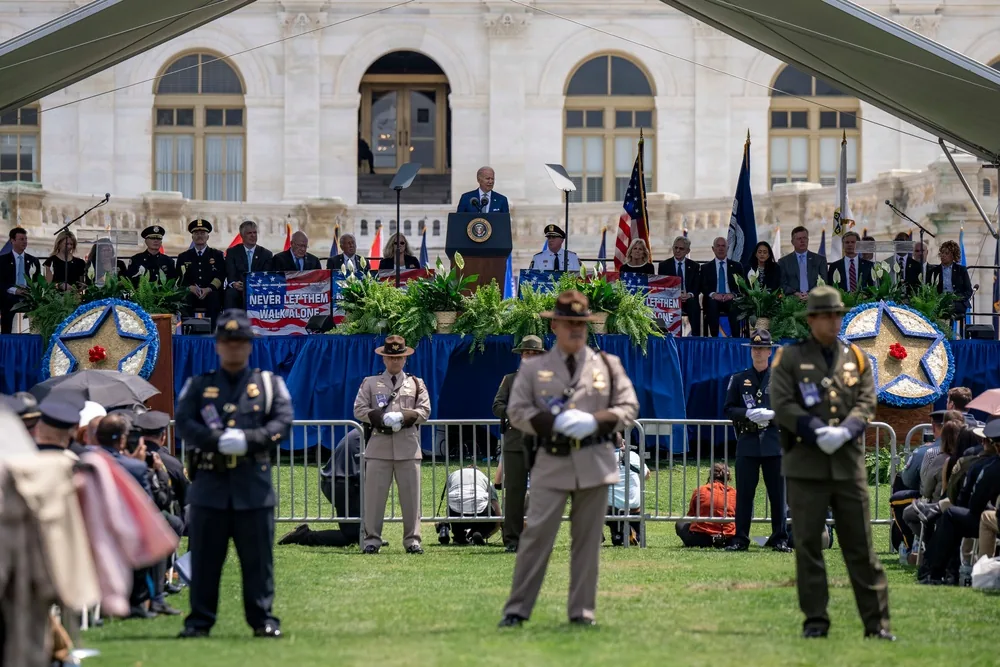
Peace Officers Memorial Day is May 15, and the normal U.S. flag protocol is half-staff for the full day, from sunrise to sunset. The observance honors federal, state, and local officers killed or disabled in the line of duty. There is one important calendar exception: if May 15 is also Armed Forces Day, the recurring Peace Officers Memorial Day rule does not call for half-staff. A separate presidential or governor?s order may still require a lowered flag for another reason.
Before changing a flag, confirm the current national and state instructions on today?s U.S. half-staff status. This guide explains the federal rule, the Armed Forces Day exception, the difference between an official order and an invitation to participate, and the correct ceremony for homes, schools, businesses, and public facilities. For date planning beyond May 15, use the half-staff calendar.
The Short Rule for May 15
In an ordinary year, display the U.S. flag at half-staff on May 15 from sunrise until sunset for Peace Officers Memorial Day. If your flag is raised later than sunrise, take it to the peak first and then lower it ceremonially. At the end of the display period, raise it to the peak again before lowering it completely. An illuminated flag that is normally displayed overnight may remain displayed, but the controlling notice for your facility or jurisdiction should decide the exact end time.
Do not confuse this observance with the federal holiday Memorial Day. The two rules are deliberately different:
| Observance | Date | Normal flag position |
|---|---|---|
| Peace Officers Memorial Day | May 15 | Half-staff from sunrise to sunset, unless May 15 is also Armed Forces Day |
| Memorial Day | Last Monday in May | Half-staff from sunrise until noon, then full-staff |
The Department of Defense states this distinction directly in its flag policy, while state notices commonly translate it into local operating instructions. For example, Virginia?s 2026 order covered both the United States and Commonwealth flags on state and local buildings and grounds from sunrise to sunset.
A reliable May 15 decision takes three checks: confirm that the date is not Armed Forces Day, read the current federal proclamation or direction, and check your governor?s notice for the flags and properties it covers. If another mourning order is already active, follow its stated start and end times. The recurring observance and a separate current order can overlap, but they are different legal and administrative reasons for the same visible flag position.
What Federal Law Actually Says
Two Code provisions work together. 4 U.S.C. ? 7(m) contains the standing flag-display rule: the flag is to be flown at half-staff on Peace Officers Memorial Day unless that date is also Armed Forces Day. The same subsection defines half-staff as halfway between the top and bottom of the staff and describes the ceremonial trip to the peak before lowering.
36 U.S.C. ? 136 describes the annual presidential proclamation. Congress requests that the President:
- designate May 15 as Peace Officers Memorial Day;
- direct United States Government officials to display the U.S. flag at half-staff on all Government buildings, subject to the ? 7(m) exception; and
- invite state and local governments and the public to observe the day with appropriate activities, including a half-staff display.
Those verbs matter. A direction to federal officials identifies a governmental duty within the federal framework. An invitation to the public encourages voluntary participation; it is not the same wording as a command that applies to every privately owned flagpole. State law, a governor?s order, a local policy, or an organization?s own rules may add requirements for a particular property.
The annual proclamation gives each year?s official presidential recognition and may call on governors to act. It does not create May 15 from scratch every year: the date and recurring rule already appear in statute. The half-staff language was added in 1994, and the provisions were later recodified into their present titles. For the broader structure of death-related periods and issuing authorities, see when the U.S. flag should be flown at half-staff.
The Armed Forces Day Exception, Explained
Armed Forces Day is observed on the third Saturday in May, while Peace Officers Memorial Day always falls on May 15. Most years they are different dates. They coincide only when May 15 is that third Saturday. In a collision year, 4 U.S.C. ? 7(m) says the flag is not flown at half-staff under the recurring Peace Officers Memorial Day rule.
The next practical example is Saturday, May 15, 2027. It is both Peace Officers Memorial Day and Armed Forces Day. By contrast, May 15, 2026 was a Friday, so the exception did not apply and federal and state notices directed the ordinary half-staff observance.
It is safest to describe the exception precisely: it switches off the standing Peace Officers Memorial Day reason for lowering the flag. It is not a universal promise that every U.S. flag must remain at full-staff whatever else happens. If the President issues a separate national mourning direction, or a governor issues a valid order covering a particular jurisdiction and event, that independent instruction may still call for half-staff on the same date. Read the current order rather than assuming the calendar exception cancels unrelated mourning.
A simple collision-year decision
- Determine whether May 15 is the third Saturday in May.
- If it is not, follow the normal Peace Officers Memorial Day protocol, subject to the current official notices.
- If it is, do not lower the flag solely because it is Peace Officers Memorial Day.
- Check current flag status for a separate federal or state order before leaving the flag at full-staff.
This reading respects both observances. The 1961 Armed Forces Day proclamation established the third Saturday and encouraged prominent flag display in support of the Armed Forces. The exception prevents the recurring mourning display from automatically controlling that shared date, while leaving other lawful and event-specific directions to operate on their own terms.
Who Should Lower Which Flags?
Peace Officers Memorial Day is a national observance, but the source and scope of an instruction still matter. The federal statute directs United States Government officials and invites states, local governments, and the public to participate. A governor may then issue a notice that orders action on specified public property and encourages others to join.
| Flag operator | What to verify | Practical May 15 action |
|---|---|---|
| Federal facility | Federal proclamation plus agency policy | Follow the agency?s official instruction and hours. |
| State or local facility | Governor?s order, state law, and local policy | Lower only the flags and properties covered by the controlling notice. |
| School or public district | Whether the order includes schools, subdivisions, or all public grounds | Use the district?s designated flag contact; do not infer scope from a headline. |
| Private home or business | Presidential and governor invitations plus property policy | Participation is commonly encouraged; use the same respectful timing when joining. |
The 2026 notices make the distinction visible. The Postal Service told its facilities that the half-staff display was required. Florida directed the U.S. and Florida flags at state and local buildings, installations, and grounds. Iowa ordered public displays and separately said individuals, businesses, schools, municipalities, counties, and other subdivisions were encouraged to participate. Connecticut also distinguished state-operated property from private entities it encouraged.
Do not assume the phrase ?all flags? means the same thing everywhere. It may mean every flag within an agency?s control, or it may expressly name the United States and state flags. If several flags are displayed together, no state, municipal, or organizational flag should be left in a position that appears superior to the lowered U.S. flag. Some organizations solve that by lowering companion flags; others temporarily remove a flag that cannot be displayed appropriately. Follow the property owner?s written protocol and the exact government notice.
When a notice is ambiguous, preserve its wording and ask the issuing office or your agency?s facilities lead. The safest public explanation is ?officially ordered for the listed government properties? or ?private participation encouraged,? not the unsupported claim that every flag in the state is legally compelled to move.
How to Perform the May 15 Flag Ceremony
Prepare before the building opens. Confirm the controlling order, inspect the halyard and clips, and assign someone for both the morning and evening movements. A half-staff display is not created by stopping the flag wherever it looks low; federal protocol defines the position as halfway between the top and bottom of the staff. The flag position calculator can help translate that rule to a specific pole.
- At sunrise or opening: attach the flag securely and hoist it briskly to the peak.
- Pause at the peak: hold it there for an instant, then lower it slowly to the halfway position.
- During display: keep the flag free, clear of the ground, roof, vegetation, and nearby hardware.
- At sunset or the ordered end: raise the flag to the peak again for an instant, then lower it completely with dignity.
- After lowering: prevent the fabric from touching the ground and fold or store it appropriately.
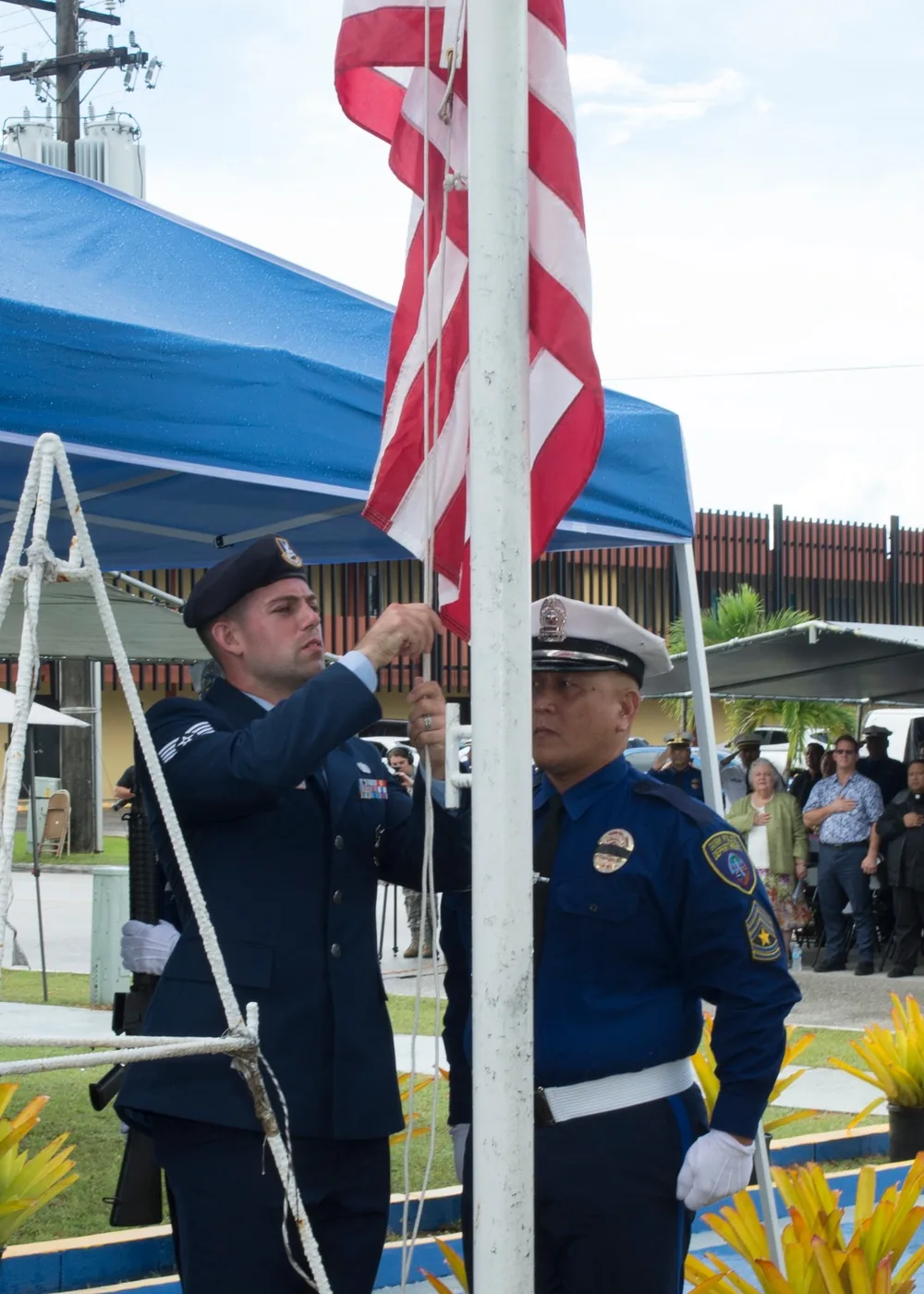
On adjacent staffs, the U.S. flag is hoisted first and lowered last. Companion flags must not be placed above it or in a position of superior honor. On a single halyard, the U.S. flag remains at the peak of that group; consult the controlling organization?s protocol before trying to create a half-staff arrangement with multiple flags on one line. If a flag cannot be lowered?such as a fixed indoor flag on a staff?do not improvise a physical half-staff position. Government and military manuals may prescribe black crepe for particular fixed-staff displays, but that is an organization-specific procedure, not a universal substitute for every civilian display.
For an outdoor flag left up after dark, provide proper illumination and follow the notice?s end time. ?Sunset? does not mean leaving a lowered, unlit flag unattended overnight. Facilities that close early should use their agency policy rather than guessing whether to lower the flag before closure.
How 2026 Was Implemented Across States
The 2026 observance shows why a national date still requires local verification. The White House proclamation designated Friday, May 15, and called on governors and other officials to direct a half-staff display. States then issued notices using their own authority and property language.
| Jurisdiction | Flags and locations named | 2026 timing |
|---|---|---|
| Virginia | U.S. and Commonwealth flags on all state and local buildings and grounds | Sunrise to sunset |
| Florida | U.S. and Florida flags at local and state buildings, installations, and grounds | Sunrise to sunset |
| Kentucky | Flags at all state office buildings; individuals, businesses, and organizations encouraged | Friday, May 15 |
| Washington | Washington and U.S. flags at all state agency facilities; others encouraged | Until close of business or sunset |
These are not contradictions. Each notice identifies the property within that state?s administrative control and may extend an invitation beyond it. One explicitly includes local grounds; another focuses on state offices; another gives ?close of business or sunset? as the operational endpoint. The shared observance does not erase those details.
Use an official notice as a mini work order. Record the issuer, publication date, active date, named flags, covered locations, start, end, and any instruction for remote offices. Save the source URL with the facilities log. If a repost or news headline omits one of those fields, return to the governor?s office or agency document instead of filling the gap by assumption.
Because current instructions can change, this 2026 comparison is an example?not a substitute for next year?s notice. Check the live status page and the issuing office each May. The calendar helps with advance scheduling, but an official order supplies the final scope for a specific public facility.
Planning Checklist for Schools, Businesses and Public Agencies
A calendar reminder is useful, but it is not a complete flag program. Government notices show that departments may be responsible for distributing instructions to every field office. A school district, company, or civic organization can use the same principle without pretending its internal procedure is a government order.
- Thirty days ahead: put May 15 on the facilities calendar and note whether it falls on the third Saturday.
- During Police Week: monitor the White House, governor?s office, and your organization?s official communications for the current proclamation or directive.
- When a notice arrives: capture the exact flags, properties, start, end, time zone, and any instructions for closed buildings.
- Assign responsibility: name a primary and backup person for the morning and evening ceremony; send the notice to remote sites.
- Inspect equipment: check the pole, halyard, clips, lighting, and the condition of every flag before the observance.
- Document completion: record when the flag reached half-staff and when it was restored or lowered for the day.
Weather and building schedules require advance decisions. Flag Code custom favors sunrise-to-sunset outdoor display; a flag displayed after dark should be properly illuminated. Some agency policies permit an all-weather flag during poor weather, while others may direct staff to remove a flag. Follow the policy that actually governs your site. Likewise, do not copy a Postal Service closed-facility procedure into a school or private business unless your own policy adopts it.
If May 15 falls on a weekend when the site is closed, do not silently move the observance to Friday or Monday. The federal date remains May 15. An issuing authority can specify a different active date for a particular jurisdiction, but facilities personnel should not invent that substitution. A lobby display, memorial program, moment of remembrance, or staff communication may supplement the flag ceremony when permitted; it does not change the official flag hours.
Finally, keep live status and long-range planning separate. Use the calendar to prepare, then verify the current flag-lowering order before acting. That last check catches overlapping national mourning periods, state-specific instructions, and late amendments.
Peace Officers Memorial Day Flag FAQ
Are flags lowered for all of Police Week?
Not automatically. Under 36 U.S.C. ? 137, Police Week is the week in which May 15 occurs. The recurring half-staff rule addressed in this guide is for Peace Officers Memorial Day itself. A specific site may follow a longer memorial display under state law, a memorial-site policy, or another order, but ?Police Week? alone should not be rewritten as a nationwide week-long half-staff command.
Is Peace Officers Memorial Day always May 15?
Yes. May 15 is fixed; the weekday changes. Police Week dates therefore move around it. In 2026 the presidential proclamation designated May 10 through May 16 as Police Week. Always use the proclamation for the year you are planning rather than copying those week dates forward.
What if the annual proclamation has not appeared yet?
The May 15 date and Armed Forces Day exception are in standing federal law, while 36 U.S.C. ? 136 requests the annual proclamation. Federal and other public employees should follow their agency?s official instruction chain. Private operators can prepare from the statute but should check current federal and state sources before describing any particular year?s proclamation as issued or any additional scope as confirmed.
Should the state flag also be at half-staff?
Read the state notice. Virginia and Florida expressly named their state flags in 2026, and the Postal Service instructed its own facilities about all other flags. Those examples do not create one universal rule for every organization. At minimum, do not leave a companion flag in a position that appears superior to the U.S. flag.
Can the flag remain at half-staff overnight?
A flag may be displayed after dark when properly illuminated, but the order?s endpoint still controls. If it says ?until sunset,? restore or lower the flag at sunset. If an agency gives ?close of business or sunset,? follow that agency instruction. Illumination permits nighttime display; it does not extend an expired mourning period.
Is ?half-mast? the correct term?
For a U.S. flag on land, half-staff is the Flag Code term. ?Half-mast? is commonly used in naval settings and everyday speech. The visible instruction is the same kind of respectful lowering, but a public-facing U.S. land protocol should use half-staff for precision.
Comments
Comments are reviewed before publication.
Sign in with Google to join the discussion.
Loading comments…