
Where to Check Michigan’s Half-Staff Status Today
Start with the Michigan half-staff status page, then open the linked notice from the Michigan Governor’s Office before changing a flag. The state’s official Flag Honors hub says notifications are issued by the Executive Office of the Governor and posted in the Governor’s newsroom. Because Michigan also follows presidential half-staff proclamations, check the current U.S. flag status as a separate layer.
This three-part check answers different questions. The Michigan status page gives a readable current result and searchable history. The Governor’s dated release supplies the official reason, locations, flags, effective period, and restoration instruction. The national page identifies a presidential instruction that may apply even when no new Michigan-specific honor has been issued.
Do not act on a search headline alone. An official release may contain “today” or “immediately” because those words were accurate when it was published. Months later, the same page can still rank in search even though the flags were returned to full staff. Open the release and compare its publication date with its actual lowering date.
Before moving a flag, answer four questions:
- Is the source the Michigan Governor’s Office, the White House, or the authority responsible for this facility?
- Does the effective date include today in the flag’s Michigan location?
- Does the notice cover the whole state, only public buildings, a district, the Capitol Complex, or another named place?
- Does it end at noon, sunset, a stated date, interment, or a later announcement?
If any answer is missing, treat the status as unconfirmed rather than inventing an end time. A flag that happens to be low at one school, store, or post office is evidence about that pole—not proof of a new statewide order. The official notice and its exact scope remain the controlling evidence.
How to Sign Up for Official Michigan Flag Honor Alerts
Michigan’s official Flag Honors page links directly to a GovDelivery topic for Flag Honor Alerts. Use that state page as the entry point: it lets you confirm that the subscription destination is associated with the Michigan Executive Office of the Governor rather than a look-alike mailing list.
- Open the Flag Honors page and select “Sign Up for Flag Honor GovDelivery Alerts.”
- Enter the requested email/contact information on the Michigan Executive Office of the Governor update page.
- Complete any confirmation step the service sends and review your subscriber preferences.
- Allow-list the delivery address or domain in the mailbox used for facilities notices.
- When an alert arrives, open its Michigan.gov release and save that URL with the effective period.
The official pages document email updates; they do not establish that every subscriber receives an SMS, app notification, or guaranteed message by a particular hour. Email delivery can also be delayed or filtered. Treat subscription as an early-warning channel, not as the only status check.
A practical setup for schools, cities, and businesses
Send alerts to a shared mailbox that more than one trained person can monitor. Create a rule that flags messages from the Michigan Governor’s Office without automatically moving them out of sight. Put the lowering window, the source URL, the covered property, and the restoration time into the same operations calendar used by the morning and evening staff.
Assign a primary operator and a backup. A Friday-afternoon notice may affect a weekend when the usual facilities employee is away. A message saying “until further notice” also requires someone to watch for the follow-up rather than closing the task after the first lowering.
The Governor’s newsroom remains the public archive if an email is missed. Search it for “flag” plus a date or honoree, then compare the result with the Michigan status and history page. The subscription tells you to look; the dated official release tells you what to do.
How to Read a Michigan Half-Staff Notice
A Michigan flag-honor release is an operating instruction, not merely a tribute. Read past the headline and extract the fields that tell a flag custodian exactly when, where, and how the honor applies. Publication time alone is not the effective time.
| Field to find | Question it answers | What to record |
|---|---|---|
| Authority | Who issued the instruction? | Governor, President, or responsible local authority |
| Reason | Whom or what does it honor? | Honoree or observance exactly as stated |
| Flags | Which flags move? | U.S. flag, Michigan flag, or other named flags |
| Scope | Which poles or properties are covered? | Statewide, public buildings, Capitol Complex, district, or named facilities |
| Start | When does lowering begin? | Date plus “immediately,” sunrise, or another stated time |
| End | When should flags return? | Noon, sunset, a date, interment, or “until further notice” |
Two official Michigan notices show why every field matters. A June 2026 release was published one day before the lowering: it called for the United States and Michigan flags to be lowered statewide on June 13 and returned to full staff on June 14. By contrast, a September 2023 notice took effect immediately at the Capitol Complex and public buildings across Michigan and continued “until further notice.” It promised a later announcement of the return date.
Those examples are historical, not current instructions. They demonstrate that a one-day order and an open-ended order need different workflows. For a dated order, schedule both the lowering and restoration before closing the notice. For an open-ended order, keep a visible pending task and monitor the official newsroom until the state supplies the ending instruction. Never substitute an assumed sunset.
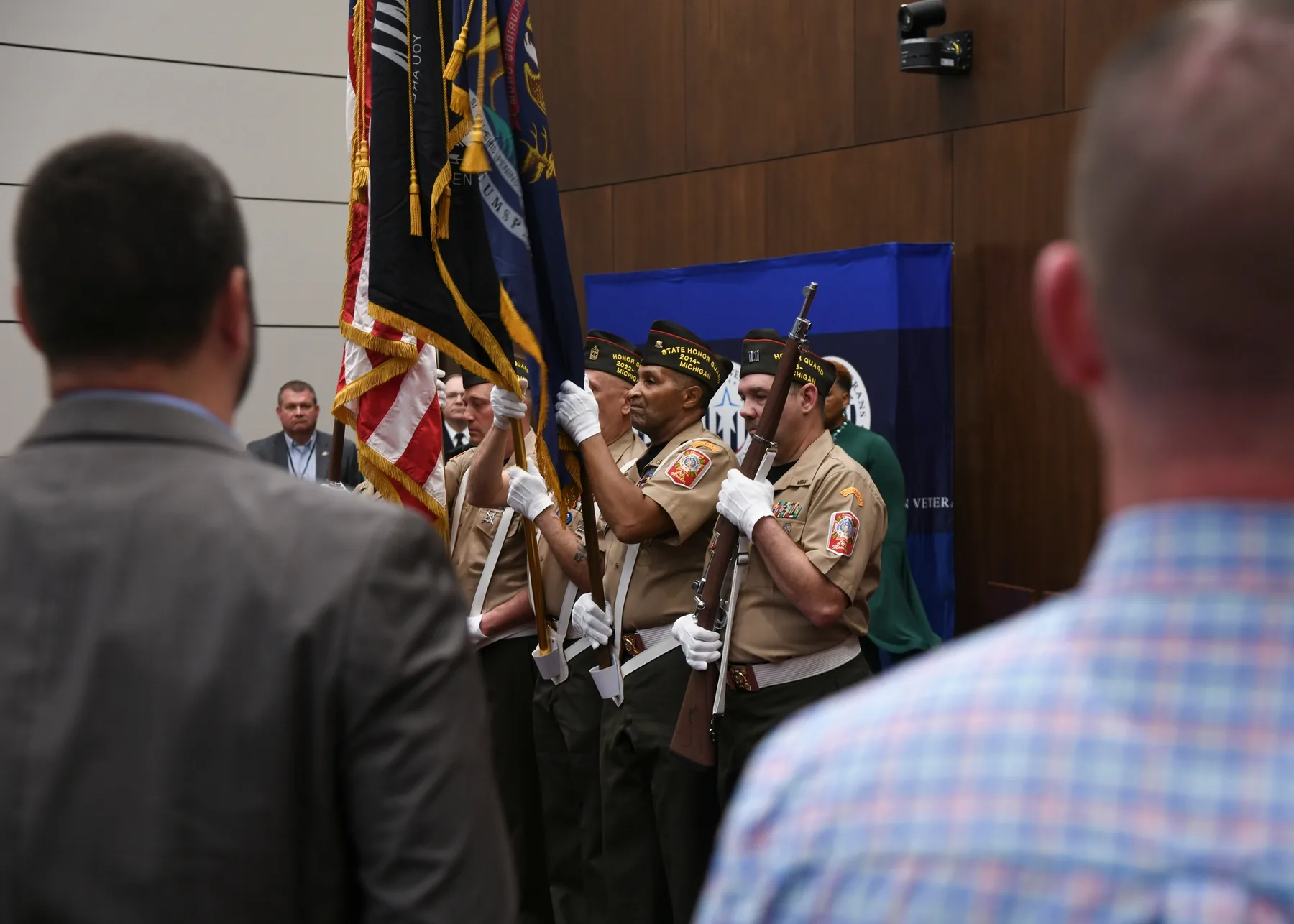
Also distinguish an invitation from a mandate. Michigan releases often encourage residents, businesses, schools, local governments, and other organizations to participate. Preserve that wording instead of telling every private owner that the notice legally commands action. Once the effective window is confirmed, add it to an operations calendar; the site’s flag calendar can help identify recurring observances, but it does not replace the source release.
What Executive Order 2013-10 Covers
Michigan Executive Order 2013-10 is the state’s standing framework for displaying flags and recognizing deaths, service, and specified observances. It helps explain why a Michigan notice may apply everywhere in the state, only in a legislative district, at the State Capitol, at military facilities, or at an individual agency or facility.
The order is best used as a decision framework:
- Identify the trigger. Is the lowering tied to a recurring observance, a presidential direction, the death of a public official, a Michigan service member, a law-enforcement officer or firefighter killed in the line of duty, or another person or event addressed by a special instruction?
- Match the trigger to the location. The order does not assign one universal geographic scope to every honor. Different categories can reach different state-controlled buildings, districts, military facilities, or agency properties.
- Find the duration. Some observances use a defined part of a day; some honors follow dates connected to death, funeral, or interment; special instructions may state another window.
- Check the current release. The dated Governor’s Office notice turns the general framework into a usable instruction and may clarify the exact flags, places, dates, and return time.
This matters because the framework also allows the governor to issue instructions for other officials, dignitaries, and tragic events. A situation does not have to fit a reader’s remembered category to produce a valid notice. Conversely, seeing that a past event once resulted in statewide lowering does not prove that a new event has the same scope.
Standing policy is not a substitute for the latest notice
Do not use the 2013 document as an exhaustive current calendar. Its annual-observance section and the current Flag Honors page are not identical: the current state hub also identifies Pearl Harbor Remembrance Day among the days when the flag is lowered. Consult the live state hub and the dated notice alongside the executive order, particularly when planning future dates.
When an honor is for a person, the order encourages facility managers to post the honoree’s name near the main entrance. That small step helps visitors understand that a lowered flag is deliberate and whom it honors. For a broader explanation of presidential, gubernatorial, and local authority, see who can order flags to half-staff.
The practical rule is simple: use Executive Order 2013-10 to understand the category and likely scope, then use the current official notice to operate the pole. Save both records when the distinction affects multiple buildings or shifts.
Statewide, Capitol-Only, District, and Facility Scope
The word “Michigan” in a headline does not automatically make an order statewide. The operative location phrase in the notice determines whether a particular pole is included. Copy that phrase into the work order before assigning staff.
| Scope language | Likely operational reach | Common mistake to avoid |
|---|---|---|
| Throughout or across the State of Michigan | The state notice describes statewide reach for the named flags; read the full sentence for covered properties | Ignoring separate language that merely encourages private participation |
| State Capitol Complex | State-controlled poles in the named Capitol complex | Extending a Capitol-only instruction to every public building |
| All public buildings and grounds | Public facilities covered by the notice across the stated geography | Assuming this wording automatically commands every home or business |
| Legislative district | Covered state facilities within the represented district under the standing framework | Treating the district honor as a statewide instruction |
| Named department, agency, military site, or facility | The specifically identified operational unit or property | Applying it to unrelated agencies or nearby private sites |
Recent official notices illustrate the difference. Michigan’s June 2026 honor for Army Cpl. George F. Sepsey used statewide language. A separate June 2026 notice for former state Sen. Robert Geake specified the State Capitol Complex. A January 2026 line-of-duty honor for Fire Chief David Haverdink named both the Capitol Complex and public buildings and grounds across Michigan. These are historical examples used to explain wording, not current flag alerts.
A property-level applicability test
- Identify who owns or controls the pole: state, county, city, school district, federal agency, business, association, or private resident.
- Underline the notice’s exact location and property language.
- Check whether participation outside that set is ordered, requested, or encouraged.
- For a multi-site organization, make a location list and mark each site “included,” “voluntary,” or “needs authority confirmation.”
- Send the official URL and the same interpretation to every shift so one branch does not improvise a broader scope.
If ownership or jurisdiction is unclear, ask the agency or governing body responsible for the facility. Do not infer statewide coverage from a photograph of a nearby lowered flag. Return to the Michigan status page, open the active source, and make the decision from its operative sentence.
Michigan Orders and Federal Orders Can Differ
Michigan has two status layers: a presidential or federal direction and a Michigan governor’s order. They often align, but they are not interchangeable. The Michigan Flag Honors hub expressly recognizes both presidential proclamations and gubernatorial action under the state’s standing framework.
| Federal layer | Michigan layer | What a custodian should do |
|---|---|---|
| Full staff | Full staff | Keep flags at full staff unless another competent authority governs the property. |
| Half-staff | No separate state notice found | Open the presidential source and follow it on covered federal property; check the Michigan hub for state implementation. |
| No national lowering | Michigan half-staff order | Follow the Michigan notice on properties it covers; do not reject it because a national page says full staff. |
| Half-staff | Michigan half-staff notice | Compare both ending instructions and keep the source that governs each property. |
This distinction is especially important for organizations with mixed sites. A federal office, a state agency, a municipal building, and a private storefront in the same city may not receive identical instructions from the same authority. Federal-facility staff should use their federal agency chain and the presidential source. Michigan state-property staff should read the Governor’s notice. Local and private custodians should identify whether their participation is directed by their own authority or encouraged by the state release.
A historical Michigan notice from January 20, 2025 shows how overlapping instructions can change during one broader mourning period. Michigan raised the U.S. and state flags for the remainder of Inauguration Day, then directed them back to half-staff through January 27 to resume honors for former President Jimmy Carter, with restoration to full staff on January 28. The example is not a current order; it demonstrates why a single label without dates and sources can mislead.
Use a two-source status check
- Open the national flag-status page and its linked presidential or federal authority.
- Open the Michigan flag-status page and its linked Governor’s Office release.
- Write down the start, end, flags, and scope from each source separately.
- Apply the instruction that governs the property; if both apply, follow the active lowering window and retain both records.
Do not “average” conflicting dates or let a dashboard override an official document. When the property’s authority is uncertain, escalate the question to that facility’s legal, administrative, or agency contact before moving the flag.
How to Lower and Restore the Flags Correctly
After confirming that an order covers the property, operate the flag in the full ceremonial sequence. Michigan’s protocol follows the U.S. rule: a flag does not move directly from its resting position to halfway.
- Inspect the pole and halyard. Clear tangles and make sure the flag can travel safely to the peak and down to the halfway position.
- Hoist the U.S. flag briskly to the peak. Hold it there for an instant.
- Lower it ceremoniously to half-staff. Michigan defines that position as halfway between the top and bottom of the staff. Use the flag-position guide if the correct point is unclear.
- Place the Michigan flag consistently. The state Flag Honors page says the Michigan flag is also lowered when the U.S. flag is at half-staff.
- At the end of display, raise the U.S. flag to the peak again. Only then lower it ceremoniously for removal.
Daylight, lighting, and multiple staffs
The normal display period is sunrise to sunset. A flag may remain displayed at night when it is properly illuminated. If a site lacks suitable illumination, its evening procedure should include taking the flag down through the peak-first sequence rather than leaving it unlit.
On adjacent staffs, the U.S. flag should be hoisted first and lowered last. A Michigan, city, organizational, or other subordinate flag should not be placed above the U.S. flag or in a position of superior prominence. On a shared halyard, the U.S. flag remains above the state flag even while the display is at half-staff.
Memorial Day has a crucial exception: the flag stays at half-staff only until noon and then rises to full staff for the rest of the day. A work order that says only “Memorial Day—half-staff” is incomplete; schedule the noon transition.
Restoration is a separate operational task
Record the return time when the lowering is assigned, not at the end of the honor. At restoration, verify that the official window has ended, raise the flag to the peak, and leave it at full staff if it remains on display. For “until further notice” orders, obtain the follow-up source before restoring.
A fixed indoor or wall-mounted flag may not have a workable half-staff position. Do not invent a black ribbon or other substitute and call it an official requirement. Ask the property’s governing authority for its approved practice, especially in a public facility.
Michigan Flag Alert FAQ and Facilities Checklist
Are flags at half-staff in Michigan today?
Because the answer changes, check the live Michigan status and open its official source. Then check the national status for a presidential instruction. Confirm the date, scope, and ending time before acting; an evergreen article should never be treated as today’s order.
Does the Michigan flag also go to half-staff?
Yes, the Michigan Flag Honors page says the Michigan flag is also lowered when the U.S. flag is lowered to half-staff. Preserve the U.S. flag’s superior position and follow the instructions for adjacent staffs or a shared halyard.
Do businesses and residents have to participate?
Read the exact release. Michigan notices commonly say residents, businesses, schools, local governments, and other organizations are “encouraged” or “urged” to participate when a statewide honor is announced. That wording should not be rewritten as a universal legal command. A public agency or regulated facility may have separate binding policy from its governing authority.
What if the notice says “until further notice”?
Keep the restoration task open. Monitor the Governor’s newsroom and your subscribed alert mailbox for a return-to-full-staff announcement. Do not guess that the order ends at sunset or after a funeral unless the source says so.
What if I missed the email alert?
The public newsroom is still the record to search. Missing or delayed email does not cancel a posted instruction. Find the dated release, compare it with both status pages, and document when the facility received and verified it.
Whom should a state facility ask about unclear instructions?
Michigan Executive Order 2013-10 directs state-department and agency questions about half-staff display at state buildings, grounds, and facilities to the Office of the Governor. Use the agency chain and official Governor contact route. For feedback about this website rather than an official order, use the site’s contact page.
Shift checklist for a Michigan flag alert
- Verify: open the Michigan and federal source links; capture the issuer, reason, flags, scope, start, and end.
- Assign: name the person lowering the flags and a backup, especially for weekends or holidays.
- Prepare: inspect the halyard, pole, lighting, and access conditions before the effective time.
- Operate: raise to the peak first, lower ceremoniously to halfway, and keep subordinate flags in the correct relative position.
- Communicate: share the official URL and scope with every covered location; post the honoree’s name where appropriate.
- Restore: schedule noon, sunset, the stated date, or the verified follow-up—not a guessed endpoint.
- Archive: retain the source, timestamps, locations, operator, and restoration confirmation for the facility record.
The durable habit is source-first: alerts draw attention, status pages organize the answer, and the official notice controls the action.
Comments
Comments are reviewed before publication.
Sign in with Google to join the discussion.
Loading comments…