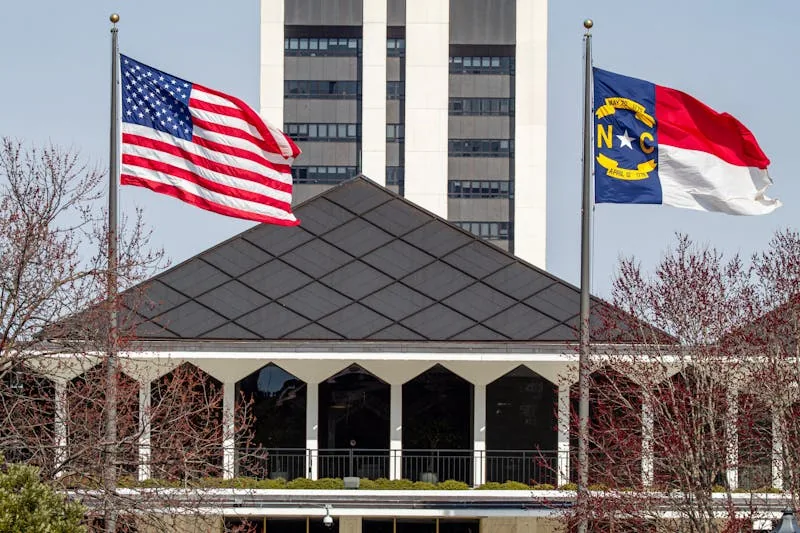
The official way to receive North Carolina flag alerts is to join the NC Department of Administration Flag Alert mailing list. The state says it uses that list to email subscribers when the Governor orders flags at state facilities flown at half-staff. An email is the beginning of the check, however, not the whole answer: open the government notice and confirm the authority, flags named, location, start time, and end time before acting. If you only need to know the current position, use the North Carolina half-staff status page. This guide instead explains how to subscribe, verify a notice, and decide whether its wording covers your flagpole.
How to Subscribe to Official NC Flag Alerts
North Carolina keeps the signup process on an official doa.nc.gov page. You do not need a third-party alert account to join the state mailing list.
- Open the Subscribe to Flag Alerts page.
- Enter an email address that is checked regularly. For a school, office, or public building, a monitored facilities inbox is usually more reliable than an employee’s personal account.
- Complete any confirmation step presented by the state’s subscription system.
- Keep the Flying Flags in North Carolina hub bookmarked. It displays recent alerts and links to the full archive.
- When a message arrives, open the linked government notice instead of making a decision from the subject line alone.
The signup page makes a specific promise: email notification of orders from the Governor concerning flags at state facilities. It does not say the list will explain every flag you might see lowered at a federal building, county office, city hall, school, business, or private home. That limitation is why a subscription should be paired with source checking.
How North Carolina Creates and Publishes a Flag Alert
The North Carolina State Government Flag Guide describes the official communication chain. The Department of Administration manages statewide communications about lowering flags. After receiving a Governor’s order, the Secretary of Administration notifies members of the Governor’s Cabinet and selected state agencies; other state agencies may receive notice through their cabinet member.
The public may learn about a statewide decision through the government website, social media, or the North Carolina Flag Alert Listserv. The guide says these orders are issued in writing and identify three essentials:
- the occasion being observed;
- whether the North Carolina flag alone, or the North Carolina and United States flags, should be lowered; and
- how long the half-staff period lasts.
The guide also states that the Secretary of Administration issues such orders in the Governor’s absence. For a reader, the practical lesson is simple: a forwarded screenshot or shortened social post may alert you that something happened, but the complete official notice is where you find the operational details.
Verify an NC Half-Staff Order in Five Checks
1. Confirm the source
Start with an official North Carolina government page, normally on doa.nc.gov or governor.nc.gov, and make sure the connection uses HTTPS. A news report can provide context, but it should not be the only evidence used to set a public facility’s flag schedule.
2. Identify the issuing authority
Determine whether you are reading a presidential action, a North Carolina Governor’s order, or a local notice. These authorities can cover different properties and can have different end times on the same day.
3. Read which flags are named
Do not assume every alert lowers both flags. The state guide expressly anticipates written orders that name the North Carolina flag or the North Carolina and U.S. flags together. Copy the wording into your facility log.
4. Record the exact start and end
Watch for terms such as beginning immediately, sunrise, noon, sunset, or a funeral or interment. A date without its time boundary is incomplete. Memorial Day is the classic trap: a 2025 North Carolina Governor release directed U.S. and NC flags to half-staff from sunrise only until noon on Monday, May 26, not until sunset.
5. Match the location and participation wording
Look for the property type and geographic area, then notice the verb. “Ordered” for state facilities is not the same as “encouraged” for residents or businesses.
| Field to check | Ended July 2026 example | Why it matters |
|---|---|---|
| Authority | Governor Josh Stein | Identifies a North Carolina state action |
| Flags | U.S. and North Carolina flags | Prevents assuming an unnamed flag is included |
| Directed scope | State facilities | Defines where the order’s directive applied |
| Time | Immediately on July 13 through sunset July 18, 2026 | Sets the restoration point |
| Other participants | Individuals, businesses, schools, municipalities, counties, and other subdivisions were encouraged | Separates an invitation from the directed scope |
This July 13–18, 2026 NC DOA notice is an ended example, not a statement about the current flag position. Its value is that it shows how much useful information one complete alert contains.
Who Must Follow an NC Flag Alert?
There is no safe one-line answer for every location. First identify who owns or controls the property, then read the exact scope and action word in the notice.
| Flag location | What to look for | Practical response |
|---|---|---|
| State facility | A Governor/DOA directive naming state facilities | Follow the notice and the facility’s agency procedure |
| DOA-managed state building | DOA operational notice and state guidance | Use the official dates, flags, and handling instructions |
| County or municipal building | Whether the statewide notice includes local subdivisions or merely encourages them; also check a local directive | Follow the instruction governing that local property |
| School or separate public agency | The alert’s exact scope plus the institution’s policy | Do not treat a general invitation as a statewide command to every campus |
| Home, business, or nonprofit | Invitation language and the owner’s chosen protocol | Participation is often encouraged; read the notice before assuming it is required |
| Federal facility | A federal proclamation, statute, or agency direction | Use the federal instruction that governs that property |
North Carolina law also supplies background rules for state institutions and political subdivisions. For example, Chapter 144 of the North Carolina General Statutes addresses display and handling of U.S. and state flags on public premises. The actual alert and the policy governing a particular facility still provide the best operational answer; this guide is not a legal determination for an individual site.
Federal, State, and Local Notices Are Not the Same
A presidential action can direct the flag at federal buildings, grounds, naval vessels, and other specifically named federal locations. 4 U.S.C. § 7 also gives governors authority to proclaim the U.S. flag at half-staff for defined state-related deaths, including qualifying state officials, active-duty service members, and first responders.
A North Carolina gubernatorial order generally speaks to the North Carolina facilities and flags it names. A local decision is narrower still. The state guide says local officials may lower U.S. and NC flags on local government buildings upon the death of a current or former locally elected official. Seeing a flag lowered at one city hall therefore does not prove that a statewide order exists.
When sources appear to disagree, compare their jurisdictions rather than choosing one headline. Check today’s U.S. half-staff status, the North Carolina state page, and any instruction that governs the specific facility. For scheduled observances and time-of-day rules, use the half-staff calendar.
What to Do After an Alert Arrives
- Preserve the source. Save the official URL or a copy of the written notice with the date received.
- Extract the five fields. Record authority, flags, location, start, and end. Note whether your facility is directed or only encouraged to participate.
- Notify the responsible person. Send the complete schedule to the staff member who controls the pole and set a reminder for the return to full-staff.
- Use the proper sequence. North Carolina’s guide says to hoist the flag to the peak for an instant, lower it to half-staff, and raise it to the peak again before lowering it for the day. The flag position calculator can help with a movable halyard.
- Recheck before the endpoint. Review the official hub for an extension, correction, or later notice instead of relying only on the first email.
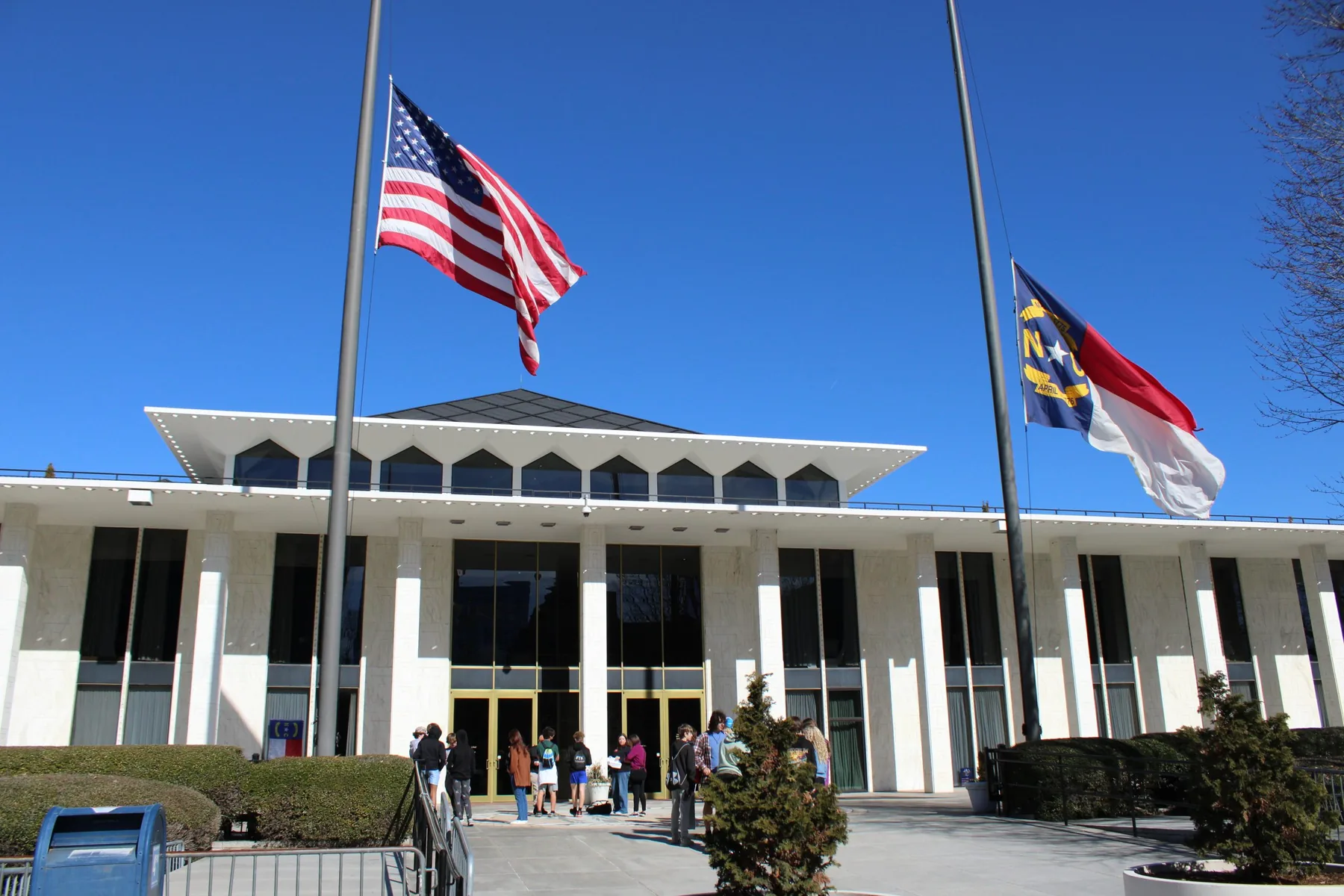
North Carolina Flag Alert FAQ
Does the email list show today’s current status?
The list notifies subscribers of covered Governor’s orders, but a current-status decision should use the complete official notice. Check the North Carolina status page for a quick summary, then follow its linked government source.
Does an NC order automatically cover private homes and businesses?
Do not assume that it does. NC alerts commonly direct state facilities and may separately encourage individuals and businesses to participate. Read the scope and wording of that specific notice.
Are both the U.S. and North Carolina flags always lowered?
No assumption is necessary: the state guide says the written order identifies whether the North Carolina flag, or the North Carolina and U.S. flags, should be lowered. Follow what the notice names and the display rules for flags sharing a pole or group.
What if a city flag is lowered but there is no statewide alert?
A local government may have issued a local-building decision. Check the city or county’s official channel. A local observance should not be expanded into a statewide claim without a Governor/DOA source.
Is “half-mast” wrong in North Carolina?
People use both terms, and USAGov mentions both. In official U.S. land-based guidance, including North Carolina’s materials, half-staff is the standard wording; half-mast is traditionally associated with vessels and naval settings.
Where can I find a notice I missed?
Start with the recent-alert list and archive on the official NC DOA flag hub. You can also search dates on the North Carolina status page and the site calendar. A missing database result is not proof that no local or official notice existed, so confirm with the responsible government source.
Comments
Comments are reviewed before publication.
Sign in with Google to join the discussion.
Loading comments…