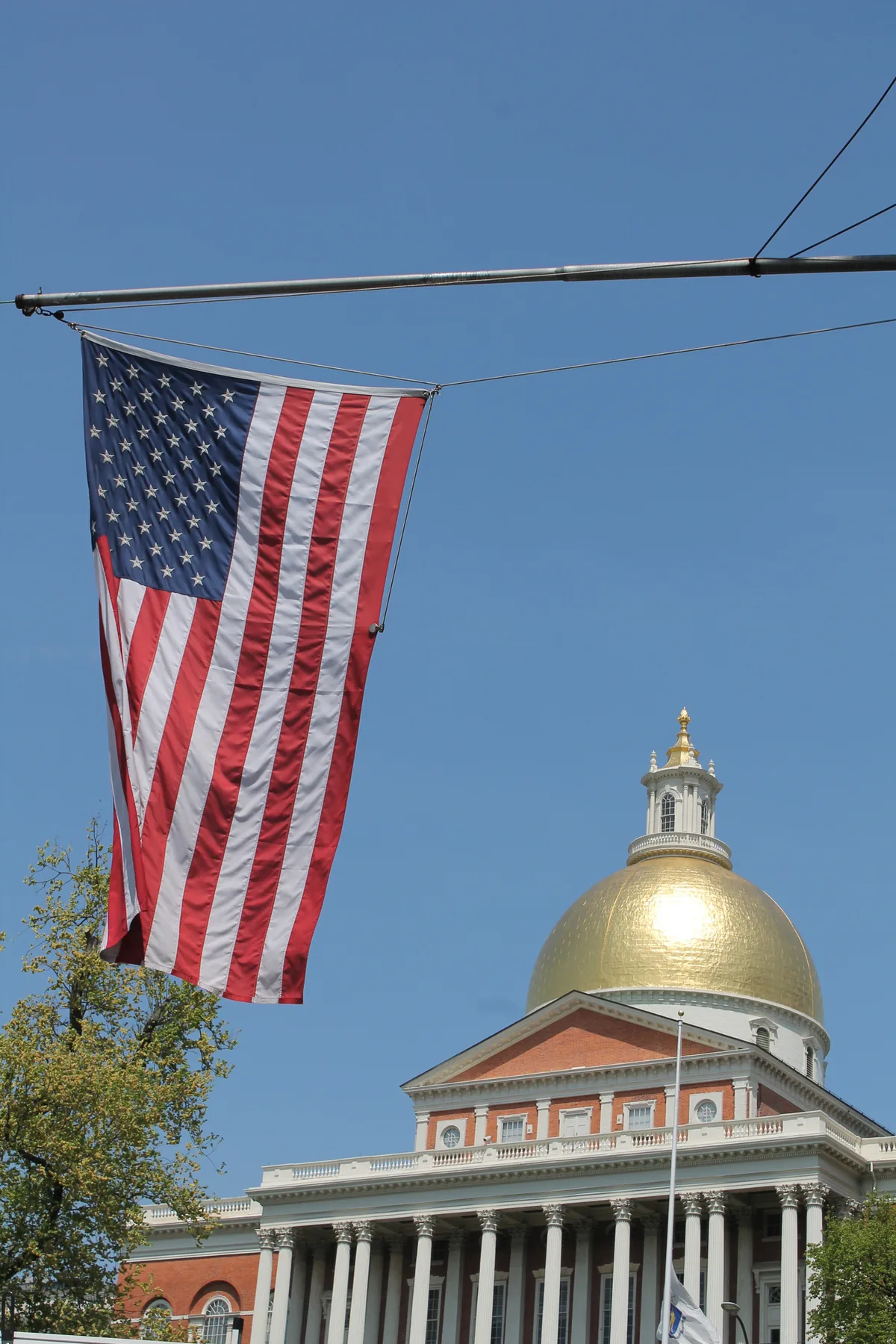
If you are checking the Massachusetts flag status today, start with the live Massachusetts flag status, then open the original government notice linked there. Confirm who issued it, which properties it covers, when it begins, and exactly when it ends before moving a flag. A flag seen near Boston may belong to the Commonwealth, the City of Boston, a federal agency, another municipality, a campus, or a private owner, so nearby poles can legitimately differ. Massachusetts uses half-staff for flags on land, although many people search for “half mast.” The live page supplies the quickest current answer; the Mass.gov, White House, city, or agency notice supplies the controlling scope and timing. If the issuer or property type is unclear, ask the facility manager instead of treating the sight of one lowered flag as proof of a statewide order.
Where to Check the Massachusetts Flag Status Today
Use a three-step source ladder. First, open the Massachusetts live status and order history for the fastest dated summary. It keeps Massachusetts and federal information visible as separate records and points to the underlying evidence. Next, open the Mass.gov Bureau of the State House Flag Status page for the Commonwealth's own status and notification information. If a national order may apply, check the original Presidential Action on the White House website and compare it with the current U.S. flag status.
Do not stop at a headline saying flags are “down across Massachusetts.” Save five operational details from the original notice:
- Issuer: President, Governor, city, agency, or another authority.
- Reason: the person, tragedy, or observance being honored.
- Scope: federal properties, Commonwealth facilities, a city system, or named sites.
- Start: the effective date and any sunrise or other time instruction.
- End: a fixed date, sunset, noon, interment, or another stated event.
The page's publication date is not automatically its effective date. A notice posted in the afternoon may direct lowering the following morning, while an order already in force may receive a later clarification. Check the timestamp and read the operative sentence rather than relying on a search-result snippet, social post, screenshot, or old browser tab.
If the three sources seem to disagree, compare jurisdiction and update time before assuming one is wrong. The state page describes Commonwealth action; a Presidential Action governs the federal scope it names; and the live status page organizes those signals for quick review. The original issuer's current text controls the details for its properties. This workflow also avoids a false “full-staff” conclusion when no fresh official confirmation is available: record the status as unconfirmed, keep checking the responsible source, and do not invent certainty.
How Massachusetts Half-Staff Email Notifications Work
The Bureau of the State House says it notifies other state-managed facilities by email when the Governor decides that flags will be flown at half-staff. Mass.gov also publishes two subscription procedures. Use the one that matches the number of recipients you need to add, and verify the instructions on the official page before sending because addresses or list-management procedures can change.
Subscribe one email address
From the address you want subscribed, send a completely blank email to [email protected]. “Blank” means no message text, no automatic signature, and no other body content. If your mail system automatically adds a disclaimer or signature, confirm whether you can disable it for that message or ask your administrator to send a genuinely blank request.
Request subscriptions for multiple addresses
Send the request to the State House Events Coordinator at [email protected]. Use Subscribe to Half-Staff Notifications as the subject. Put each email address on a separate line in the body. This route is for adding multiple recipients; it is different from sending the single-address blank listserv message.
A notification is an alert, not the complete operating instruction. Open the linked or referenced notice and record its issuer, effective period, property scope, and endpoint. Receiving a message does not prove that every home, business, municipal building, federal facility, or independent campus in Massachusetts is legally covered. Conversely, a missing email does not prove that no order exists: delivery can be delayed, filtered, or sent to a person who is away.
For an organization, assign a primary recipient and a backup, allowlist the relevant sender if your security policy permits it, and keep a simple log of each notice and restoration time. Test access before a holiday or staff absence. If an alert appears incomplete, use the Mass.gov Flag Status page and the original issuing page rather than forwarding an unsupported summary. These are practical reliability measures, not additional rules imposed by the Commonwealth.
What Massachusetts Law Actually Covers
Massachusetts General Laws chapter 2, section 6A is more specific than the phrase “flags throughout Massachusetts” may suggest. Its opening language concerns the flag of the Commonwealth at the main or administration building of each public institution, other state-owned or state-controlled buildings, and state military installations. Section 6 separately addresses ordinary display of the U.S. and Commonwealth flags at public institutions. Read those property and flag definitions before applying a rule.
Section 6A includes several distinct occasions and periods:
- When the national flag is at half-staff, the Commonwealth flag is lowered at the covered sites for the same period.
- A Massachusetts Governor or former Governor receives a 30-day period beginning on the date of death.
- Several current statewide officeholders and a U.S. Senator from Massachusetts are covered from death through sunset on the day of interment.
- A U.S. Representative's period is limited to covered sites in that congressional district.
- A current member of the General Court is honored at covered sites in the member's representative or senatorial district, as applicable.
- For other current or former elected officials, the statute calls for orders or instructions issued by or at the direction of the Governor.
The law also addresses military and POW/MIA cases. For a Massachusetts resident killed while performing military duty under official orders in active-duty status, the Commonwealth flag may be lowered from the day of death through sunset on the day of interment in accordance with Governor-issued or Governor-directed instructions. If POW or MIA remains are repatriated within Massachusetts, the period runs from their arrival through the day of interment. National POW/MIA Recognition Day—the third Friday in September—has an annual sunrise-to-sunset Commonwealth-flag rule. Put that recurring date on the half-staff calendar, but still check for any current instructions.
District limits and overlapping periods matter
A district-specific provision is not automatically statewide. Identify the district and the sites covered before issuing work orders. Section 6A also says coinciding periods are satisfied without adding a separate extra period for each death. In practice, track every applicable record and restore only when the remaining applicable period has ended; do not “stack” another full period after an overlap merely because two events occurred.
Federal law adds another layer. Under 4 U.S.C. § 7(m), a Governor has authority to proclaim half-staff display of the U.S. flag for specified state officials, active-duty Armed Forces members, and line-of-duty first responders. It also contains a special federal-installation consequence for a qualifying military-death proclamation. That does not make every detail of Massachusetts § 6A a universal private-property command. This summary is operational guidance, not legal advice; a public facility should read the current statute and the operative notice, then consult its responsible counsel or facilities authority when coverage remains uncertain.
Federal, State, Boston, and Local Orders Are Not the Same
“In Massachusetts” describes geography, not a single flag-management system. The President, Governor, City of Boston, another municipality, a department, and a private owner may each issue or adopt a direction within a different sphere. Two poles a block apart can therefore have different valid instructions.
| Source | Typical scope to verify | What the operator should open |
|---|---|---|
| President | Federal buildings, grounds, military posts, naval stations, vessels, and other places named in the action | The original White House Presidential Action and the facility's federal instruction |
| Massachusetts Governor | State buildings or another class explicitly named in the notice, subject to applicable law | The current Mass.gov status and the Governor's operative text |
| Boston or another municipality | City or town buildings, flagstaffs, or sites stated by the municipal order | The Mayor, council, clerk, or other official city record |
| Department or public entity | Facilities under that department's or entity's jurisdiction | The department notice and facilities chain |
| Home, business, or private organization | Its own flagpole, often participating voluntarily | The owner's policy plus the official order being honored |
Boston's own symbols page illustrates the distinction. It says the U.S. flag at Boston City Hall is lowered whenever the President or Governor orders it. That is a stated City Hall practice of following those authorities; it does not turn the municipal building into a federal or Commonwealth-owned facility. The same page also describes Boston's own flag-display customs and dates on which municipal buildings display the U.S. flag.
A narrower example came from the Boston Police Department on Peace Officers Memorial Day, May 15, 2026. Its announcement said the American flag and all other flags on Boston Police facilities would be flown at half-staff that day. The named scope matters: the notice supports an instruction for those department facilities, not a standing claim that every Boston, Massachusetts, federal, campus, or private pole was controlled by that announcement.

When multiple notices apply to one property, keep them as separate records rather than blending them into a vague statewide instruction. Note the issuer, covered property, start, and endpoint for each. A local body may choose to follow state or federal leadership, but voluntary alignment and legal ownership are different questions. If the building's status is uncertain, the responsible facilities office—not the distance between two flagpoles—is the best source for determining which instruction controls.
Why a Flag Near Boston May Not Match the Online Status
A visible mismatch is a prompt to investigate, not proof of a secret statewide order or a Flag Code violation. Begin with the pole, not the skyline. Write down the address, observation time, and property name, then identify whether it is a Commonwealth office, Boston municipal building, federal courthouse, school or university, cemetery, police or fire facility, independent authority, business, or home.
Work through these checks in order:
- Confirm the date and local time. The order may start at sunrise, end at sunset, change at noon, or have expired since a cached page was loaded.
- Identify the owner or controller. A federal building and a nearby city building do not necessarily receive the same instruction.
- Identify the flag. From a distance, the U.S., Massachusetts, Boston, institutional, memorial, or service flag can be mistaken for another.
- Read the operative scope. Compare “all state buildings,” “Boston Police facilities,” a named district, or another precise phrase with the property.
- Check the endpoint and overlaps. One applicable instruction may continue after another ends.
- Ask the facility. Give the address and time so staff can check the actual pole and work order.
Weather can also change what you see without changing the official status. The Bureau of the State House policy says flags should not be displayed in inclement weather unless an all-weather flag is used. Boston says the U.S. flag at City Hall is ordinarily displayed daily except Sundays and severe weather. An empty pole can therefore reflect an established display practice rather than a declaration of full-staff or half-staff status.
Other explanations—maintenance, a damaged flag, a delayed movement, staff error, or voluntary private mourning—are reasonable troubleshooting possibilities, but they are not verified facts about a particular site. A campus, cemetery, courthouse, firehouse, or business can have its own management chain. Do not label a display wrong from a photo alone.
If the discrepancy remains, contact the property manager, clerk, public-information office, or facilities desk. Share a timestamped photo if safe and appropriate, the exact location, the flag you observed, and the official notice you compared. That gives the controller useful evidence and avoids turning an uncertain observation into an unsupported public claim.
How to Read the Start and End Time Correctly
Copy the notice's time phrase exactly. “Published today” is not an instruction, and “for three days” is not precise unless the first day is known. Record the effective date, local start, ending condition, property scope, and source URL in one line that another person can follow.
- Sunrise to sunset on a fixed date: use the date and the flagpole's locality, not the reader's location.
- Until noon: change the position at noon. Memorial Day's standard rule is half-staff until noon and full-staff afterward.
- For 10 or 30 days: count from the date specified by the controlling rule and document the planned restoration day.
- Until sunset on the day of interment: keep the endpoint open until the issuing office confirms the interment date; never estimate it from the posting date.
- District-only: apply the time only at covered sites in the named congressional, representative, or senatorial district.
- Overlapping orders: track each record and remain at half-staff while any instruction applicable to that property is still active.
Massachusetts notices sometimes use event-based language. A 2025 Governor notice for State Senator Edward J. Kennedy, for example, directed flags at all state buildings starting that day until sunset on the day of interment. The release did not turn “interment” into a guessed calendar date. A facility following that wording would need a later official confirmation or instruction before scheduling restoration.
For sunrise or sunset, use the city or town where the flag stands. The U.S. Naval Observatory offers an official rise/set calculation service, while an agency may have its own designated operational time source. Record the location, date, Eastern Time result, and source used. Boston and Pittsfield do not have identical solar times merely because both are in Massachusetts.
Return to full-staff only after the last applicable instruction ends
Before restoration, compare the half-staff calendar, the live state page, and every saved federal, state, or local notice that covers the property. If one ends at sunset Friday and another runs through interment on Saturday, the second still controls. Do not add extra mourning days after all applicable periods end, and do not shorten an open-ended period by assumption.
The physical movement also has a sequence. Under 4 U.S.C. § 7(m), first hoist the flag to the peak for an instant, then lower it to half-staff. Before lowering it for the day, raise it to the peak again. When the mourning period ends while the flag remains displayed, raise it to the peak. The half-staff position guide shows the correct placement and movement for the pole.
A Two-Minute Massachusetts Verification Checklist
Use this checklist before changing a flag or sending instructions to multiple buildings. It is an editorial operations aid, not a substitute for your agency's policy or legal review.
- Set the date and location. Write the Massachusetts city or town and the current Eastern Time. Do not rely on a tab opened yesterday.
- Check both signals. Open the Massachusetts live page and the U.S. national status. A state action can exist without a federal one, and their endpoints can differ.
- Open the issuer's record. Use Mass.gov for a Governor or Bureau instruction, the White House for a Presidential Action, or the named city, town, department, or agency page for a local instruction.
- Match the property and flag. Decide whether phrases such as “all state buildings,” “federal facilities,” “Boston Police facilities,” or a named district actually include your site.
- Copy the start and end. Record sunrise, noon, sunset, a fixed last date, interment, or another event exactly. Mark an unknown interment date as awaiting confirmation.
- Check overlaps. List every active notice that applies. Do not restore while one remains in force.
- Move the flag correctly. Raise to the peak first, lower to half-staff, and raise to the peak again before final lowering.
- Log and communicate. Save the source URL, checked time, decision, restoration trigger, and responsible operator.
A useful log line is: checked time | issuer | covered property | start | end/trigger | source | operator. For example, a first release may say “all state buildings” but omit a known funeral date. Record the property scope and leave the end trigger open instead of guessing. Assign someone to revisit the official page, and note when the next check will occur.
For a multi-building organization, send the original link with the instruction, not just “lower flags today.” Name the covered sites and the planned restoration trigger. A backup recipient should be able to reproduce the decision from the log if the primary operator is unavailable. These recordkeeping steps are practical safeguards; each organization may set its own retention, approval, and escalation rules.
Massachusetts Flag Status FAQ
Is “half-mast” wrong in Massachusetts?
People will understand it, and it is a common search phrase. For a flag on a land-based staff, however, half-staff is the standard U.S. term. Title 4, section 7 of the U.S. Code uses “half-staff” and defines it as halfway between the top and bottom of the staff. Half-mast is traditionally associated with a ship or naval setting. The practical display position expresses the same mourning idea, but official Massachusetts facility instructions generally use “half-staff.”
Does a Massachusetts order require homes and businesses to lower flags?
Do not assume so. Read the order's exact scope. Massachusetts General Laws chapter 2, section 6A names public institutions, state-owned or state-controlled buildings, and state military installations for its Commonwealth-flag rules. A Governor release may say “all state buildings” or may invite broader participation. A request or invitation is different from a mandate covering private property. A homeowner or business can choose to participate consistently with its own policy, but should not describe that choice as legally required unless the controlling text actually says so. Separate lease, association, employer, or local rules may also need review.
Do the Massachusetts and U.S. flags move together?
At Bureau of the State House facilities, official policy says the U.S. and Commonwealth flags are treated alike in half-staff cases. Massachusetts law also says the Commonwealth flag is lowered at covered sites when the national flag is lowered. Still, an operator should read the current notice: some statutory language focuses on the Commonwealth flag, while a particular Governor release may expressly name both flags. On one pole with a shared halyard, the U.S. flag retains its superior position; “together” does not mean placing another flag above it.
Can Boston lower flags when the statewide page says full-staff?
A valid narrower action is possible. Boston has municipal display practices, and a city department can issue an instruction for facilities under its control. The Boston Police Peace Officers Memorial Day example applied to Boston Police facilities. Such a record does not silently change the Commonwealth status, just as a Commonwealth notice does not erase an independently applicable federal instruction. Verify the Boston issuer and the named city properties before treating a local lowering as citywide.
What if the notice ends on the day of interment but gives no date?
Do not guess. Record the endpoint as “sunset on the day of interment—date awaiting official confirmation,” keep the original notice, and assign a person to check the issuer's updates. A funeral-service date in a news report is not automatically the interment date, and an obituary should not replace the authority's restoration instruction. If the information remains unavailable, contact the issuing or facilities office. Restore only after the event-based endpoint is confirmed and no other applicable order continues.
Comments
Comments are reviewed before publication.
Sign in with Google to join the discussion.
Loading comments…