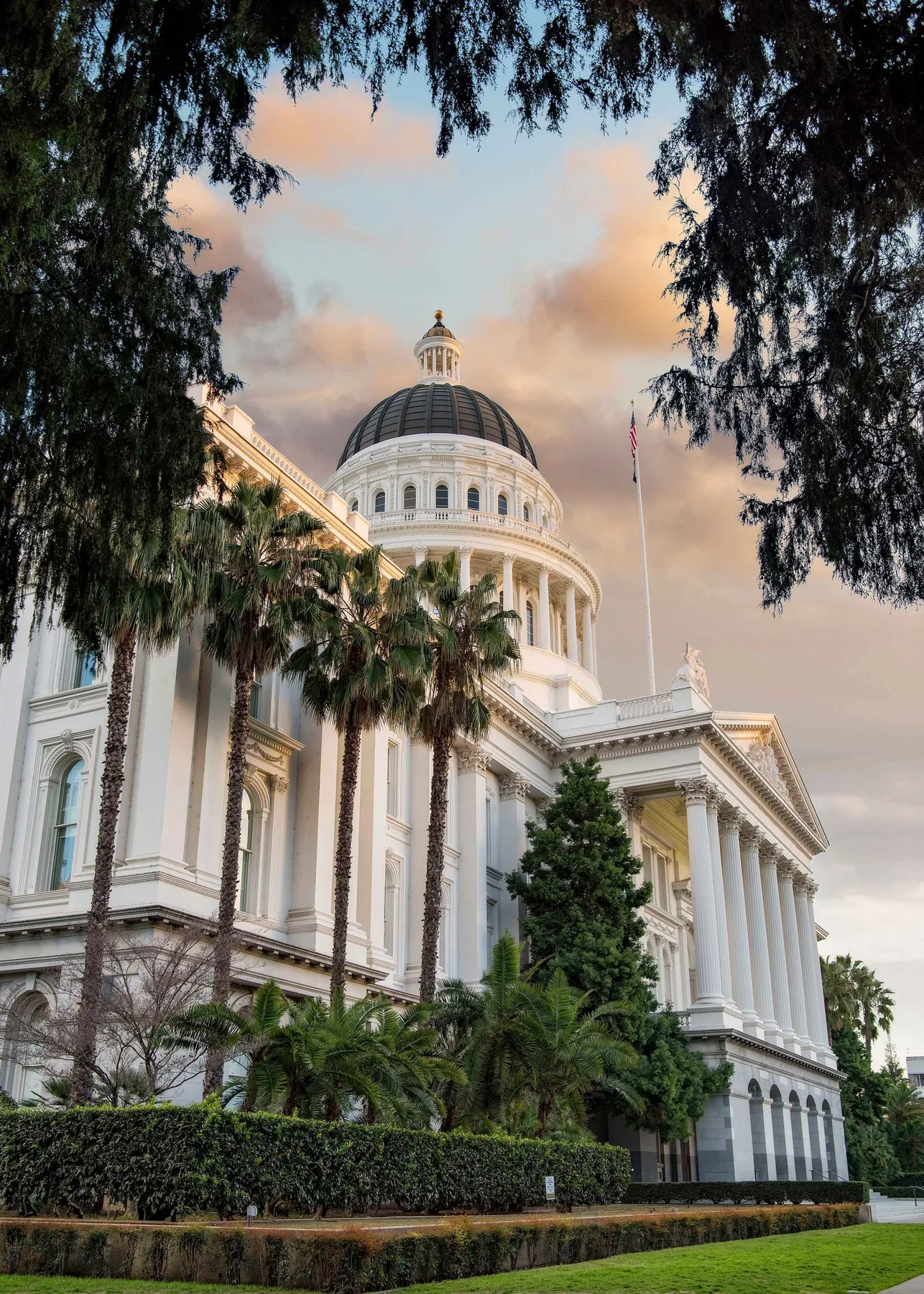
California half-staff rules do not place every flagpole under one command. A presidential direction controls the federal facilities and flags identified in that document. A governor's direction reaches California state property only as broadly as its wording says. Counties and cities act through their own adopted authority for locally controlled sites, while a business, association, school, or resident may have a separate policy or voluntary choice. Before changing a display, identify who controls the pole, which flag is named, where the notice applies, and when it starts and ends. This evergreen guide explains those jurisdiction layers as of August 19, 2026. It does not claim that California flags are lowered today; a live status decision requires a fresh official notice.
Which authority controls a California flagpole?
Begin with the property, not with a photograph of a nearby flag. A federal courthouse in Los Angeles, a California department office in Sacramento, a county library, and a privately owned shopping center can all stand in the same state while following different chains of authority. The right question is not simply, "Is California at half-staff?" It is, "Which instruction governs this particular flag at this particular site?"
| Property layer | Primary authority to check | Key evidence |
|---|---|---|
| Federal facility | White House, federal statute, GSA, or the responsible agency | Federal locations, named flag, and federal implementation notice |
| California state facility | Governor's office plus the state agency or DGS channel | Whether the notice says the State Capitol, all state buildings, or another defined group |
| County or city facility | Local charter, code, board policy, mayor, manager, clerk, or public works procedure | Locally covered buildings, approving official, notification path, and duration |
| Private or shared property | Owner, employer, school, association, landlord, or site policy | Permission, voluntary participation, lease or governing rules, and safe operation |
USA.gov's current flag overview identifies the President, state governors, and the mayor of the District of Columbia as principal half-staff authorities. That summary is a useful starting point, but it does not erase the scope language in a particular proclamation. The current text of 4 U.S.C. section 7 supplies federal rules and defined governor authority; an agency or local policy then explains who implements the instruction on the ground.
A March 2026 California notice shows why exact wording matters. The governor directed flags at the State Capitol and all state buildings to be lowered for a memorial period that ended at sunset on a stated Saturday. That document supports a conclusion about the listed state sites during that historical window. It does not, by itself, prove that every city hall, county courthouse, federal post office, business, or home was under the same mandatory instruction.
Use a six-field intake note before anyone touches the pole: issuer, publication date, flags named, property or facilities named, start, and end. If the notice lacks a field needed for safe operation, contact the facility owner or responsible agency. Do not fill the gap with an old order, a social post, or the position of a neighboring flag.
What a presidential half-staff order changes in California
A presidential half-staff order normally changes the position of the U.S. flag at the federal places described in the document. In California, that can include federal office buildings, military installations, federal grounds, or other federal facilities. The operative language is the order itself. A title saying that the nation is honoring someone is not a substitute for reading which locations are covered and when the period ends.
The White House proclamation issued July 13, 2026, for Senator Lindsey Graham provides a concrete, now-expired example. It named the White House, federal public buildings and grounds, military posts, naval stations, and federal naval vessels across the United States, territories, and possessions. It also addressed American facilities abroad. Most importantly for an operator, it ended at a specific clock time: 6:00 p.m. on July 18. The order did not say simply "through the weekend" or leave restoration to guesswork.
For a federal building manager, the instruction also moves through an implementation chain. The GSA Flag Policy distinguishes GSA-operated buildings, delegated buildings, and leased buildings, and assigns practical responsibility accordingly. It describes different notification paths for nationwide, statewide, local, and agency-wide actions. A federal tenant should therefore follow the authorized facility notice, not improvise a different end time because another nearby property changed its flag sooner.
Presidential scope should not be stretched to unrelated property. A privately owned storefront in California does not become federal property when a national proclamation is issued. A city hall remains subject to its own controlling government and policy unless the presidential document or another applicable rule reaches it. A private owner may choose to follow a national mourning period as a respectful practice, but that voluntary decision is different from saying the White House directly operates the pole.
The reverse assumption is risky too: a governor's California direction does not automatically bind every federal flagpole inside the state. Current 4 U.S.C. section 7 contains defined governor authority and category-specific federal effects, while GSA and other agencies maintain implementation procedures. Federal personnel should confirm that the event fits the applicable statutory or policy route and that the instruction reached their facility.
The safe federal checklist is short: open the signed presidential action, verify the named property class, copy the start and endpoint exactly, and confirm the facility notice. If the order gives 6:00 p.m., do not silently convert it to sunset. If it says sunset, do not substitute close of business. Small wording differences determine the correct operating time.
How California governor directions work at state facilities
At a California state facility, a governor's direction is implemented through the state agency or the Department of General Services, depending on who manages the property. The first operational question is still scope. A release may apply to all state buildings, only named Capitol facilities, or another defined set of locations. Staff should not broaden that language because the issuing office is statewide.
California's State Administrative Manual section 1330.8 describes the administrative framework for flags at state buildings. The official indexed text says the American flag is generally lowered there by presidential or gubernatorial decree. It also assigns purchase and display responsibility either to the individual state agency or to DGS Facilities Management Division, based on who maintains the building. If an agency wants a lowering outside those usual decrees, the manual routes authorization through the agency secretary. That chain keeps a well-intended local decision from being mistaken for a statewide instruction.
The manual also says the California state flag is displayed in the same manner as the American flag at these sites. Separately, Government Code section 436 requires the two flags to be the same size when both are used, places the national flag above the state flag on a single pole, and gives the national flag first honor. Those placement rules matter during a lowering, but section 436 is not itself a perpetual half-staff command.
Two California notices published on January 6, 2026, reveal how much the location phrase can change. For the Los Angeles fires remembrance, the governor ordered all flags on state buildings to half-staff for January 7. In a separate notice for Congressman Doug LaMalfa, the listed locations were the State Capitol and Capitol Annex Swing Space. Same date, same issuing office, different reach.
That comparison supplies a reliable reading rule. "All state buildings" is broad within the state-building category; "State Capitol and Capitol Annex Swing Space" is narrow. Neither phrase automatically includes a county courthouse, a municipal library, a federal office, or a private workplace. It also should not be rewritten as "all government buildings," which is a different and much wider claim.
A state-site operator should save the governor's original notice, note the flags and buildings named, and confirm the endpoint with the agency facilities contact. If the release and an internal instruction appear inconsistent, pause and ask the issuing chain rather than choosing the broader version. For readers, both January notices are historical examples only; they do not describe the flag position on August 19, 2026.
When city and county rules create a different result
City and county flagpoles are locally controlled property, even though they stand inside California. A municipality may adopt federal and state mourning periods into its own policy, create a verification chain, and recognize additional local deaths. That is why a state office and a city facility across the street can sometimes show different positions without proving that one crew made an error.
Sacramento offers a current, detailed example. The city's Flag Policy covers identified City facilities and assigns enforcement to the Public Works director or designee. Following a state or federal announcement, the City Manager or designee verifies the event, notifies Public Works, and Public Works tells the responsible facility personnel. The policy includes presidential and gubernatorial directions, listed deaths, and recurring observances. It also has a Sacramento-specific instruction that the American flag be flown by itself when displayed at half-staff.
That last instruction illustrates a key boundary. It appears in Sacramento's municipal policy; it should not be repeated as though it were a universal sentence from federal law or a rule binding every California flagpole. A nearby county, another city, a school district, or a state agency may use a different policy and display configuration while still respecting the U.S. flag's position of honor.
San Leandro's administrative code, reproduced in an official 2014 council report, shows another local model. The policy covered City-owned property, gave City Hall decision-making to the mayor or city manager, assigned implementation to Public Works, and allowed other facility departments to designate staff. It also listed local death categories beyond national mourning. Because the retrieved document is old, it is useful proof that local structures differ, but it should be checked with the city before anyone treats every clause as current in 2026.
The same caution applies to counties. A county courthouse, sheriff's facility, library, or administrative center may answer to a county policy, elected board, chief administrative office, or facilities department. A city press release is not authority for a county pole, and a county notice is not automatically authority for a school district. Look for the owning entity on the building directory, then locate that entity's flag policy, clerk notice, executive directive, or facilities bulletin.
When two public flags disagree, do not copy the one that is easier to see. Record each property's owner, ask which notice each operator received, and compare the effective window. The likely explanations are different authority, different property scope, a local memorial provision, or delayed implementation. The correct remedy is verification through the responsible government, not a broader claim that every public flag in California must always match.
What schools, businesses, HOAs, and residents should do
Schools, workplaces, associations, and homes require separate answers because they do not share one operating authority. California law may require ordinary flag display at a type of property, protect an owner's ability to display a flag, or leave a mourning choice voluntary. Those are different legal ideas. A display requirement or protection should not be rewritten as an automatic obligation to follow every state order.
Schools: California Government Code section 431 says the U.S. and California flags must be prominently displayed during business hours at listed locations. The list includes every university, college, high school, and elementary school, public and private, at the entrance, on the grounds, or on the administration building. That establishes ordinary display, but a school operator should still use the district, campus, charter, private-school, or facilities chain to decide how a particular half-staff notice applies. A teacher or visitor should not independently change a campus pole.
Businesses: A private employer generally controls its workplace flagpole through ownership, a lease, building management, and safety procedures. Following a verified presidential or governor mourning period can be respectful, but it should be described as voluntary unless a rule actually reaches that property. In a multi-tenant building, the tenant that sees the announcement may not control the exterior pole. Send the source document and endpoint to property management instead of operating unfamiliar equipment.
HOAs: California Civil Code section 4705 limits an association's ability to prohibit a member's fabric, cloth, or paper U.S. flag in the member's separate interest or exclusive-use common area, subject to its stated safety exception. Section 4710 addresses noncommercial signs, posters, flags, and banners and preserves specified safety, material, location, and legal limits. These protections concern whether and how a member may display something. They do not compel the member to lower a flag or give the member control of an association-owned common-area pole.
Residents: Congressional Research Service analysis explains that most Flag Code display provisions for private citizens lack an explicit enforcement mechanism and are generally advisory. A homeowner may choose to match a confirmed national or California mourning period. The careful way is to save the official notice, follow the exact time window, and use the prescribed raising and lowering sequence. Renters should also check who controls an exterior mounting point and avoid altering common property without permission.
Across all four groups, separate respect from authority. Participation can be sincere even when voluntary, and compliance can require a formal chain even when an individual strongly agrees with the tribute. If the pole is not yours to operate, notify the person who controls it. If it is yours, confirm the source and endpoint before acting. For a disputed lease, association restriction, or safety rule, use the actual governing documents and seek qualified advice rather than relying on a general flag article.
How to apply dates, times, and flag-position instructions
Turn an official notice into a work order before moving the flag. Write down the calendar date at the property, the applicable local time, the stated beginning, the stated end, and what happens after the end. "Until sunset," "until noon," and "until 6:00 p.m." are not interchangeable. California uses Pacific civil time, but whether that means standard or daylight time depends on the date; follow any time-zone language the issuing document supplies.
The physical sequence is stable. Current 4 U.S.C. section 7 says a flag entering half-staff should first be hoisted to the peak for an instant and then lowered to the half-staff position. Before it is lowered for the day, it should be raised to the peak again. If a flag is already flying at full staff when the period begins, raise it fully if necessary before making the ceremonial descent. Do not simply stop the halyard halfway while raising it from the bottom.
Memorial Day is a special recurring pattern: the U.S. flag is at half-staff until noon and then raised to full staff for the rest of the day. Sacramento's municipal policy reflects that noon transition. Do not copy it into an unrelated governor or presidential order. The controlling document may call for sunset, a fixed clock time, or another endpoint. Our flag-position guide covers the physical placement and sequence in more detail; it does not decide whether a particular California property is presently covered.
Past 2026 notices demonstrate the difference. California's Jesse Jackson direction ended Saturday at sunset. The July presidential order for Senator Lindsey Graham ended at 6:00 p.m. on the named date. An operator would create an error by restoring both flags at sunset or both at 6:00 p.m. Read the endpoint literally, check whether the order identifies a time zone, and use the local facility chain when wording is unclear.
For ordinary outdoor display, 4 U.S.C. section 6 describes the sunrise-to-sunset custom and allows 24-hour display when the flag is properly illuminated during darkness. That general display custom should not override a more precise mourning endpoint. An illuminated flag can remain outdoors overnight at half-staff when the valid order covers that period; illumination does not shorten the order or move the flag to full staff.
Use the site's flag calendar to plan recurring observances, including Memorial Day and other established dates, but always compare a calendar entry with any new official action. A calendar cannot predict an unexpected death or emergency proclamation. The final work order should state: property, authority, flag or flags, start, endpoint, position sequence, illumination needs, and the person responsible for restoration.
How to verify a California notice before moving a flag
Verification has two parts: prove that the notice is authentic, then prove that it applies to the pole. An official order can be genuine yet expired, limited to federal sites, or limited to the State Capitol. A current-looking social post can quote an old release. Start with the issuing government's own page and finish with the property controller's operating notice.
For a national action, search the White House Presidential Actions archive and open the individual proclamation or memorandum. For a California action, search the Governor of California newsroom and open the complete release or attached proclamation. Do not stop at a search snippet. Read the publication date, the actual instruction, the covered property language, and the final time sentence.
Then create a six-field evidence card:
- Issuer: President, governor, local government, or agency head.
- Publication: official page title, URL, and publication date.
- Flags: U.S. flag, California flag, all flags, or another named set.
- Properties: federal sites, all state buildings, named Capitol sites, city facilities, or another precise group.
- Start: effective date and time, including the property's time zone when relevant.
- End: sunset, noon, interment, a fixed time, or another exact endpoint.
Next, confirm implementation. State employees should use their agency or DGS facilities channel. Federal employees should use their agency or GSA notification. City and county staff should use the clerk, manager, board, or facilities process named by local policy. Private operators should verify that they control the pole and treat participation as voluntary unless an applicable rule says otherwise. If the order and the facilities message conflict, pause and ask the responsible office to resolve it.
The California half-staff status page is the live handoff for current and historical lookup. It keeps California and federal records separate and links readers toward original evidence. Use it to discover a possible order, then open the cited government source before acting. This rules guide intentionally does not state whether flags are lowered today, because that answer can change after publication.
Reject weak evidence. A photograph cannot prove the date, property owner, reason, or endpoint. A neighboring pole may follow a different authority. A repost may omit the sentence that narrows the locations. A database may not yet include a new order. When no fresh official confirmation is available, record that the status is unconfirmed and leave the final operational decision to the property's authorized manager.
The practical rule is simple: never expand authority, geography, flags, or time beyond the document. California state buildings follow valid state directions through their operating chain; federal, local, school, association, business, and residential poles require their own authority analysis. Save the six fields and the restoration instruction, and the tribute can be both respectful and accurate.
Comments
Comments are reviewed before publication.
Sign in with Google to join the discussion.
Loading comments…